

Saudi ban on Lebanese agricultural products comes into effect

1 / 3
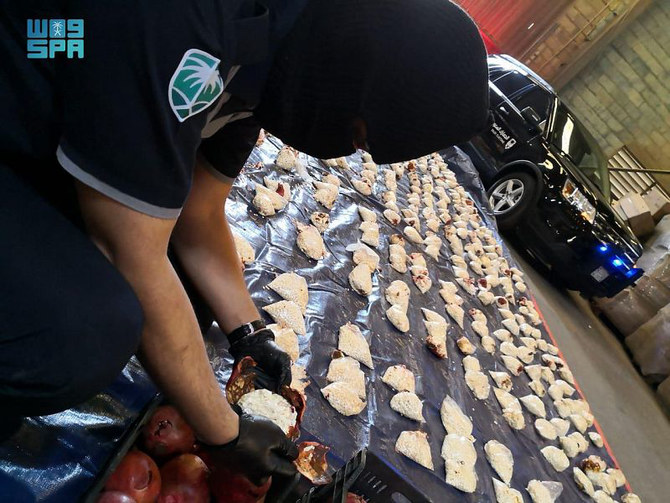
A Saudi Custom officer opens imported pomegranates, as customs foiled a attempt to smuggle millions of Captagon pills, which came from Lebanon. (SPA)
2 / 3
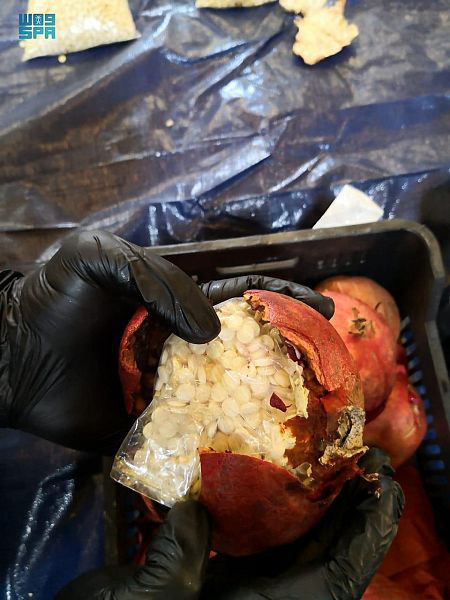
Amphetamine pills are shown hidden inside a pomegranate fruit seized from a shipment by Saudi anti-narcotics authorities. (SPA)
3 / 3
Amphetamine pills are shown hidden inside a pomegranate fruit seized from a shipment by Saudi anti-narcotics authorities. (SPA)
Short Url
Updated 26 April 2021
Follow

Saudi ban on Lebanese agricultural products comes into effect

  • Darian appealed to King Salman and Crown Prince Mohammed bin Salman to “help Lebanon get out of the crisis that the people are passing through, amid the inability to form the new government awaited by the Lebanese”

BEIRUT: The UAE joined other Gulf states in supporting Saudi Arabia’s decision to ban imports of agricultural products from Lebanon which came into effect on Sunday.
The UAE Ministry of Foreign Affairs and International Cooperation said it was “proven” that agricultural imports were used to smuggle narcotics to Saudi Arabia, and that it supported the Kingdom’s measures to ensure the protection of Saudi society from narcotics as part of its efforts to “fight organized crime, and its right to protect its society’s safety.”
Kuwait, Bahrain, and Oman on Saturday backed their Gulf neighbor amid silence from Lebanese officials about the source of a pomegranate shipment that was seized on Friday in Dammam and found to be stuffed with millions of Captagon pills.
Lebanese authorities did not undertake any immediate measure in the Port of Beirut or on the frontier crossings with Syria.
Lebanese President Michel Aoun called a security meeting on Monday to address the crisis. It will be attended by caretaker Prime Minister Hassan Diab, and the ministers of defense, agriculture, interior, foreign affairs, finance, and economy, in addition to the heads of security agencies and customs, farmers and exporters.
The meeting will discuss the circumstances of the Saudi decision and the measures to be undertaken to address its repercussions.
Lebanon’s ambassador to Saudi Arabia, Fawzi Kabbara, asked his country to take security measures to “stop this farce, impose the most severe penalties against the smugglers, strictly control the borders, pursue narcotics factories, and present guarantees to Saudi authorities as soon as possible that such acts will not get repeated in the future.”
He emphasized “the importance of preserving the reputation of Lebanon and the innocent Lebanese and on maintaining the best relations between Lebanon and Saudi Arabia.”
Grand Mufti of Lebanon Sheikh Abdul Latif Darian also voiced his support for the Kingdom’s decision to close its borders due to the “crime of smuggling, rejected and condemned by the Shariah and moral values, which causes serious repercussions and further deterioration of the Lebanese economy.”

FASTFACT

Kuwait, Bahrain, and Oman on Saturday backed their Gulf neighbor amid silence from Lebanese officials about the source of a pomegranate shipment that was seized on Friday in Dammam and found to be stuffed with millions of Captagon pills.

Darian appealed to King Salman and Crown Prince Mohammed bin Salman to “help Lebanon get out of the crisis that the people are passing through, amid the inability to form the new government awaited by the Lebanese.”
He hoped that the Saudi decision would be temporary until matters were sorted out by the Lebanese state which, he said, should take “hasty and firm steps” to prevent any problems with bilateral relations.
In his Sunday sermon, Maronite Patriarch Mar Bechara Boutros Al-Rahi conveyed the outcry from Lebanese farmers and condemned what had happened.
“This shipment is not Lebanese, and no name of a Lebanese farmer of source is mentioned on it,” said the cleric.
Al-Rahi called on the government to undertake a “swift investigation to unveil the perpetrators and smugglers and impose severe penalties on them, and resolve this problem with Saudi Arabia, which is the biggest supporter of the Lebanese farmers who export 80 percent of their products to it.”
He also said he had contacted the Saudi ambassador to Lebanon, Walid Al-Bukhari, and “we notified him of our condemnation, asking him to transmit it to the Kingdom and hoping that it will take into consideration Lebanon and its honest farmers’ conditions.”
Al-Bukhari said on Sunday that the total quantity of narcotics and psychotropic substances coming from Lebanon that had been seized amounted to more than 600 million Captagon pills and hundreds of kilos of marijuana during the past six years.
“The quantities detected are enough to infest the whole Arab world, not only Saudi Arabia, with narcotics and psychotropic substances,” he added.


US condemns RSF drone attack on World Food Programme convoy in Sudan’s North Kordofan

Updated 42 min 12 sec ago
Follow

US condemns RSF drone attack on World Food Programme convoy in Sudan’s North Kordofan

  • Denise Brown, the UN Humanitarian Coordinator for Sudan, also expresses concern over the drone attack

WASHINGTON: The US has condemned a drone attack by Rapid Support Forces on an aid convoy in Sudan’s North Kordofan state that killed one person and injured three others.

“The United States condemns the recent drone attack on a World Food Program convoy in North Kordofan transporting food to famine-stricken people which killed one and wounded many others,” US Senior Adviser for Arab and African Affairs Massad Boulos wrote on X.

“Destroying food intended for people in need and killing humanitarian workers is sickening,” the US envoy wrote.

“The Trump Administration has zero tolerance for this destruction of life and of U.S.-funded assistance; we demand accountability and extend our condolences to all those affected by these inexcusable events and terrible war,” he added.

The Sudan Doctors Network, on its social media accounts, said the World Food Programme (WFP) convoy was struck by RSF drones in the Allah Karim area as it headed toward displaced people in El-Obeid, the state capital.

The network described the attack as a “clear violation of international humanitarian law,” warning that it undermines efforts to deliver life-saving aid to civilians amid worsening humanitarian conditions across the country.

There was no immediate comment from the rebel group.


Denise Brown, the UN Humanitarian Coordinator for Sudan, in a statement also expressed concern over the drone attack which hit the aid trucks in North Kordofan.

“I am deeply concerned by a drone attack earlier today on trucks contracted by the World Food Programme (WFP) in North Kordofan, the aftermath of which I came across a few hours later, as I left the state capital, El Obeid.”

“The trucks were en route from Kosti to deliver life-saving food assistance to displaced families near El Obeid when they were struck, tragically killing at least one individual and injuring many more. The trucks caught fire, destroying food commodities intended for life-saving humanitarian response.”

Brown added that “Humanitarian personnel, assets and supplies must be protected at all times. Attacks on aid operations undermine efforts to reach people facing hunger and displacement.”

“Safe and unimpeded humanitarian access remains critical to ensure assistance reaches the most vulnerable people across Sudan.”

Since April 2023, the conflict between Sudan’s army and the paramilitary forces has killed tens of thousands, displaced 11 million and which the UN has described as one of the world’s worst humanitarian crises.

An alert issued by the Integrated Food Security Phase Classification (IPC), confirmed famine conditions in El-Fasher and Kadugli, the capital of South Kordofan, about 800 kilometers to the east.

The IPC said that 20 more areas in Sudan’s Darfur and neighboring Kordofan were at risk of famine.

Of Sudan’s 18 states, the RSF controls all five states in the western Darfur region, except for parts of North Darfur that remain under army control. The army holds most areas of the remaining 13 states across the south, north, east and center of the country, including the capital, Khartoum.

The conflict between the army and the RSF, which erupted in April 2023, has killed thousands of people and displaced millions.