

25 die after New Delhi hospitals hit by oxygen shortage

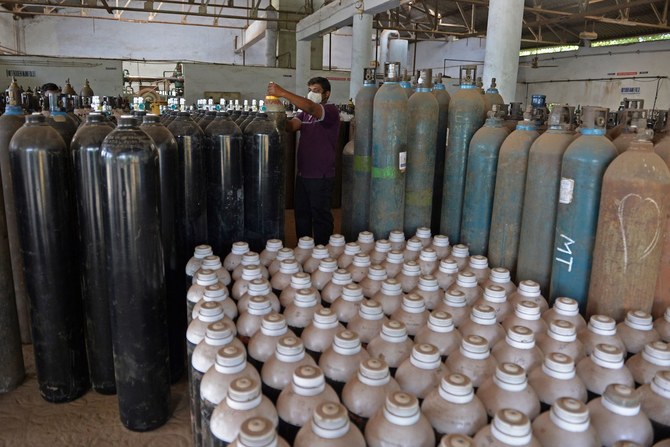
A worker arranges medical oxygen cylinders to be transported to hospitals amid Covid-19 coronavirus pandemic at a facility on the outskirts of Chennai on April 24, 2021. (AFP)
Short Url
Updated 25 April 2021
Follow

25 die after New Delhi hospitals hit by oxygen shortage

  • Patients asked to sign disclaimer forms as emergency supplies run low amid record virus surge
  • New Delhi police recovered oxygen cylinders from a house in the city amid reports of oxygen trucks being looted

NEW DELHI: A shortage of emergency oxygen at hospitals in New Delhi claimed 25 lives on Saturday, the second such incident in recent days, as the capital registered a record 348 deaths and more than 24,000 coronavirus cases in 24 hours.

India also witnessed a new high in COVID-19 infections, with 348,000 positive cases and 2,634 deaths reported across the country on Saturday.

“Those patients were critically ill, and it happened in the critical care area,” Dr. D. K. Baluja, medical superintendent of the Jaipur Golden Hospital (JGH) in New Delhi, told Arab News on Saturday.

He blamed the incident, which took place late on Friday, on the failure of the government to supply the oxygen on time.

“We were promised 3.5 metric tons of oxygen from the government. The supply was to reach us by 5 p.m., but it arrived past midnight and by then 25 patients had died,” Baluja said.

The incident follows the deaths of 25 other patients at the Sri Ganga Ram Hospital in New Delhi under similar circumstances on Friday.
Amid the shortage in oxygen, some hospitals in the capital have begun asking patients’ relatives to sign declaration forms absolving them of all responsibility in case of death.

“In case of scarcity of oxygen, if any patient suffers, it will be the responsibility of the patient’s relatives and not the hospital,” Saroj Hospital said in a statement on Saturday, before issuing a plea for supplies to “save the lives of over 160 COVID-19 patients.”

“We have alerted our patients about the oxygen situation in our hospitals and other hospitals,” Dr. P. K. Bhardwaj, director of Saroj Hospital, told Arab News.

He said that emergency supplies in all hospitals were at “critical” levels, with most left “with only a few hours of oxygen.”
“The administration has completely collapsed because they failed to add any medical infrastructure in the last year. We are trying hard to procure oxygen, but no one is coming to help us,” he said.

Amid the shortage, there were reports of people hoarding oxygen cylinders to resell on the black market. A small cylinder costs around $170 — several times higher than the average rate.

On Saturday, New Delhi police recovered 32 large and 16 small oxygen cylinders from a house in the west of the city amid reports of oxygen trucks being looted at the outskirts of the capital on Wednesday.

“If anyone obstructs oxygen supply, we will hang that man,” the New Delhi High Court said on Saturday after hearing petitions from city-based hospitals that had asked the court to intervene.

The court also termed the second wave of the coronavirus outbreak as “a tsunami” before asking the federal government about its preparedness regarding infrastructure, hospitals, medical staff, medicines, vaccines and oxygen.

New Delhi’s local government told the court on Saturday that it needs 480 metric tons of oxygen every day, or “the health system will collapse.”

“Something disastrous will happen,” New Delhi Chief Minister Arvind Kejriwal told the court, adding that the city had “received only 297 metric tons of oxygen on Friday.”

Experts blamed the authorities for a “lack of serious approach” in handling the pandemic.

Malini Aisola, a New Delhi-based healthcare expert and co-convenor of the All India Drug Action Network, a campaign for affordable drugs, said the present crisis was “a collapse of the health system.”

“Had the government done some planning and shown a serious approach toward public health, this crisis could have been averted,” Aisola told Arab News.

She said that a variety of emergency solutions is needed, including restoring essential supplies of oxygen, oxygenated beds, and providing medical support to patients who are unable to be accommodated in hospitals so that they can be stabilized and start treatment at home.



US to cut roughly 200 NATO positions, sources say

Updated 4 sec ago
Follow

US to cut roughly 200 NATO positions, sources say

  • Trump famously threatened to withdraw from NATO during ⁠his first presidential term and said on the campaign trail that he would encourage Russia to attack NATO members that did not pay their fair share on defense

WASHINGTON: The United States plans to reduce the number of personnel it has stationed within several key NATO command centers, a move that could intensify concerns ​in Europe about Washington’s commitment to the alliance, three sources familiar with the matter said this week.
As part of the move, which the Trump administration has communicated to some European capitals, the US will eliminate roughly 200 positions from the NATO entities that oversee and plan the alliance’s military and intelligence operations, said the sources, who requested anonymity to discuss private diplomatic conversations.
Among the bodies that will be affected, said the sources, are the UK-based NATO Intelligence Fusion Center and the Allied Special Operations Forces Command in Brussels. Portugal-based STRIKFORNATO, which oversees some maritime operations, will also be cut, as will several other similar NATO entities, the sources said.
The sources did not specify why the US had decided to cut the number of staff dedicated to the NATO roles, but the moves broadly align with the ‌Trump administration’s stated intention to ‌shift more resources toward the Western Hemisphere.
The Washington Post first reported the decision.

TRUMP ‌RE-POSTS ⁠MESSAGE ​IDENTIFYING NATO ‌AS THREAT
The changes are small relative to the size of the US military force stationed in Europe and do not necessarily signal a broader US shift away from the continent. Around 80,000 military personnel are stationed in Europe, almost half of them in Germany. But the moves are nonetheless likely to stoke European anxiety about the future of the alliance, which is already running high given US President Donald Trump’s stepped-up campaign to wrest Greenland away from Denmark, raising the unprecedented prospect of territorial aggression within NATO.
On Tuesday morning, the US president, who is scheduled to fly to the World Economic Forum in Switzerland in the evening, shared another user’s post on social media that identified NATO as a threat to the ⁠United States. The post described China and Russia as merely “boogeymen.”
Asked for comment, a NATO official said changes to US staffing are not unusual and that the US presence in ‌Europe is larger than it has been in years.
“NATO and US authorities are in ‍close contact about our overall posture – to ensure NATO retains our ‍robust capacity to deter and defend,” the NATO official said.
The White House and the Pentagon did not respond to requests for ‍comment.

MILITARY IMPACT UNCLEAR, SYMBOLIC IMPACT OBVIOUS
Reuters could not obtain a full list of NATO entities that will be affected by the new policy. About 400 US personnel are stationed within the entities that will see cuts, one of the sources said, meaning the total number of Americans at the affected NATO bodies will be reduced by roughly half.
Rather than recalling servicemembers from their current posts, the US will for the most part decline to ​backfill them as they move on from their positions, the sources said.
The drawdown comes as the alliance traverses one of the most diplomatically fraught moments in its 77-year history. Trump famously threatened to withdraw from NATO during ⁠his first presidential term and said on the campaign trail that he would encourage Russian President Vladimir Putin to attack NATO members that did not pay their fair share on defense. But he appeared to warm to NATO over the first half of 2025, effusively praising NATO Secretary-General Mark Rutte and other European leaders after they agreed to boost defense spending at a June summit.
In recent weeks, however, his administration has again provoked alarm across Europe. In early December, Pentagon officials told diplomats that the US wants Europe to take over the majority of NATO’s conventional defense capabilities, from intelligence to missiles, by 2027, a deadline that struck European officials as unrealistic. A key US national security document released shortly after called for the US to dedicate more of its military resources to the Western Hemisphere, calling into question whether Europe will continue to be a priority theater for the US
In the first weeks of 2026, Trump has revived his longstanding campaign to acquire Greenland, an overseas territory of Denmark, enraging officials in Copenhagen and throughout Europe, many of whom believe any territorial aggression within the alliance would mark the end of NATO. Over the weekend, ‌Trump said he would slap several NATO countries with tariffs starting February 1 due to their support for Denmark’s sovereignty over the island. That has caused European Union officials to mull retaliatory tariffs of their own.