

13 COVID-19 patients die in Indian hospital blaze

1 / 2
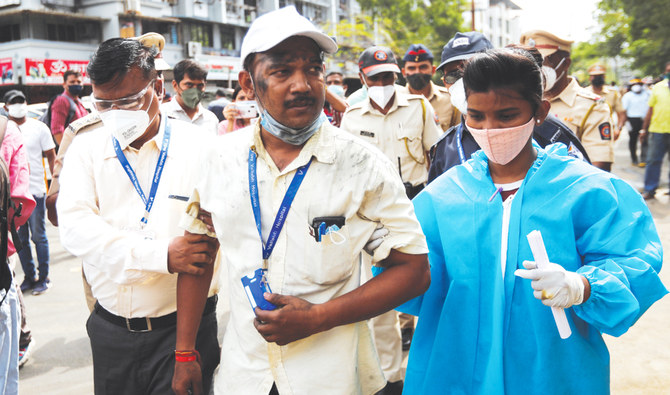
An employee of a hospital in western India is evacuated after it caught fire on Friday amid an extreme surge in coronavirus infections across the nation. (Reuters)
2 / 2
India’s health care system has long suffered from underfunding and the new outbreak has seen critical shortages in oxygen, drugs and hospital beds. (Reuters)
Short Url
Updated 24 April 2021
Follow

13 COVID-19 patients die in Indian hospital blaze

  • No oxygen, hospitals overwhelmed as 333,000 new cases reported
  • India’s health care system has long suffered from underfunding

NEW DELHI: On a day when intensive care patients died when a fire broke out at a coronavirus hospital on the outskirts of Mumbai, dozens of others choked to death as India’s healthcare system was overwhelmed, facing a critical shortage of oxygen amid a devastating surge in infections.
India has reported 333,000 new cases in the past 24 hours, for a second day recording the world’s highest daily tally of coronavirus.
Daily coronavirus deaths jumped to 2,263, while officials across northern and western India, including the capital, New Delhi, warned that most health facilities were full and running out of oxygen.
The fire that broke out at the ICU of the COVID-19 hospital in the Virar area of the Palghar district killed 13 patients in what was the second major hospital incident in the western state of Maharashtra within a week. On Wednesday, an oxygen leakage at a hospital in Nasik district claimed the lives of 24 patients who were on ventilators.
“Such accidents show the pressure under which these hospitals are working and also the laxity in enforcing quality regulations in hospitals,” Mumbai-based researcher and Indian Journal of Medical Ethics editor, Dr. Amar Jesani, told Arab News.
“The situation is extremely grim across the country. People are not able to find a bed, oxygen. It seems a significant number of deaths are taking place due to the non-availability of critical care,” he said.

FASTFACT

The chief minister of Delhi, Arvind Kejriwal, warned in a meeting with Prime Minister Narendra Modi on Friday that there was a ‘huge shortage of oxygen’ at hospitals in India’s capital territory.

TV channels showed footage of people with empty oxygen cylinders lining up outside refilling facilities across the country, hoping to save critically ill relatives.
While the situation in Maharashtra is the worst, with more than 67,000 new COVID-19 cases and 600 deaths reported in the past 24 hours, New Delhi is also under increasing pressure as it reported 24,000 new COVID-19 cases and a record of 306 deaths in the past 24 hours.
The chief minister of Delhi, Arvind Kejriwal, warned in a meeting with Prime Minister Narendra Modi on Friday that there was a “huge shortage of oxygen” at hospitals in India’s capital territory.
At Sir Ganga Ram Hospital, one of the oldest medical facilities in New Delhi, 25 people have died, the hospital’s medical director, Satendra Katoch, said.
 “Low oxygen concentration likely contributed to the deaths of critical patients,” he said. “Critical patients need high pressure, stable oxygen supply.”
As the hospital’s statement that another 60 patients were at risk resulted in panic, oxygen was supplied later in the day.
The developments came as Modi held meetings on Friday with experts, chief ministers of states and oxygen manufacturers to address the crisis, which his government has been accused of mishandling.


Federal agents must limit tear gas for now at protests outside Portland ICE building, judge says

Updated 04 February 2026
Follow

Federal agents must limit tear gas for now at protests outside Portland ICE building, judge says

  • The ruling came in response to a lawsuit filed by the ACLU of Oregon on behalf of protesters and freelance journalists covering demonstrations at the flashpoint US Immigration and Customs Enforcement building

PORTLAND, Oregon: A judge in Oregon on Tuesday temporarily restricted federal officers from using tear gas at protests at the US Immigration and Customs Enforcement building in Portland, just days after agents launched gas at a crowd of demonstrators including young children that local officials described as peaceful.
US District Judge Michael Simon ordered federal officers not to use chemical or projectile munitions on people who pose no imminent threat of physical harm, or who are merely trespassing or refusing to disperse. Simon also limited federal officers from firing munitions at the head, neck or torso “unless the officer is legally justified in using deadly force against that person.”
Simon, whose temporary restraining order is in effect for 14 days, wrote that the nation “is now at a crossroads.”
“In a well-functioning constitutional democratic republic, free speech, courageous newsgathering, and nonviolent protest are all permitted, respected, and even celebrated,” he wrote. “In helping our nation find its constitutional compass, an impartial and independent judiciary operating under the rule of law has a responsibility that it may not shirk.”
Ruling follows a lawsuit filed by the ACLU of Oregon
The ruling came in response to a lawsuit filed by the ACLU of Oregon on behalf of protesters and freelance journalists covering demonstrations at the flashpoint US Immigration and Customs Enforcement building.
The suit names as defendants the Department of Homeland Security and its head Kristi Noem, as well as President Donald Trump. It argues that federal officers’ use of chemical munitions and excessive force is a retaliation against protesters that chills their First Amendment rights.
The Department of Homeland Security said federal officers have “followed their training and used the minimum amount of force necessary to protect themselves, the public, and federal property.”
“DHS is taking appropriate and constitutional measures to uphold the rule of law and protect our officers and the public from dangerous rioters,” spokesperson Tricia McLaughlin said.
Courts consider question of tear gas use
Cities across the country have seen demonstrations against the administration’s immigration enforcement surge.
Last month, a federal appeals court suspended a decision that prohibited federal officers from using tear gas or pepper spray against peaceful protesters in Minnesota who aren’t obstructing law enforcement. An appeals court also halted a ruling from a federal judge in Chicago that restricted federal agents from using certain riot control weapons, such as tear gas and pepper balls, unless necessary to prevent an immediate threat. A similar lawsuit brought by the state is now before the same judge.
The Oregon complaint describes instances in which the plaintiffs — including a protester known for wearing a chicken costume, a married couple in their 80s and two freelance journalists — had chemical or “less-lethal” munitions used against them.
In October, 83-year-old Vietnam War veteran Richard Eckman and his 84-year-old wife Laurie Eckman joined a peaceful march to the ICE building. Federal officers then launched chemical munitions at the crowd, hitting Laurie Eckman in the head with a pepper ball and causing her to bleed, according to the complaint. With bloody clothes and hair, she sought treatment at a hospital, which gave her instructions for caring for a concussion. A munition also hit her husband’s walker, the complaint says.
Jack Dickinson, who frequently attends protests at the ICE building in a chicken suit, has had munitions aimed at him while posing no threat, according to the complaint. Federal officers have shot munitions at his face respirator and at his back, and launched a tear-gas canister that sparked next to his leg and burned a hole in his costume, the complaint says.
Freelance journalists Hugo Rios and Mason Lake have similarly been hit with pepper balls and tear gassed while marked as press, the complaint says.
“Defendants must be enjoined from gassing, shooting, hitting and arresting peaceful Portlanders and journalists willing to document federal abuses as if they are enemy combatants,” the complaint states.
The owner and residents of the affordable housing complex across the street from the ICE building has filed a separate lawsuit, similarly seeking to restrict federal officers’ use of tear gas because its residents have been repeatedly exposed over the past year.
Local officials have also spoken out against use of chemical munitions. Portland Mayor Keith Wilson demanded ICE leave the city after federal officers used such munitions Saturday at what he described as a “peaceful daytime protest where the vast majority of those present violated no laws, made no threat, and posed no danger to federal forces.”
“To those who continue to work for ICE: Resign. To those who control this facility: Leave,” Wilson wrote in a statement Saturday night.
The protest was one of many similar demonstrations nationwide against the immigration crackdown in cities like Minneapolis, where in recent weeks federal agents killed two people, Alex Pretti and Renee Good.