General: Afghan military will collapse without some US help

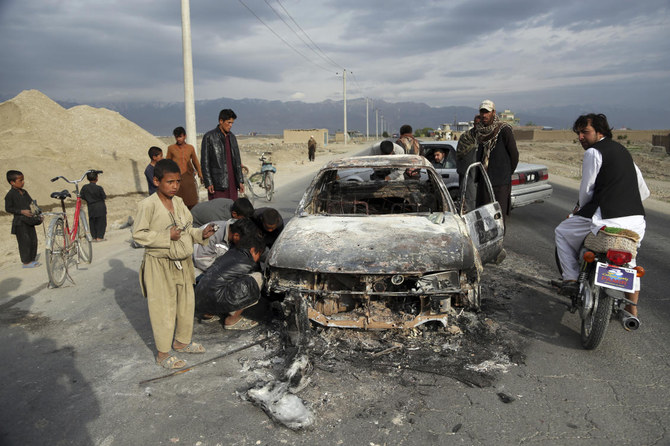
Afghans watch a civilian vehicle burnt after being shot by US forces in Kabul. U.S. military has begun shipping equipment ahead of May 1, start of final phase to pullout from Afghanistan. (AP)
Short Url
Updated 22 April 2021
Follow

General: Afghan military will collapse without some US help

  • Head of U.S. Central Command said as U.S. pulls out all forces “my concern is the Afghans' ability to hold ground”
  • U.S. officials have made it clear that military commanders didn’t recommend the full, unconditional withdrawal that Biden has ordered

WASHINGTON: Afghanistan’s military “will certainly collapse” without some continued American support once all US troops are withdrawn, the top US general for the Middle East told Congress Thursday.
Gen. Frank McKenzie also said he was very concerned about the Afghan government’s ability to protect the US Embassy in Kabul.
McKenzie, head of US Central Command, said that as the US pulls out all forces, “my concern is the Afghans’ ability to hold ground” and whether they will able to continue to maintain and fly their aircraft without US aid and financial support.
He said it will be paramount to protect the US Embassy and “it is a matter of great concern to me whether or not the future government of Afghanistan will be able to do that once we leave.”
McKenzie has spent the week detailing to lawmakers the steep challenges facing the US military as it moves to withdraw all troops from Afghanistan by Sept. 11, as ordered by President Joe Biden last week. Walking a careful line, the general has painted a dire picture of the road ahead, while also avoiding any pushback on Biden’s decision.
US officials have made it clear that military commanders did not recommend the full, unconditional withdrawal that Biden has ordered.
Military leaders have consistently argued for a drawdown based on security conditions in the country, saying that pulling troops out by a certain date eliminates pressure on the Taliban and weakens US leverage in the peace talks with the group.
Still, McKenzie said the Biden administration’s “deliberate and methodical” withdrawal discussion “was heartening,” implicitly drawing a contrast with former President Donald Trump’s penchant for making abrupt troop withdrawal decisions and announcing them by tweet.
In public and private sessions with lawmakers, McKenzie has been pressed about how the US will maintain pressure on the Taliban and prevent terrorist groups from taking hold in Afghanistan again once the United States and its coalition partners leave.
The US has more than 2,500 troops in the country; the NATO coalition has said it will follow the same timetable for withdrawing the more than 7,000 allied forces.
He told the Senate Armed Service Committee on Thursday that once troops leave the country, it will take “considerably longer” than four hours to move armed drones or other aircraft in and out of Afghanistan to provide overhead surveillance or counterterrorism strikes. He said it will require far more aircraft than he is using now.
Defense Secretary Lloyd Austin, speaking at NATO earlier this month, said the US will continue to support the Afghans after the withdrawal. He said “we will look to continue funding key capabilities such as the Afghan Air Force and Special Mission Wing, and we will seek to continue paying salaries for Afghan Security Forces.”
Austin and others have said the US will maintain the ability to counter terrorists in Afghanistan, but there are few details, and officials say they have not yet gotten any diplomatic agreements for basing with any of the surrounding nations.
McKenzie has declined to provide details during the public sessions.
He said there are no decisions yet on what size of diplomatic contingent will be left at the US Embassy in the Afghan capital, and whether it will include a security cooperation office. Those decisions, he said, could reflect how the US ensures the defense of the embassy. Marines often provide security at other embassies around the world.
Senators voiced divided views on the withdrawal, with comments crossing party lines. Several lawmakers questioned whether the US will be able to prevent the Taliban from allowing a resurgence of terrorist groups in Afghanistan who are seeking to attack America. Others asked if the US will be able to adequately account for how the Afghan government spends any American money.
Sen. Jeanne Shaheen, D-N.H. said there are concerns that a US withdrawal will create a vacuum in the country that China, Russian or Iran will fill. But Sen. Elizabeth Warren, D-Mass., argued that the US presence in Afghanistan over the past 10 years has not led to much improvement. She said the government is still corrupt and the Taliban control a larger portion of the country than it did before.
The Pentagon has said it’s not clear yet whether any US contractors will remain in the country. The Defense Department says the number of contractors in Afghanistan started to decline over the past year or so. According to the latest numbers, there are close to 17,000 Defense Department-funded contractors in Afghanistan and less than one-third of those were Americans.
The total included more than 2,800 armed and unarmed private security contractors, of which more than 1,500 are armed. Of those 1,500, about 600 are Americans.


Federal agents must limit tear gas for now at protests outside Portland ICE building, judge says

Updated 04 February 2026
Follow

Federal agents must limit tear gas for now at protests outside Portland ICE building, judge says

  • The ruling came in response to a lawsuit filed by the ACLU of Oregon on behalf of protesters and freelance journalists covering demonstrations at the flashpoint US Immigration and Customs Enforcement building

PORTLAND, Oregon: A judge in Oregon on Tuesday temporarily restricted federal officers from using tear gas at protests at the US Immigration and Customs Enforcement building in Portland, just days after agents launched gas at a crowd of demonstrators including young children that local officials described as peaceful.
US District Judge Michael Simon ordered federal officers not to use chemical or projectile munitions on people who pose no imminent threat of physical harm, or who are merely trespassing or refusing to disperse. Simon also limited federal officers from firing munitions at the head, neck or torso “unless the officer is legally justified in using deadly force against that person.”
Simon, whose temporary restraining order is in effect for 14 days, wrote that the nation “is now at a crossroads.”
“In a well-functioning constitutional democratic republic, free speech, courageous newsgathering, and nonviolent protest are all permitted, respected, and even celebrated,” he wrote. “In helping our nation find its constitutional compass, an impartial and independent judiciary operating under the rule of law has a responsibility that it may not shirk.”
Ruling follows a lawsuit filed by the ACLU of Oregon
The ruling came in response to a lawsuit filed by the ACLU of Oregon on behalf of protesters and freelance journalists covering demonstrations at the flashpoint US Immigration and Customs Enforcement building.
The suit names as defendants the Department of Homeland Security and its head Kristi Noem, as well as President Donald Trump. It argues that federal officers’ use of chemical munitions and excessive force is a retaliation against protesters that chills their First Amendment rights.
The Department of Homeland Security said federal officers have “followed their training and used the minimum amount of force necessary to protect themselves, the public, and federal property.”
“DHS is taking appropriate and constitutional measures to uphold the rule of law and protect our officers and the public from dangerous rioters,” spokesperson Tricia McLaughlin said.
Courts consider question of tear gas use
Cities across the country have seen demonstrations against the administration’s immigration enforcement surge.
Last month, a federal appeals court suspended a decision that prohibited federal officers from using tear gas or pepper spray against peaceful protesters in Minnesota who aren’t obstructing law enforcement. An appeals court also halted a ruling from a federal judge in Chicago that restricted federal agents from using certain riot control weapons, such as tear gas and pepper balls, unless necessary to prevent an immediate threat. A similar lawsuit brought by the state is now before the same judge.
The Oregon complaint describes instances in which the plaintiffs — including a protester known for wearing a chicken costume, a married couple in their 80s and two freelance journalists — had chemical or “less-lethal” munitions used against them.
In October, 83-year-old Vietnam War veteran Richard Eckman and his 84-year-old wife Laurie Eckman joined a peaceful march to the ICE building. Federal officers then launched chemical munitions at the crowd, hitting Laurie Eckman in the head with a pepper ball and causing her to bleed, according to the complaint. With bloody clothes and hair, she sought treatment at a hospital, which gave her instructions for caring for a concussion. A munition also hit her husband’s walker, the complaint says.
Jack Dickinson, who frequently attends protests at the ICE building in a chicken suit, has had munitions aimed at him while posing no threat, according to the complaint. Federal officers have shot munitions at his face respirator and at his back, and launched a tear-gas canister that sparked next to his leg and burned a hole in his costume, the complaint says.
Freelance journalists Hugo Rios and Mason Lake have similarly been hit with pepper balls and tear gassed while marked as press, the complaint says.
“Defendants must be enjoined from gassing, shooting, hitting and arresting peaceful Portlanders and journalists willing to document federal abuses as if they are enemy combatants,” the complaint states.
The owner and residents of the affordable housing complex across the street from the ICE building has filed a separate lawsuit, similarly seeking to restrict federal officers’ use of tear gas because its residents have been repeatedly exposed over the past year.
Local officials have also spoken out against use of chemical munitions. Portland Mayor Keith Wilson demanded ICE leave the city after federal officers used such munitions Saturday at what he described as a “peaceful daytime protest where the vast majority of those present violated no laws, made no threat, and posed no danger to federal forces.”
“To those who continue to work for ICE: Resign. To those who control this facility: Leave,” Wilson wrote in a statement Saturday night.
The protest was one of many similar demonstrations nationwide against the immigration crackdown in cities like Minneapolis, where in recent weeks federal agents killed two people, Alex Pretti and Renee Good.