

US formally excludes Turkey from F-35 consortium 

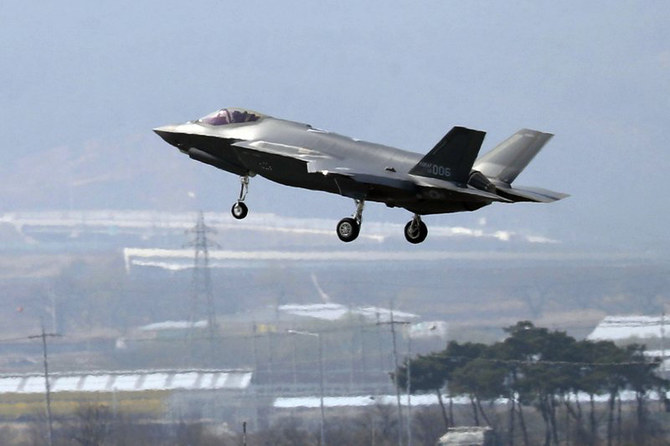
In this March 29, 2019, photo, a US F-35A fighter jet prepares to land at Chungju Air Base in Chungju, South Korea (Kang Jong-min/Newsis via AP)
Short Url
Updated 22 April 2021
Follow

US formally excludes Turkey from F-35 consortium 

  • Move comes after Turkish purchase of Russian missile defense system
  • Russia-Turkey relationship remains unsteady following Ankara backing for Ukraine

ANKARA: The US has reportedly informed Turkey of its formal exclusion from the new F-35 consortium agreement.  

The long-awaited decision comes as little surprise, following Turkey’s acquisition of Russia’s S-400 anti-aircraft weapons system, amid fears over its compatibility with the F-35 and its possible use for Moscow to obtain intelligence on NATO members.  

Turkish companies are expected to fulfill commitments to manufacturing thousands of parts for the F-35 program until next year, but Ankara will no longer be able to obtain the aircraft. 

Turkey now faces a decision over its direction in terms of military procurement, with relations with Moscow complicated by the latest standoff between Ankara and Kremlin over Ukraine. 

Sinan Ulgen, a former Turkish diplomat and chairman of the Istanbul-based Center for Economics and Foreign Policy (EDAM), told Arab News: “Exclusion from the F-35 program has two important consequences. One is obviously about the companies that have until now participated in the manufacturing process of the F-35s. There is no going back because the manufacturing process shifted away from Turkey to other countries.”

The other consequence, he said, concerned the Turkish airforce and Ankara’s deterrence power without the acquisition of the fifth-generation aircraft. 

“There is no real, tangible way to replace the F-35s with another such platform. The only commercially available fifth-generation platforms that could potentially replace them is the Russian Su-57, and the Chinese (Chengdu J-20) but both of them will create more complications given that they are not NATO-interoperable, and it would be considered a signal that Turkey is distancing itself further away from the West,” Ulgen added. 

In February, Turkey hired a Washington-based lobbying firm to attempt to orchestrate a return to the F-35 program with a six-month contract, claiming that its removal was not fair. 

The lobbyists were also expected to get back money Ankara paid to buy over 100 of the jets, but as yet nothing has come of this.  

“Turkey could work on creating the conditions for its return to the F-35 program, which will require an elaborate negotiation with the US. If that is not possible, and if CAATSA (Countering America’s Adversaries Through Sanctions Act) sanctions are not lifted, Turkey could create its own domestic fighter plane (development) program,” Ulgen said.

“So far, there has been no solution for manufacturing (an) engine for that potential plan. Secondly, even if that problem is solved, Turkey can only acquire a sizeable number of these airplanes — realistically speaking — in a timeframe of between 2025 and 2030, which means that Turkey’s air superiority will be diminished given that many countries in the region have started to require fifth-generation planes. It will be a strategic gap if it is not addressed properly.”

On Thursday, Selcuk Bayraktar, executive of Turkish drone producer Baykar, and son-in-law of Turkish President Recep Tayyip Erdogan, announced that his firm had accelerated its National Unmanned Combat Aircraft project. 

It remains to be seen to what part Russia will play in future Turkish military procurement. 

As Ankara voices support for Kiev amid Russian military reinforcement along its border with Ukraine, Turkey’s defense ties with Moscow might become unsustainable in the short run. 

Russian Deputy Prime Minister Yuri Borisov said on Wednesday the Kremlin will scrutinize the prospect of military and technical cooperation with Turkey if Ankara delivers drones to Ukraine. 

That was triggered by a report in Turkey’s pro-government Turkiye newspaper claiming that Ankara was ready to sell its weapons and drones to all countries, including Ukraine, following their successful deployment in the recent conflict between Armenia and Azerbaijan in Nagorno-Karabakh. 

Ulgen said the future of military and industrial cooperation with Russia remains clouded, with Borisov’s statement showing how difficult it would be to rely on Moscow as a safe partner. 

“It also demonstrates the differences between trying to find alternative suppliers outside of the NATO framework. Unlike some NATO partners like Canada, which halt supplies of some specific materials and don’t go beyond that, Russia is trying to gain and use leverage over Turkey, and put pressure on Turkey’s foreign policy positions through its supply lines to the military,” he said. 

Last week, Canada canceled permits for high-tech arms exports to Turkey over the “credible evidence” that the Canadian technology, as an end-user, was diverted to the fighting in Nagorno-Karabakh last year. 


Syrian military tells civilians to evacuate contested area east of Aleppo amid rising tensions

Updated 15 January 2026
Follow

Syrian military tells civilians to evacuate contested area east of Aleppo amid rising tensions

  • Syria’s military has announced it will open a “humanitarian corridor” for civilians to evacuate from an area in Aleppo province
  • This follows several days of intense clashes between government forces and the Kurdish-led Syrian Democratic Forces

DAMASCUS: Syria’s military said it would open a corridor Thursday for civilians to evacuate an area of Aleppo province that has seen a military buildup following intense clashes between government and Kurdish-led forces in Aleppo city.
The army’s announcement late Wednesday — which said civilians would be able to evacuate through the “humanitarian corridor” from 9 a.m. to 5 p.m. Thursday — appeared to signal plans for an offensive in the towns of Deir Hafer and Maskana and surrounding areas, about 60 kilometers (40 miles) east of Aleppo city.
The military called on the Kurdish-led Syrian Democratic Forces and other armed groups to withdraw to the other side of the the Euphrates River, to the east of the contested zone.
Syrian government troops have already sent troop reinforcements to the area after accusing the SDF of building up its own forces there, which the SDF denied. There have been limited exchanges of fire between the two sides, and the SDF has said that Turkish drones carried out strikes there.
The government has accused the SDF of launching drone strikes in Aleppo city, including one that hit the Aleppo governorate building on Saturday shortly after two Cabinet ministers and a local official held a news conference there.
The tensions in the Deir Hafer area come after several days of intense clashes last week in Aleppo city that ended with the evacuation of Kurdish fighters and government forces taking control of three contested neighborhoods. The fighting killed at least 23 people, wounded dozens more, and displaced tens of thousands.
The fighting broke out as negotiations have stalled between Damascus and the SDF, which controls large swaths of northeast Syria, over an agreement to integrate their forces and for the central government to take control of institutions including border crossings and oil fields in the northeast.
Some of the factions that make up the new Syrian army, which was formed after the fall of former President Bashar Assad in a rebel offensive in December 2024, were previously Turkiye-backed insurgent groups that have a long history of clashing with Kurdish forces.
The SDF for years has been the main US partner in Syria in fighting against the Daesh group, but Turkiye considers the SDF a terrorist organization because of its association with the Kurdistan Workers’ Party, or PKK, which has waged a long-running insurgency in Turkiye. A peace process is now underway.
Despite the long-running US support for the SDF, the Trump administration has also developed close ties with the government of interim Syrian President Ahmad Al-Sharaa and has pushed the Kurds to implement the integration deal. Washington has so far avoided publicly taking sides in the clashes in Aleppo.
The SDF in a statement warned of “dangerous repercussions on civilians, infrastructure, and vital facilities” in case of a further escalation and said Damascus bears “full responsibility for this escalation and all ensuing humanitarian and security repercussions in the region.”
Adm. Brad Cooper, commander of US Central Command, said in a statement Tuesday that the US is “closely monitoring” the situation and called for “all parties to exercise maximum restraint, avoid actions that could further escalate tensions, and prioritize the protection of civilians and critical infrastructure.” He called on the parties to “return to the negotiating table in good faith.”
Al-Sharaa blasts the SDF
In a televised interview aired Wednesday, Al-Sharaa praised the “courage of the Kurds” and said he would guarantee their rights and wants them to be part of the Syrian army, but he lashed out at the SDF.
He accused the group of not abiding by an agreement reached last year under which their forces were supposed to withdraw from neighborhoods they controlled in Aleppo city and of forcibly preventing civilians from leaving when the army opened a corridor for them to evacuate amid the recent clashes.
Al-Sharaa claimed that the SDF refused attempts by France and the US to mediate a ceasefire and withdrawal of Kurdish forces during the clashes due to an order from the PKK.
The interview was initially intended to air Tuesday on Shams TV, a broadcaster based in Irbil — the seat of northern Iraq’s semi-autonomous Kurdish region — but was canceled for what the station initially said were technical reasons.
Later the station’s manager said that the interview had been spiked out of fear of further inflaming tensions because of the hard line Al-Sharaa took against the SDF.
Syria’s state TV station instead aired clips from the interview on Wednesday. There was no immediate response from the SDF to Al-Sharaa’s comments.