Dubai’s ENOC expands petrochemical pipeline and storage tanks in Kingdom

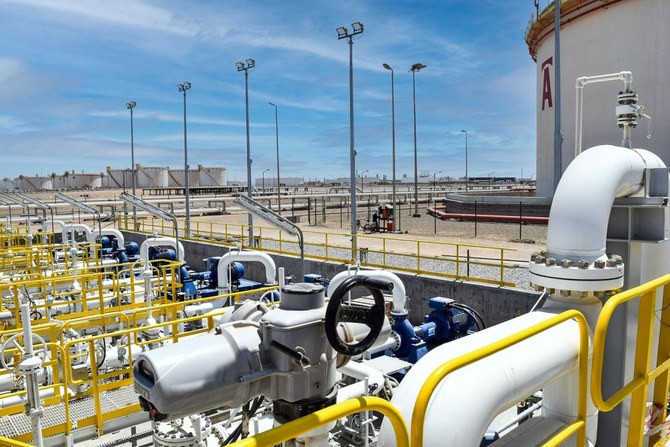
ENOC Group is adding pipeline and storage capacity in Saudi Arabia. (Supplied)
Short Url
Updated 22 April 2021
Follow

Dubai’s ENOC expands petrochemical pipeline and storage tanks in Kingdom

  • Project to boost export capacity
  • ENOC eyes expansion in Kingdom

RIYADH: Dubai’s ENOC Group and Rotary Arabia have completed construction of pipelines and tanks to store and transport petrochemicals in Saudi Arabia.
The infrastructure development between Horizon Terminals Limited, ENOC’s terminals arm, and Rotary Arabia – the front-end contractors for the project, saw the construction of four new pipelines from Farabi Petrochemicals’ Yanbu facility on the Red Sea coast to storage tanks at Arabtank Terminal. ENOC sa
The GCC’s chemical capacity is expected to increase by more than a third over the next decad* reaching 231.8 million tons, driven by refining expansion and chemical integration.
Arab Tank Terminal Limited (ATTL) – which is Horizon Terminals’ Saudi based terminal, has a petroleum and chemical storage capacity of 288,100 cubic meters spread across 26 storage tank.
Two additional pipelines were also constructed from ATTL to Berth 21 at Port of King Fahad Yanbu.
“The GCC chemical industry today is predominantly focused on petrochemicals which make up 72 percent of its total production, with Saudi Arabia being the leading producer in the region, accounting for 68.2 percent of total chemical output,” said ENOC Group CEO Saif Humaid Al-Falasi. “Our expansion into the Kingdom comes at a time when the regional market is poised to step up overseas production capacity by 7.6 percent.”
Farabi Petrochemicals currently supplies to the domestic market and benefits from the Port of King Fahad Yanbu infrastructure to export chemicals to the GCC, Europe and Asia.
The new pipelines from its Yanbu facility will enable faster and more efficient transportation of petrochemical products.


King Abdulaziz Airport among world’s busiest after record-breaking 2025

Updated 02 January 2026
Follow

King Abdulaziz Airport among world’s busiest after record-breaking 2025

RIYADH: King Abdulaziz International Airport has achieved a new historical milestone, reaching 53.4 million passengers in a single year.

This is the highest number ever recorded at a Saudi airport since the beginning of air travel in the Kingdom, placing it among the world’s mega airports in terms of passenger traffic, according to the Saudi Press Agency.

The airport handled a total of 310,000 flights and 60.4 million bags, representing a 12 percent increase compared to 2024. It also handled 9.57 million Zamzam water containers and 2,968 cargo flights. 

This achievement reflects the airport’s qualitative transformation and its position as a regional hub and national gateway connecting the Kingdom to the world. It also highlights its role in facilitating the movement of visitors and pilgrims, promoting tourism in line with the goals of Vision 2030, diversifying the economy, and providing a distinguished travel experience. 

For his part, CEO of Jeddah Airports Co. Mazen Johar, affirmed that reaching 53.4 million passengers confirms the airport’s high operational readiness and represents a pivotal milestone for moving to the next phase, in preparation for doubling this number, God willing, in the coming years. 

He pointed out that this national achievement would not have been possible without the grace of God Almighty, followed by the directives of the wise leadership and the continuous follow-up from the minister of transport and logistics, the president of the General Authority of Civil Aviation, and the CEO of Airports Holding Co. 

He explained that King Abdulaziz International Airport is strengthening its position as a major aviation hub in the region through expansions, increased capacity, and improved services, supporting the objectives of the aviation program and aligning with the goals of the Kingdom’s Vision 2030. 

The CEO of Jeddah Airports Co. expressed his gratitude to the partners in success from various government and private sectors for their fruitful cooperation through a collaborative work system that contributed to providing the best services.