

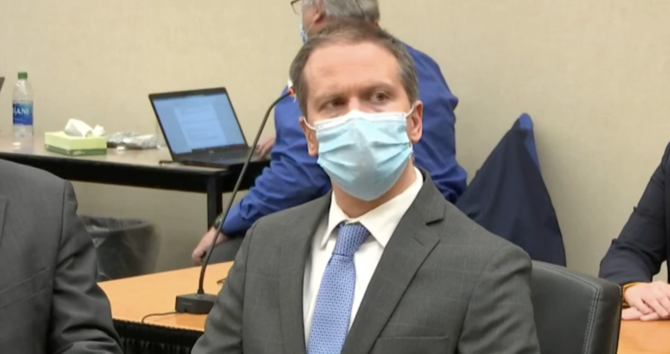

MINNEAPOLIS: Former Minneapolis police officer Derek Chauvin was convicted on Tuesday of murdering George Floyd, a milestone in the fraught racial history of the United States and a rebuke of law enforcement’s treatment of Black Americans.
A 12-member jury found Chauvin, 45, guilty of all three charges of second-degree murder, third-degree murder and manslaughter after considering three weeks of testimony from 45 witnesses, including bystanders, police officials and medical experts. Deliberations began on Monday and lasted just over 10 hours.
In a confrontation captured on video, Chauvin, a white veteran of the police force, pushed his knee into the neck of Floyd, a 46-year-old Black man in handcuffs, for more than nine minutes on May 25, 2020. Chauvin and three fellow officers were attempting to arrest Floyd, accused of using a fake $20 bill to buy cigarettes at a grocery store.
The jurors remained still and quiet as the verdict was read. Chauvin, wearing a gray suit with a blue tie as well as a light-blue face mask, nodded and stood quickly when the judge ruled that his bail was revoked. He was taken out of the courtroom in handcuffs and placed in the custody of the Hennepin County sheriff.
The conviction triggered a wave of relief and reflection not only across the United States but in countries around the world.
“It was a murder in the full light of day and it ripped the blinders off for the whole world to see the systemic racism,” President Joe Biden said in televised remarks. “This can be a giant step forward in the march toward justice in America.”
Outside the courthouse, a crowd of several hundred people erupted in cheers when the verdict was announced — a scene that unfolded in cities across the country. Car horns honked, demonstrators blocked traffic and chanted: “George Floyd” and “All three counts.”
At George Floyd Square in Minneapolis, the intersection where Floyd was killed and which was later named in his honor, people screamed, applauded and some threw dollar bills in the air in celebration.
While celebrating the verdict, protesters called for justice in the case of Daunte Wright, a Black man who was fatally shot by a police officer after a routine traffic stop on April 11, just a few miles from where Chauvin stood trial. Kimberly Potter, who has turned in her badge, has been charged with manslaughter in that case.
George Floyd’s brother Philonize, speaking at a news conference with several family members, said: “We are able to breathe again” after the verdict, but he added the fight for justice was not over.
“We have to protest because it seems like this is a never-ending cycle,” he said.
’FIRST STEP TOWARDS JUSTICE’
Chauvin could now face up to 40 years in prison. While the US criminal justice system and juries have long given leeway and some legal protection to police officers who use violence to subdue civilians, the Minneapolis jurors found that Chauvin had crossed the line and used excessive force.
Chauvin’s defense team did not immediately respond to a request for comment on the verdict but is considered likely to appeal the conviction.
In a trial that opened on March 29, the defense argued that Chauvin behaved as any “reasonable police officer” would have under those circumstances, and sought to raise doubts about the cause of Floyd’s death.
In his comments, Biden emphasized his support for legislation “to root out unconstitutional policing,” including the George Floyd Justice in Policing Act, which has been passed by the US House of Representatives and seeks to increase accountability for law enforcement misconduct.
The Police Officers Federation of Minneapolis said in a statement published in the Minneapolis Star Tribune that “there are no winners in this case, and we respect the jury’s decision,” adding: “We need to stop the divisive comments, and we all need to do better to create a Minneapolis we all love.”
The intersection of race and law enforcement has long been contentious in the United States, underscored by a series of deadly incidents involving white police officers and Black people in recent years.
Floyd’s death prompted protests against racism and police brutality in many US cities and other countries last summer, even as the world grappled with the coronavirus pandemic.
Biden and Vice President Kamala Harris watched the verdict being read out along with staff in the White House’s private dining room, the White House said. Biden, Harris and first lady Jill Biden all spoke with Philonize Floyd.
“Nothing is going to make it all better but at least ... now there’s some justice,” Biden told the Floyd family, according to a video posted to Twitter.
Minnesota Attorney General Keith Ellison told reporters that the verdict was a “first step toward justice” and should serve as a launching point for police reform. “We need to use this verdict as an inflection point.”
HOURS OF TESTIMONY
Under Minnesota sentencing guidelines, Chauvin faces 12-1/2 years in prison for his murder conviction as a first-time criminal offender.
Prosecutors could seek a longer sentence of up to 40 years if Hennepin County District Judge Peter Cahill determines that there were “aggravating factors.” Cahill said Chauvin’s sentencing was likely eight weeks away.
The Minneapolis Police Department fired Chauvin and the three other officers the day after Floyd’s murder. The three others are due to face trial later this year on aiding-and-abetting charges.
Witnesses called by prosecutors included a cardiologist, a pulmonologist and a forensic pathologist, who testified that videos and autopsy results confirmed that Chauvin killed Floyd by starving him of oxygen.
Also among the prosecution witnesses was Darnella Frazier, a teenager who used her cellphone to make a video depicting Floyd’s ordeal — images that catalyzed the subsequent protests. Floyd can be heard crying out for his mother and telling officers he could not breathe.
Other eyewitnesses described the horror and trauma of watching Floyd die in front of them. Minneapolis Police Chief Medaria Arradondo testified that Chauvin’s actions during the arrest represented an egregious breach of his training.
The jurors, who consisted of four white women, two white men, three Black men, one Black woman and two multiracial women, were sequestered during deliberations.


