

NGOs seek $5.5 bn to rescue 34 mln people from famine in countries such as Yemen, South Sudan

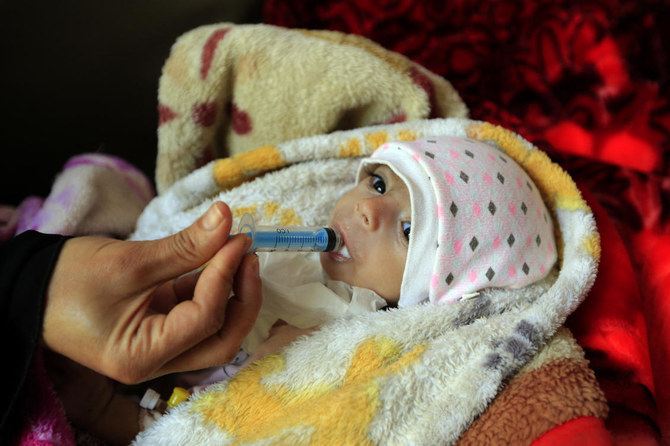
A Yemeni mother feeds her malnourished child at Al-Sabeen Maternity and Child Hospital in the Houthi-rebel-held Yemeni capital Sanaa. (File/AFP)
Short Url
Updated 20 April 2021
Follow

NGOs seek $5.5 bn to rescue 34 mln people from famine in countries such as Yemen, South Sudan

  • $5.5 billion needed for urgent food assistance to reach more than 34 million

GENEVA: More than 260 non-governmental organizations signed an open letter on Tuesday calling on governments to donate $5.5 billion to prevent famine in 2021 in countries that include Yemen and South Sudan.

The sum has been called for by the United Nations’ World Food Programme and the Food and Agriculture Organization.

“We call on you to provide the additional $5.5 billion needed for urgent food assistance to reach more than 34 million girls, boys, women and men around the globe who are a step away from famine. This assistance must begin immediately,” the open letter said.

The letter was penned by NGOs working with an estimated 270 million people “facing hunger, starvation or famine all over the world.”

They include Oxfam, Christian Aid, World Vision, Tearfund, Save the Children and Care International

“In Yemen, Afghanistan, Ethiopia, South Sudan, Burkina Faso, DR Congo, Honduras, Venezuela, Nigeria, Haiti, Central African Republic, Uganda, Zimbabwe, Sudan and beyond we help people who are doing all they can to simply get through one more day,” the letter said.

“These people are not starving, they are being starved.”

“It is human actions that are driving famine and hunger and it is our actions that can stop the worst impacts,” the NGOs insisted.

“There is no place for famine and starvation in the 21st century. History will judge us all by the actions we take today.”


Bangladesh says at least 287 killed during Hasina-era abductions

Updated 3 sec ago
Follow

Bangladesh says at least 287 killed during Hasina-era abductions

DHAKA: A Bangladesh commission investigating disappearances during the rule of ousted prime minister Sheikh Hasina said Monday at least 287 people were assumed to have been killed.
The commission said some corpses were believed to have been dumped in rivers, including the Buriganga in the capital, Dhaka, or buried in mass graves.
The government-appointed commission, formed after Hasina was toppled by a mass uprising in August 2024, said it had investigated 1,569 cases of abductions, with 287 of the victims presumed dead.
“We have identified a number of unmarked graves in several places where the bodies were presumably buried,” Nur Khan Liton, a commission member, told AFP.
“The commission has recommended that Bangladesh seek cooperation from forensic experts to identify the bodies and collect and preserve DNA samples from family members.”
In its final report, submitted to the government on Sunday, the commission said that security forces had acted under the command of Hasina and her top officials.
The report said many of those abducted had belonged to the country’s largest Islamist party, Jamaat-e-Islami, or the Bangladesh Nationalist Party (BNP), both in opposition to Hasina.
In a separate investigation, police in December began exhuming a mass grave in Dhaka.
The grave included at least eight victims of the uprising against Hasina, bodies all found with bullet wounds, according to Criminal Investigation Department (CID) chief Md Sibgat Ullah.
The United Nations says up to 1,400 people were killed in crackdowns as Hasina attempted to cling to power.
She was sentenced to death in absentia in November for crimes against humanity.
“We are grateful for finally being able to know where our brother is buried,” said Mohamed Nabil, whose 28-year-old sibling Sohel Rana was identified as one of the dead in the grave in Dhaka.
“But we demand a swift trial for the police officials who shot at the people during the uprising.”