

Cooperate despite ‘genocide’? Biden tests ties with China, Russia

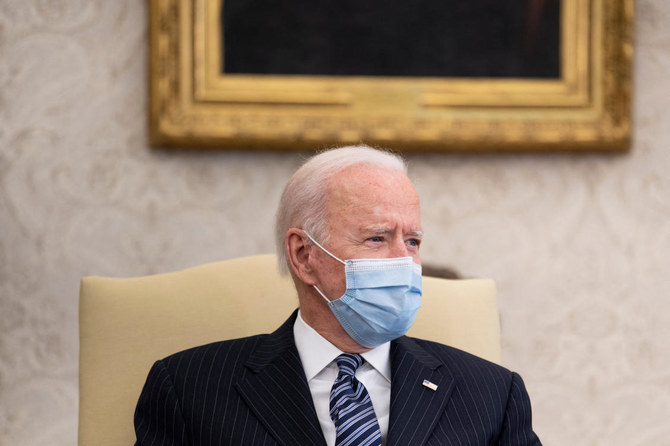
US President Joe Biden. (File/AFP)
Short Url
Updated 20 April 2021
Follow

Cooperate despite ‘genocide’? Biden tests ties with China, Russia

  • Climate envoy John Kerry issued a joint statement with China saying the two nations are “committed to cooperating with each other”

WASHINGTON: US President Joe Biden’s administration accuses China of genocide but reached a joint pledge to cooperate on climate. The White House is also working to arrange a summit with Russia, despite imposing harsh new sanctions.

Biden’s strategy is not about easing tensions, so often the stated goal of diplomacy, but identifying narrow areas to work together — especially on climate change — while acknowledging that much of the relationship will remain hostile.

Biden alluded to America’s Cold War relationship with the Soviet Union last week after he ordered sanctions and the expulsion of Russian diplomats as a way to impose costs over Moscow’s alleged interference in US elections and a major hacking operation.

“We want a stable, predictable relationship,” said Biden, who proposed a summit in a neutral country during a telephone call with Russian President Vladimir Putin even while pressing him over the health of jailed dissident Alexei Navalny.

“Throughout our long history of competition, our two countries have been able to find ways to manage tensions and to keep them from escalating out of control,” he said.

Biden’s relationship with China is guided by a similar philosophy — described, in a colloquial phrase popular in his White House, as being able to walk and chew gum at the same time.

Secretary of State Antony Blinken, in a speech Monday, defended the approach from expected criticism by saying that no nation’s climate efforts would “excuse bad behavior.”

“Climate is not a trading card; it is our future,” Blinken said.

Climate envoy John Kerry, after a visit to Shanghai last week, issued a joint statement with China saying the two nations are “committed to cooperating with each other.”

However general in tone, it marked a stark contrast to a testy first meeting between top officials in March in Alaska, where Blinken raised concerns on a host of Chinese actions including what Washington has described as “genocide” against Uyghurs and other mostly Muslim Turkic-speaking people.

Biden has invited Putin and Chinese President Xi Jinping to a climate summit this week, with Kerry saying it would be tantamount to “killing yourself” not to work together on climate despite other disagreements.

Biden’s cool approach follows the highly personalized diplomacy of his predecessor Donald Trump, who voiced admiration for Putin and in his last year in office incessantly berated Beijing, which he blamed for the devastating Covid-19 pandemic.

Ryan Hass, a senior fellow at the Brookings Institution who advised former president Barack Obama on China, detected a “gradual but significant shift” in the stance toward Beijing under Biden.

“His administration has dialed down the rhetorical heat and focused purposefully on concrete areas of the relationship where American interests are impacted by Chinese actions,” Hass said.

“Both sides also have slowly begun restoring direct functioning channels of diplomatic communication to address areas of concern and explore opportunities for coordination.”

China and the United States are the world’s top two economies and together account for half of global emissions responsible for climate change. Russia is the fourth biggest emitter and Putin has accepted an invitation to speak at the climate summit.

Putin’s decision to participate “signals that he, too, is interested in preserving some space in the fraught US-Russian relationship,” said Heather Conley, a senior vice president at the Center for Strategic and International Studies.

But, Conley said: “Speaking at a virtual summit and mitigating climate impacts are two very different things.”

“What is striking to me is that while both Beijing and Moscow are speaking the language of climate change before international audiences, at home, they are putting their foot on the accelerator to increase global carbon emissions,” she said, pointing to Russia’s fossil-fuel industry and China’s reliance on coal plants.

In a recent essay, Andrew Erickson, a China expert at the US Naval War College, and Gabriel Collins of Rice University argued that the United States should look to compete rather than coordinate with China on climate. They said the United States could champion a carbon tax on exports — already backed by the European Union — to force China to cut back on coal.

“Xi’s bullish talk of combating climate change is a smokescreen for a more calculated agenda,” they wrote in Foreign Affairs.

“Chinese policymakers know their country is critical to any comprehensive international effort to curb greenhouse gas emissions, and they are trying to use that leverage to advance Chinese interests in other areas.”


Asia rings in 2026 and Australia is defiant after its worst mass shooting

Updated 4 sec ago
Follow

Asia rings in 2026 and Australia is defiant after its worst mass shooting

  • Australia holds defiant celebrations after its worst mass shooting in nearly 30 years
  • Hong Kong holds a subdued event after a deadly fire in tower blocks
MELBOURNE, Australia: Auckland was the first major city to ring in 2026 with a fireworks display launched from New Zealand’s tallest structure, Sky Tower, followed by a defiant celebration in Australia in the aftermath of its worst mass shooting.
South Pacific countries were the first to bid farewell to 2025. Clocks stuck midnight in Auckland 18 hours before the famous ball drop in New York’s Times Square. The five-minute display involved 3,500 fireworks.

Defiant celebration in Australia after worst mass shooting

Australia’s east coast welcomed 2026 two hours after New Zealand. In Sydney, the country’s largest city, celebrations were held under the pall of Australia’s worst mass shooting in almost 30 years. Two gunmen targeted a Hannukah celebration at Bondi Beach on Dec. 14, killing 15 and wounding 40.
A heavy police presence monitored the thousands who thronged to the waterfront to watch a fireworks show centered on the Sydney Harbor Bridge. Many officers openly carried rapid-fire rifles, a first for the annual event.
An hour before midnight, the massacre victims were commemorated with a minute of silence while images of a menorah were projected on the bridge pylons. The crowd was invited to show solidarity with Australia’s Jewish community.
New South Wales Premier Chris Minns urged Sydney residents not to stay away through fear, saying extremists would interpret smaller crowds at New Year’s Eve festivities as a victory.
“We have to show defiance in the face of this terrible crime and say that we’re not going to be cowered by this kind of terrorism,” he said.

Indonesia and Hong Kong hold subdued events

In Indonesia, one of Australia’s nearest neighbors, cities scaled back festivities as a gesture of solidarity with communities devastated by floods and landslides that struck parts of Sumatra island a month ago, claiming more than 1,100 lives.
The capital, Jakarta, was not ringing in 2026 with its usual fanfare, choosing subdued celebrations with a program centered on prayers for victims, city Gov. Pramono Anung said last week.
Makassar Mayor Munafri Arifuddin urged residents of one of Indonesia’s largest cities to forgo parties, calling for prayer and reflection. “Empathy and restraint are more meaningful than fireworks and crowds,” he said.
Concerts and fireworks on Indonesia’s tourist island of Bali were canceled and replaced with a cultural arts event featuring traditional dances.
Hong Kong, too, was ringing in 2026 without the usual spectacle in the sky over iconic Victoria Harbor, after a massive fire in November killed at least 161 people.
The facades of eight landmarks were turning into giant countdown clocks presenting a three-minute light show at midnight.
Many parts of Asia welcome the new year by observing age-old traditions.
In Japan, crowds were gathering at a Buddhist temple in Tokyo for a bell striking at midnight. In the South Korean capital, Seoul, a bell tolling and countdown ceremony were being held at the Bosingak Pavilion.

Berliners celebrate in snowfall

Tourists and Berliners alike marked the end of 2025 by enjoying snowfall, taking selfies and making snowmen in front of the German capital’s cathedral and the iconic Brandenburg Gate. The Berlin TV Tower was nearly invisible thanks to the falling flakes and fog.
Quieter celebrations in Greece and Cyprus
Greece and Cyprus were ringing in 2026 by turning down the volume, replacing traditional fireworks with low-noise pyrotechnics, light shows and drone displays in capital cities. Low-noise fireworks avoid the explosive bursts that generate the loud cracks of traditional displays.
Officials in the countries said the change is intended to make celebrations more welcoming for children and pets, particularly animals sensitive to loud noise.

Additional security in New York City

Police in New York City will have additional anti-terrorism measures at the Times Square ball drop, with “mobile screening teams” in search of suspicious activity. It is not in response to a specific threat, according to NYPD Commissioner Jessica Tisch.
After the ball drops in Times Square, it will rise once again, sparking in red, white and blue, to mark the country’s upcoming 250th birthday celebration. It will be one of several patriotic flourishes throughout the night, organizers said.
Zohran Mamdani will take office as mayor at the start of 2026. Two swearing-in ceremonies are planned, starting with a private ceremonial event around midnight in an old subway station.