

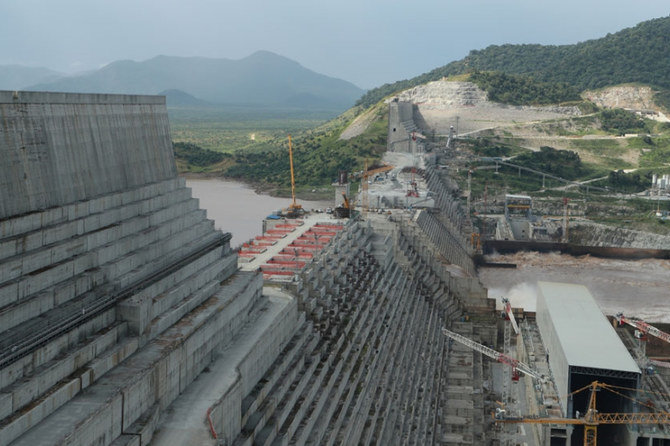

CAIRO: Ethiopia had rejected 15 different ideas put forward by Egypt to help resolve a bitter row over the development of a highly controversial Nile dam project, a senior minister has revealed.
Egyptian Minister of Water Resources and Irrigation Mohammed Abdel-Ati said Addis Ababa had poured cold water on all of Cairo’s suggestions to reach agreement about water rights and other issues related to the Grand Ethiopian Renaissance Dam (GERD) scheme.
His claims came as Egyptian Foreign Minister Sameh Shoukry embarked on a tour of African countries to highlight Egypt’s position regarding the latest developments in the GERD negotiations.
During his trip – taking in Comoros, South Africa, the Democratic Republic of the Congo, Senegal, Kenya, and Tunisia – Shoukry delivered letters from Egyptian President Abdel Fattah El-Sisi to the leaders of the countries explaining Cairo’s stance on the matter.
Ahmed Hafez, a spokesman for the Egyptian Foreign Ministry, said the tour was aimed at reviving talks and supporting the process of reaching a binding legal agreement between Egypt, Sudan, and Ethiopia on issues such as the filling and operation of the dam.
Addressing a meeting of the Egyptian Senate’s defense and national security committee, Abdel-Ati said Cairo had shown great flexibility during its discussions with Ethiopia.
He pointed out that most of Egypt’s estimated annual 60 billion cubic meters of water resources came from the Nile, with limited quantities of rainwater and deep groundwater from the deserts.
“The total water needs in Egypt reach about 114 billion cubic meters annually,” he added.
The supply gap was compensated for through the reuse of agricultural drainage water and surface groundwater in the Nile valley and delta, in addition to importing food products from abroad corresponding to 34 billion cubic meters of water annually, he said.
Abdel-Ati blamed the failure in negotiations on Ethiopian “intransigence” and “unilateral measures” taken by Addis Ababa.
“Egypt has already signed the initials of the Washington agreement, which confirms Egypt’s clear desire to reach a deal,” the minister added.
He noted that Egypt had presented 15 scenarios for filling and operating the dam in a way that met with Ethiopian requirements and prevented tangible harm to the two downstream countries, but Ethiopia had dismissed the proposals.
The volume of rainwater in Ethiopia amounted to more than 935 billion cubic meters per year, and 94 percent of its land was green compared to 6 percent in Egypt, Abdel-Ati said.
He added that Ethiopia had more than 100 million livestock animals that consumed 84 billion cubic meters of water annually, which was equal to the combined water share of Egypt and Sudan, and its share of blue water (running water in the river) was about 150 billion cubic meters every year.
Ethiopia, he said, also withdrew water from Lake Tana for agricultural uses.


