

Greek FM visits Egypt in lead-up to Saudi Arabia visit

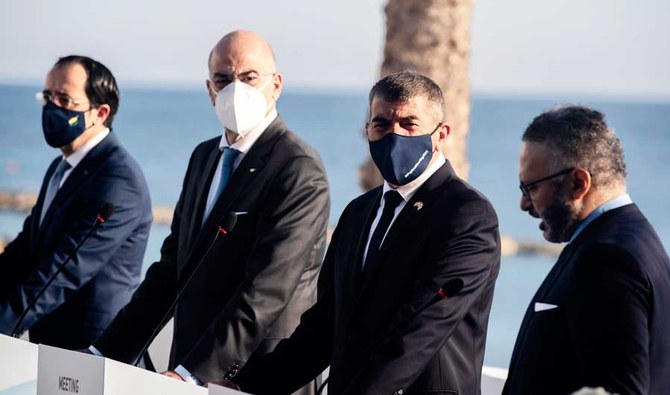
Foreign ministers from Cyprus, Greece, Israel, and adviser to the president of the UAE Anwar Gargash hold a press conference in Paphos on Friday. (AFP)
Short Url
Updated 19 April 2021
Follow

Greek FM visits Egypt in lead-up to Saudi Arabia visit

  • Diplomatic move by Athens against backdrop of Libyan situation, tension with Turkey

CAIRO: Greek Foreign Minister Nikos Dendias arrived in Egypt on Sunday during a tour leading up to a visit to Saudi Arabia. It comes within the framework of a diplomatic move by Athens against the backdrop of the situation in Libya and tension with Turkey in the eastern Mediterranean.

Dendias tweeted on Saturday: “Yesterday I was in Cyprus to participate in the quartet meeting with Emirates, Israel and Cyprus, and I will go tomorrow to Cairo, and on Tuesday to Saudi Arabia, while I will participate on Monday in the European Council meeting.”
Egyptian Foreign Minister Sameh Shoukry held talks with Greek Foreign Affairs Minister Nikos Dendias on his arrival in Cairo. They dealt with the bilateral ties between the countries and ways of enhancing them, in addition to the trilateral cooperation between Egypt, Greece and Cyprus, and regional and international issues of common concern.
Last February, foreign ministers participating in the “Friendship Forum” in Athens, which included Egypt, Bahrain, the UAE, Saudi Arabia, Greece and Cyprus, in the absence of Jordan, stressed the importance of stability in the Middle East and the Eastern Mediterranean region.
Participants said that “discussion of confronting provocative acts and violations in the Middle East and the Eastern Mediterranean was held.”
Saudi Arabia and Greece carried out a joint air exercise, “Eye of the Falcon 1,” in Crete, with the aim of refining and developing the skills of the air crew and technical division, and raising the combat readiness of their air forces. This was in addition to exchanging military expertise in the implementation and planning of air operations.

FASTFACT

Saudi Arabia and Greece carried out a joint air exercise, ‘Eye of the Falcon 1,’ in Crete, with the aim of refining and developing the skills of the air crew and technical division, and raising the combat readiness of their air forces.

Greek and Turkish disputes over maritime rights continue in the eastern Mediterranean region, with each side claiming encroachment on their maritime areas, while Arab countries condemn what they describe as Turkish military intervention in several Arab countries such as Iraq, Libya and Syria.
The two ministers held a consultation session in Cairo to address common regional issues.
The Greek foreign minister tweeted through his official account on Twitter that he and his Egyptian counterpart discussed bilateral relations and developments in the eastern Mediterranean.
Spokesperson for the Egyptian Foreign Ministry, Ambassador Ahmed Hafez, said that the talks between the two ministers dealt with issues of bilateral cooperation and regional issues that were a priority for both countries.
The Greek minister’s visit is the second in less than a month and a half. He is discussing with Egyptian officials bilateral cooperation and reviewing the latest developments within common political files, most notably the eastern Mediterranean, Libya, as well as Syria.


How one displaced family in Gaza is observing Ramadan’s first day under a fragile ceasefire deal

Updated 7 sec ago
Follow

How one displaced family in Gaza is observing Ramadan’s first day under a fragile ceasefire deal

KHAN YOUNIS, Gaza Strip: Waleed al Zamli longingly recalled the joys and traditions of the first day of Ramadan before the Israel-Hamas war had drastically altered his life: Lanterns for the children. Sweets. Special dishes.
“Before the war, we would greet it with happiness,” the father of 11 said, speaking from Muwasi, an area crowded with tents sheltering Palestinians who were forced by the Israeli military offensive to flee their homes.
Not anymore, he said.
It saddens and pains him that he’s unable to provide for his family, which now ekes out an existence in displacement. Al Zamli lost his job after the shop where he had worked was destroyed, he said.
So, for the first Ramadan “iftar,” the fast-breaking meal, his wife picked up meals Wednesday from a charity kitchen that the family has heavily depended on. She made soup to go with it.
“This year, there’s no happiness,” al Zamli said.
Hardships and losses dampen Ramadan’s spirit for many
Ramadan arrived in Gaza under a fragile ceasefire deal, but many Palestinians there say the month’s typically festive spirit is eluding them as they grapple with the hardships of their daily lives and the grief and losses of the war.
Some of these difficulties were on display at the charity kitchen where dozens crowded, many with their arms outstretched as they vied for a spot and held empty pots. They included children, women and elderly people.
During Ramadan, observant Muslims fast daily from dawn to sunset. It’s a time for increased worship, religious reflection and charity. In normal circumstances, the month often brings families and friends together to break their fast in joyous gatherings.
But circumstances in Gaza are far from normal. Israel’s military offensive has killed more than 72,000 Palestinians, according to Gaza’s Health Ministry, and caused widespread destruction and displaced most of the territory’s residents. Israel launched the offensive after Hamas-led militants killed some 1,200 people, mostly civilians, and took another 251 hostage in their attack on Oct. 7, 2023.
For al Zamli, the biggest challenge this Ramadan is providing food for his family. He said he’s received limited aid. Foods, like meat and poultry, are more expensive than their prewar prices, he said, and with no income many items are beyond his reach.
“The children want to feel happy like other people’s children, to get dressed and to eat something clean and special,” he said.
The financial strain can be especially amplified during Ramadan, he said. Typically, many shoppers throng to markets to stock up on food staples and buy decor and other supplies. Food can play a central role as the daily fasting gives way to nourishing, and for some elaborate, iftar meals. Muslims also eat a predawn meal known as “suhoor” to nurture their bodies ahead of the fast.
As Gaza residents visited markets this week, some lamented how economic woes cast a pall on the month.
Ramadan decorations among the ruins
Still, amid the struggles, some in the Gaza Strip have worked to bring a taste of the month’s festivities — for example, hanging strands of Ramadan decorations among the ruins. At their displacement camp, al Zamli’s children played with empty soda cans fashioned to look like Ramadan lanterns.
The Oct. 10 US-brokered ceasefire deal attempted to halt more than two years of war between Israel and Hamas. While the heaviest fighting has subsided, the ceasefire has seen almost daily Israeli fire.
Israeli forces have carried out repeated airstrikes and frequently fire on Palestinians near military-held zones, killing more than 600 Palestinians, according to Gaza health officials. The ministry, which is part of the Hamas-led government, maintains detailed casualty records that are seen as generally reliable by UN agencies and independent experts. But it does not distinguish between civilians and militants.
Militants have carried out shooting attacks on Israeli troops, and Israel says its strikes are in response to that and other violations. Four Israeli soldiers have been killed.
Despite some much-needed respite under the shaky ceasefire deal, many daily struggles, big and small, persisted.
Al Zamli said the war has deprived him and his family of many things. A son-in-law, he said, was killed, shortly after he married his now-widowed daughter.
This Ramadan, he will pray “for the bloodshed to end … and to feel security, safety, and tranquility” and “to be able to provide good food and clothes for our children.”