

‘Full speed ahead’ on new Iranian nuclear deal

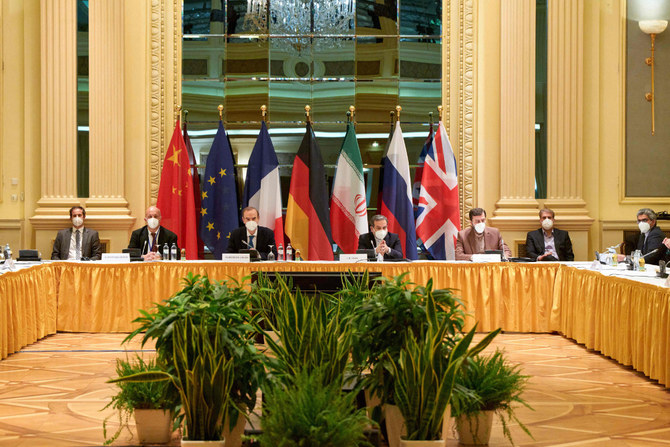
Parties to the Iran nuclear deal — Germany, France, Britain, China, Russia and Iran – are shown attending a meeting at the Grand Hotel of Vienna as they try to restore the Iran nuclear deal. (AFP)
Short Url
Updated 18 April 2021
Follow

‘Full speed ahead’ on new Iranian nuclear deal

  • China’s envoy to the talks said all participants had agreed to accelerate work on issues including which sanctions on Iran the US would lift

JEDDAH: Talks on reviving the nuclear deal with Iran will pick up speed after a second round of negotiations ended in Vienna, delegates said on Saturday.

China’s envoy to the talks said all participants — China, Russia, France, Britain, Germany and Iran — had agreed to accelerate work on issues including which sanctions on Iran the US would lift.

“All parties have agreed to further pick up their pace in subsequent days by engaging in more extensive, substantive work on sanctions-lifting as well as other relevant issues,” Wang Qun said.

The Joint Comprehensive Plan of Action (JCPOA), the 2015 deal to curb Iran’s nuclear program in return for the lifting of sanctions, collapsed in 2018 when the US pulled out. Donald Trump reimposed sanctions, and Iran responded by enriching fissile uranium to levels of purity banned under the deal.

New US President Joe Biden has offered to lift sanctions if Iran returns to compliance with the JCPOA, but so far Iran has insisted that sanctions must be eased first. Talks to break the deadlock began in Vienna last week, involving a group of signatories to the deal known as the Joint Commission.

The US is not present as Iran has declined face-to-face negotiation, but EU officials chairing the talks are carrying out shuttle diplomacy with a US delegation in a nearby hotel.

Wang said: “In the next few days we hope the Joint Commission will immediately start negotiating the specific formula of sanction-lifting.”

EU envoy Enrique Mora said: “Progress has been made in a far from easy task. Now we need more detailed work.”

Tehran’s chief negotiator, Abbas Araqchi, said the Iranian delegation had submitted proposed texts on nuclear issues and the lifting of sanctions, and that work on a common text, “at least in areas where there are common views,” could begin. While serious disagreements remained, “a new understanding appears to be emerging and there is now a common final goal among all,” he said.

The talks have been complicated by an Israeli sabotage attack last week, causing an explosion that crippled Iran’s flagship nuclear development plant at Natanz. Iran on Saturday named a man it wants to arrest in connection with the blast.

“Reza Karimi, the perpetrator of this sabotage ... has been identified” by Iran’s intelligence ministry, but had fled the country before the explosion, state TV said. “Necessary steps are underway for his arrest and return to the country through legal channels,” it said.

State TV also broadcast footage of rows of what it said were uranium enrichment centrifuges that had replaced the ones damaged in the blast at Natanz.


Syrian government vows to protect Kurds in Aleppo, accuses SDF of planting explosives

Updated 4 sec ago
Follow

Syrian government vows to protect Kurds in Aleppo, accuses SDF of planting explosives

  • Kurdish-led group targeting neighborhoods with mortars, machine guns, Ministry of Defense says
  • Army declares Ashrafieh, Sheikh Maqsoud ‘closed military zone’ after hundreds of civilians evacuated

LONDON: The Syrian government on Wednesday affirmed its commitment to protect all citizens, including Kurds, as armed tensions in Aleppo between the Syrian army and the Kurdish-led Syrian Democratic Forces continued for a fourth day.

The Ministry of Defense accused the SDF of planting explosives on roads and setting booby traps in the Sheikh Maqsoud and Ashrafieh neighborhoods, and bombarding them with mortar shells and heavy machine gun fire.

The army designated the two neighborhoods a “closed military zone” after the Syrian Arab Red Crescent evacuated 850 civilians from the area.

The government said in a statement that the SDF played no role in the city’s security and military affairs.

“This confirms that the exclusive responsibility for maintaining security and protecting residents falls upon the Syrian state and its legitimate institutions, in accordance with the constitution and applicable laws,” it said.

Protecting all citizens, including Kurds, was a non-negotiable responsibility upheld without discrimination based on ethnicity or affiliation, it said.

It also rejected any portrayal of its security measures as targeting a specific community, according to the Syrian Arab News Agency.

“The authorities concerned stress that those displaced from areas of tension are exclusively civilians, all of them Kurdish citizens who left their neighborhoods out of fear of escalation,” the statement said.

“They sought refuge in areas under the control of the state and its official institutions, which clearly demonstrates the trust of Kurdish citizens in the Syrian state and its ability to provide them with protection and security and refutes claims alleging that they face threats or targeted actions.”

The government called for the withdrawal of armed groups from Aleppo.

At least three civilians and a Syrian soldier have been killed and dozens more injured in Aleppo since Tuesday. Authorities have accused the SDF of targeting medical and educational facilities.

The escalation in violence has dealt a blow to an agreement between the two sides that was meant to be implemented by the end of last year.

The Syrian government reached an agreement with the SDF in March that included plans to integrate the group’s military, territory and natural resources, including oil fields, into the new government in Damascus.