

French nationals in Pakistan refuse embassy call to leave

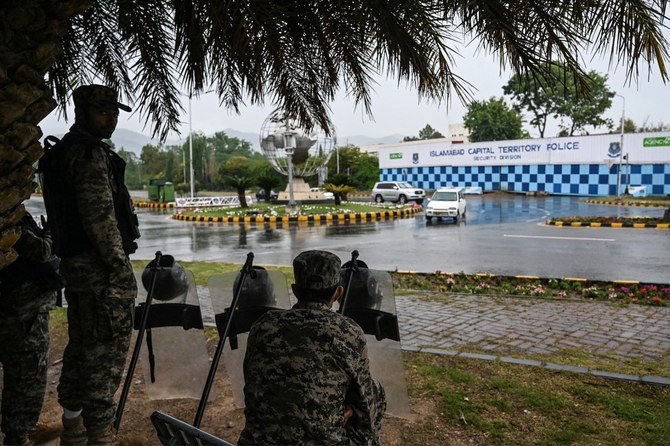
Paramilitary soldiers stand guard in front of the French Embassy in the Red Zone which was secured with shipping containers by the authorities to beef up security following violent anti-France protests, in Islamabad on April 15, 2021. (AFP)
Short Url
Updated 17 April 2021
Follow

French nationals in Pakistan refuse embassy call to leave

  • Embassy announcement came after days of violent protests by Tehreek-e-Labbaik Pakistan (TLP) demanding expulsion of France’s envoy to Islamabad
  • French nationals question the timing of the embassy’s message as the Pakistani government had just announced the ban on the TLP

ISLAMABAD: The French community in Pakistan is torn between disbelief, fear and annoyance in reaction to their embassy’s call for them to leave the country after violent protests this week by a religious political party.

Most, it seems, have decided to stay put.

In a terse three-line email, accompanied by the words “urgent,” the embassy in Islamabad on Thursday recommended its nationals and French companies temporarily leave Pakistan, because of “serious threats.”

The email, which did not specify the nature of the risks, caused shock and consternation among the few hundred-strong French community.

Jean-Michel Quarantotti, who has taught French at the American school in Islamabad for three years, was first alerted to the embassy advisory by a student.

“I won’t hide from you that at first I felt a little bit of fear, panic,” he told AFP.

“It’s not my first foreign country — I did a lot before arriving in Pakistan — but I was really shocked. I didn’t expect to go through this.”

His first thought was to pack up and leave, but after discussing the situation with colleagues he said reason took over from emotion.

“The Pakistanis around me advised me to stay,” he said. “They told me that they would protect me.”

“It was very touching to see the solidarity around me, from people who told me: ‘We are here for you, do not worry, we will defend you’.”

The embassy announcement came after days of violent protests by Tehreek-e-Labbaik Pakistan (TLP) after the arrest in Lahore Monday of leader Saad Rizvi, who had called for a march on the capital to demand the expulsion of the French ambassador.

Four policemen were killed in the rioting.

The TLP has been behind several anti-France rallies since President Emmanuel Macron defended the right of Charlie Hebdo magazine to republish cartoons depicting the Prophet Muhammad.

Many of the French people contacted by AFP questioned the timing of the embassy’s message as the Pakistani government had just announced the ban on the TLP and seemed to have the situation under control.

“Yes, there are a lot of risks to live here,” said Quarantotti, “but we don’t need to panic the French community with words that are badly chosen.

“We wonder a little why France needed to publicize this message at the international level, when it could have given a much more discreet message to the (French) community.”

Fellow national Julien — an assumed name because he does not wish to divulge his identity — has also chosen to stay put.
“It’s a recommendation, so I won’t leave,” he told AFP.

He also refused his employer’s offer to repatriate him to Europe or put armed guards outside his home.

“Anyway, since October, November, it’s been all ups and downs. So we’ll wait for it to calm down,” the Islamabad resident said.

“The watchword is vigilance,” added Laurent Cinot, a consultant for the World Bank who arrived in the capital less than two months ago.

He said any threat was not from ordinary Pakistanis, but only the TLP.

Another Frenchman living in Lahore — who is not allowed to give his name or that of his French company for security reasons — has spent nearly ten years in Pakistan in two stints.

“Since I’ve been here a long time, I didn’t really panic,” he said.

Still, he is the only French national contacted by AFP who will leave — on the orders of his employers.

For Cinot, the embassy message will have the unfortunate effect of sending back another very negative picture of Pakistan to France.

“It does not deserve it because, honestly, it is a magnificent country with people who are quite fascinating and kind ... extremely kind,” he said.


Multi-party summit pushes for talks between Pakistan government, opposition to ease tensions

Updated 5 sec ago
Follow

Multi-party summit pushes for talks between Pakistan government, opposition to ease tensions

  • National Dialogue Committee group organizes summit attended by prominent lawyers, politicians and journalists in Islamabad
  • Participants urge government to lift alleged ban on political activities, end politically motivated cases and release women prisoners

ISLAMABAD: Participants of a meeting featuring prominent politicians, lawyers and civil society members on Wednesday urged the government to initiate talks with former prime minister Imran Khan’s Pakistan Tehreek-e-Insaf (PTI) party, lift alleged bans on political activities and release jailed leaders of the PTI to foster reconciliation and pave the way for economic prosperity.

The summit was organized by the National Dialogue Committee (NDC), a political group formed last month by former PTI members Chaudhry Fawad Husain, ex-Sindh governor Imran Ismail and Mehmood Moulvi. The NDC has called for efforts to ease political tensions in the country and facilitate dialogue between the government and Khan’s party. 

The development takes place amid rising tensions between the PTI and Pakistan’s military and government. Khan, who remains in jail on a slew of charges he says are politically motivated, blames the military and the government for colluding to keep him away from power by rigging the 2024 general election and implicating him in false cases. Both deny his allegations. 

Since Khan was ousted in a parliamentary vote in April 2022, the PTI has complained of a widespread state crackdown, while Khan and his senior party colleagues have been embroiled in dozens of legal cases. Prime Minister Shehbaz Sharif last month reiterated his openness to talks with the PTI.

“The prime objective of the dialogue is that we want to bring the political temperatures down,” Ismail told Arab News after the conference concluded. 

“At the moment, the heat is so much that people— especially in politics— they do not want to sit across the table and discuss the pertaining issues of Pakistan which is blocking the way for investment.”

Former prime minister Shahid Khaqan Abbasi, who heads the Awaam Pakistan political party, attended the summit along with Jamaat-e-Islami senior leader Liaquat Baloch, Muttahida Quami Movement-Pakistan’s Waseem Akhtar and Haroon

Rasheed, president of the Supreme Court Bar Association. Journalists Asma Shirazi and Fahd Husain also attended the meeting. 

Members of the Pakistan Peoples Party, the ruling Pakistan Muslim League-Nawaz (PML-N) and the PTI did not attend the gathering. 

Muhammad Ali Saif, a former adviser to the Khyber Pakhtunkhwa chief minister, told participants of the meeting that Pakistan was currently in a “dysfunctional state” due to extreme political polarization.

“The tension between the PTI and the institutions, particularly the army, at the moment is the most fundamental, the most prominent and the most crucial issue,” Saif noted. 

‘CHANGED FACES’

The summit issued a joint communiqué after the meeting, proposing six specific confidence-building measures. These included lifting an alleged ban on political activities and the appointment of the leaders of opposition in Pakistan’s Senate and National Assembly. 

It also called for the immediate release of women political prisoners, such as Khan’s wife Bushra Bibi and PTI leader Yasmin Rashid, and the withdrawal of cases against supporters of political parties.

The communiqué also called for an end to media censorship and proposed that the government and opposition should “neither use the Pakistan Armed Forces for their politics nor engage in negative propaganda against them.”

Amir Khan, an overseas Pakistani businessperson, complained that frequent political changes in the country had undermined investors’ confidence.

“I came here with investment ideas, I came to know that faces have changed after a year,” Amir Khan said, referring to the frequent change in government personnel. 

The NDC plans to consult senior opposition leaders currently in prison to finalize a representative committee for talks once the government announces its own team.

“Let us create some environment. Let us bring some temperatures down and then we will do it,” Ismail said regarding a potential meeting with the jailed Khan. 

Khan’s party, on the other hand, has been calling for a “meaningful” political dialogue with the government. 

However, it has accused the government of denying PTI members meetings with Khan in the Rawalpindi prison where he remains incarcerated. 

“For dialogue to be meaningful, it is essential that these authorized representatives are allowed regular and unhindered access to Imran Khan so that any engagement accurately reflects his views and PTI’s collective position,” PTI leader Azhar Leghari told Arab News last week.