

Indian vaccine maker asks US to ease export curbs

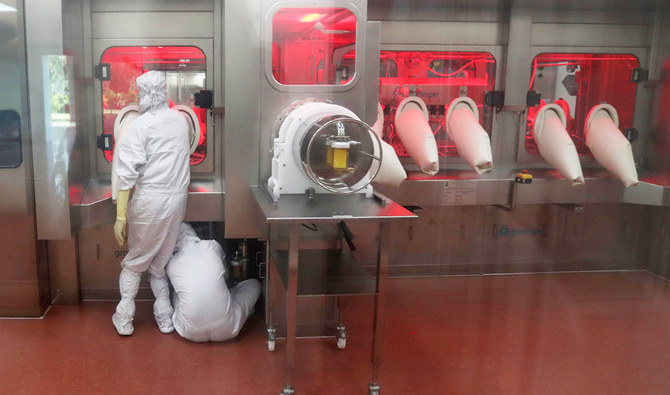
Employees operate a filling machine inside a laboratory at the Serum Institute of India, in Pune, India, Thursday, Jan. 21, 2021. (AP)
Short Url
Updated 17 April 2021
Follow

Indian vaccine maker asks US to ease export curbs

  • Serum Institute of India paused exports to COVAX after a devastating surge of infections in India resulted in increased domestic demand

NEW DELHI: The chief executive of Serum Institute of India, the world’s largest maker of vaccines and a critical supplier of the UN-backed COVAX facility, asked President Joe Biden on Twitter to lift the US embargo on exporting raw materials needed to make the the jabs.
Vaccine makers and experts in India have been concerned that the use of the Defense Production Act by the US to boost their own vaccine production was resulting in exports of critical raw materials being stopped. This was hobbling vaccine production in other parts of the world.
Stéphane Bancel, CEO for Moderna, said Tuesday in an online event that export embargoes were also preventing American vaccine makers from exporting shots globally and resulting in shortages.
“If we are to truly unite in beating this virus, on behalf of the vaccine industry outside the US, I humbly request you to lift the embargo of raw material exports out of the US so that vaccine production can ramp up,” wrote Adar Poonawalla, CEO of Serum Institute of India.
He had earlier said that pivoting away from suppliers in the US could result in a delay of up to six months for the production of the COVID-19 vaccine developed by Novavax. Serum Institute and Novavax have inked a deal to supply 1.1 billion doses of the vaccine to COVAX to equitably distribute it across the globe.

NUMBER

200,000 new infections were detected recently in India.

Serum Institute of India paused exports to COVAX after a devastating surge of infections in India resulted in increased domestic demand.
Over 200,000 new infections were detected recently and major cities, like Mumbai and New Delhi, are under virus restrictions. Hospitals are overwhelmed and authorities are scrambling to try and vaccinate enough people to slow down the spread. But in doing so, India relies heavily on AstraZeneca shots made by Serum Institute of India.
Poonawalla had said the unavailability of the raw materials, such as the specific medium needed to grow microorganisms, would prevent Serum Institute from scaling up the production of the vaccine developed by Novavax.
The company had been planning to make up to 40 million shots of the vaccine monthly.
Ramping up the production of this shot could also help India. Novavax has applied for emergency use of the vaccine to regulators in Europe, the US and the World Health Organization. If approved, India would be able to use the shot under new regulations that make it easier to greenlight vaccines that have received the nod by the UK, the US, Europe, Japan or WHO.


Kuwait to boost Islamic finance with sukuk regulation

Updated 05 February 2026
Follow

Kuwait to boost Islamic finance with sukuk regulation

  • The move supports sustainable financing and is part of Kuwait’s efforts to diversify its oil-dependent economy

RIYADH: Kuwait is planning to introduce legislation to regulate the issuance of sukuk, or Islamic bonds, both domestically and internationally, as part of efforts to support more sustainable financing for the oil-rich Gulf nation, Prime Minister Sheikh Ahmad Abdullah Al-Ahmad Al-Sabah said on Wednesday.

Speaking at the World Governments Summit in Dubai, Al-Sabah highlighted that Kuwait is exploring a variety of debt instruments to diversify its economy. The country has been implementing fiscal reforms aimed at stimulating growth and controlling its budget deficit amid persistently low oil prices. Hydrocarbons continue to dominate Kuwait’s revenue stream, accounting for nearly 90 percent of government income in 2024.

The Gulf Cooperation Council’s debt capital market is projected to exceed $1.25 trillion by 2026, driven by project funding and government initiatives, representing a 13.6 percent expansion, according to Fitch Ratings.

The region is expected to remain one of the largest sources of US dollar-denominated debt and sukuk issuance among emerging markets. Fitch also noted that cross-sector economic diversification, refinancing needs, and deficit funding are key factors behind this growth.

“We are about to approve the first legislation regulating issuance of government sukuk locally and internationally, in accordance with Islamic laws,” Al-Sabah said.

“This enables us to deal with financial challenges flexibly and responsibly, and to plan for medium and long-term finances.”

Kuwait returned to global debt markets last year with strong results, raising $11.25 billion through a three-part bond sale — the country’s first US dollar issuance since 2017 — drawing substantial investor demand. In March, a new public debt law raised the borrowing ceiling to 30 billion dinars ($98 billion) from 10 billion dinars, enabling longer-term borrowing.

The Gulf’s debt capital markets, which totaled $1.1 trillion at the end of the third quarter of 2025, have evolved from primarily sovereign funding tools into increasingly sophisticated instruments serving governments, banks, and corporates alike. As diversification efforts accelerate and refinancing cycles intensify, regional issuers have become regular participants in global debt markets, reinforcing the GCC’s role in emerging-market capital flows.

In 2025, GCC countries accounted for 35 percent of all emerging-market US dollar debt issuance, excluding China, with growth in US dollar sukuk issuance notably outpacing conventional bonds. The region’s total outstanding debt capital markets grew more than 14 percent year on year, reaching $1.1 trillion.