

Karachi clerics spread the word: Getting COVID-19 shot won’t break Ramadan fast

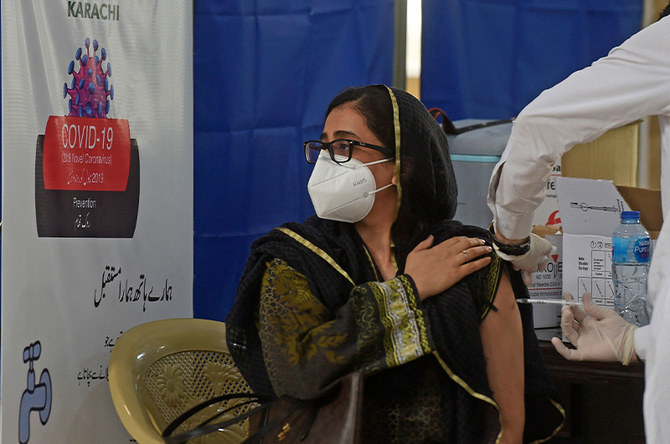
A woman is inoculated with a Covid-19 coronavirus vaccine at a vaccination center in Karachi, Pakistan, on March 16, 2021. (AFP)
Short Url
Updated 17 April 2021
Follow

Karachi clerics spread the word: Getting COVID-19 shot won’t break Ramadan fast

  • Doctors at vaccination centers in Karachi observe a drop in the number of visitors since the beginning of the fasting month
  • Pakistan Medical Association says more awareness campaigns are needed to convince people that vaccination won't nullify their fast

KARACHI: Prayer leaders in Pakistan's southern megacity of Karachi have asked worshippers during Friday sermons to get vaccinated against the coronavirus in Ramadan as the number of those getting their jabs has dropped during the first days of the fasting month.

While sermons in the country usually revolve around topics such as worship, rituals, and the importance of charity during Ramadan, Maulana Muhammad Miskeen Naqshbandi, a prayer leader at Jamia Masjid Dargah Abdullah Shah Ghazi, stressed during his speech this Friday the importance of vaccination and that it should be done even while fasting, as the country is facing a third wave of the coronavirus disease.

“Injection of vaccine doesn’t violate the principles set by Islamic jurists for fasting. It neither goes to stomach nor mind, so there is no problem in getting any injection, be it the COVID-19 vaccine or normal injection,” Naqshbandi said.

He said he had realized the urgency of the situation after several worshipers had come to him for guidance.

"There was a misconception, which I removed in today’s sermon,” he told Arab News after Friday prayers.

"Mosque is the most effective medium to get people educated. People need vaccines to fight this pandemic," he said.

Dr. Umair Siqqiqui who delivers Friday sermons at Karachi's Majid Ali Haider Karar Clifton, last week, before the beginning of Ramadan, also after Friday prayers asked worshipers to get vaccinated. He said, however, that they can do so after Iftar, when they break the fast.

“Vaccines, including those of coronavirus should be received but there are different conditions," he told Arab News, adding that if doctors prescribe it as urgent, it would break the fast but the person who receives it could just fast again for one day after Ramadan.

“Religious scholars should provide guidelines,” he said, adding that as millions attend Friday prayers, mosques the world’s biggest media.

At Karachi's Khaliq Dina Hall, which is one of the busiest vaccination centers in the seaside metropolis, doctors say the number of visitors has dropped since the start of Ramadan.

“On normal days, we would vaccinate from 1,500 to 2,300 but the number has dropped to 1,000 daily,” Dr. Farhat Abbas, in charge of the vaccination center, told Arab News.

He expressed hope that the numbers will increase again after authorities have extended vaccination until midnight.

Pakistan Medical Association secretary general Dr. Qaisar Sajjad said that despite the fact that religious scholars have endorsed the opinion of doctors to continue with vaccination during the fast, more awareness is still needed.

“The government has done arrangement for vaccination during night but since we are going through the peak of a third wave and the cases of coronavirus infection are growing, the authorities should run a rigorous campaign with video messages of religious scholars so that the process may go fast all the time,” he said.

“This is a pandemic and people should be made aware,” Dr. Sajjad added.

Similar problems related to vaccination during the fasting month are also faced by Muslim communities abroad.

In the UK, the Muslim community has pop-up vaccination centers at mosques.

"We have been provided by National Health Service pop-up vaccination centers at mosques and community centers so that the process may not get slow," Muhammad Asimuddin, a British Pakistani and mosque committee member, told Arab News over the phone from London.

"The British Islamic Medical Association has told the community that getting vaccine jab will not break the fast."


Pakistan says responding to Afghan ‘offensive operations’ after border fire as tensions escalate

Updated 26 February 2026
Follow

Pakistan says responding to Afghan ‘offensive operations’ after border fire as tensions escalate

  • Afghan Taliban spokesperson says “large-scale offensive operations” launched against Pakistani military bases
  • Pakistan says Afghan forces opened “unprovoked” fire across multiple sectors along shared border

ISLAMABAD: Afghanistan’s Taliban authorities said on Thursday they had launched “large-scale offensive operations” against Pakistani military bases and installations, prompting Pakistan to say its forces were responding to what it described as unprovoked fire along the shared border.

The escalation follows Islamabad’s weekend airstrikes targeting what it said were Tehreek-e-Taliban Pakistan (TTP) and Daesh militant camps inside Afghanistan in response to a wave of recent bombings and attacks in Pakistan. Islamabad said the strikes killed over 100 militants, while Kabul said dozens of civilians were killed and condemned the attacks as a violation of its sovereignty.

In a post on social media platform X, Afghan government spokesperson Zabihullah Mujahid said Afghanistan had launched “large-scale offensive operations” in response to repeated violations by the Pakistani military.


Pakistan’s Ministry of Information said Afghan forces had initiated hostilities along multiple points of the frontier.

“Afghan Taliban regime unprovoked action along the Pakistan–Afghanistan border given an immediate, and effective response,” the ministry said in a statement.

The statement said Pakistani forces were targeting Taliban positions in the Chitral, Khyber, Mohmand, Kurram and Bajaur sectors, claiming heavy Afghan casualties and the destruction of multiple posts and equipment. It added that Pakistan would take all necessary measures to safeguard its territorial integrity and the security of its citizens.


Separately, security officials said Pakistani forces had carried out counterattacks in several border sectors.

“Pakistan’s security forces are giving a befitting reply to the unprovoked Afghan aggression with full force,” a security official said, declining to be named. 

“The Pakistani security forces’ counter-attack destroyed Taliban’s hideouts and the Khawarij fled,” they added, referring to TTP militants. 

The claims from both sides could not be independently verified.

Cross-border violence has intensified in recent weeks, with Pakistan blaming a surge in suicide bombings and militant attacks on militants it says are based in Afghanistan. Kabul denies providing safe havens to anti-Pakistan militant groups.

The clashes mark the third major escalation between the neighbors in less than a year. Similar Pakistani strikes last year triggered weeklong clashes before Qatar, Türkiye and other regional actors mediated a ceasefire in October.

The 2,600-kilometer (1,600-mile) frontier, a key trade and transit corridor linking Pakistan to landlocked Afghanistan and onward to Central Asia, has faced repeated closures amid tensions, disrupting commerce and humanitarian movement. Trade between the two nations has remained closed since October 2025.