

Chief of Tehreek-e-Labaik asks supporters to call off protests as Pakistan moves to ban party

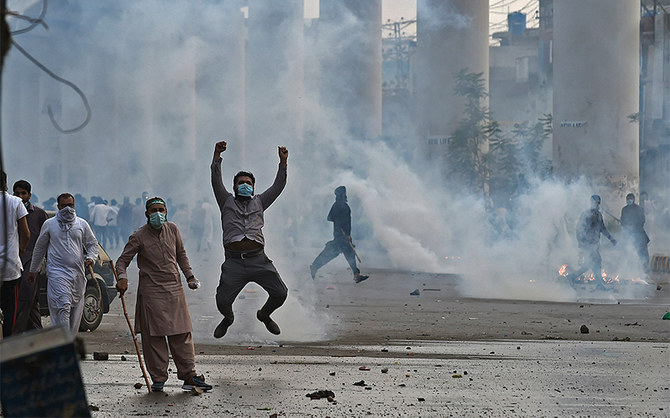
Police use tear gas to disperse supporters of Tehreek-e-Labbaik Pakistan (TLP) during a protest in Lahore on April 12, 2021, after the arrest of their leader, who has called for the expulsion of the French ambassador. (AFP)
Short Url
Updated 16 April 2021
Follow

Chief of Tehreek-e-Labaik asks supporters to call off protests as Pakistan moves to ban party

  • Saad Rizvi tells supporters not to indulge in illegal activity, immediately clear roadblocks, return peacefully to homes and cooperate with authorities
  • Rizvi’s appeal comes a day after cabinet approved proposal by interior ministry to ban TLP and file a case with Supreme Court to dissolve the party

KARACHI: Saad Rizvi, the head of the Tehreek-e-Labaik Pakistan religious political party, has called on his supporters to “immediately” halt protests being held across the country against Rizvi’z arrest, the party chief said in a handwritten letter shared on Twitter on Thursday by a top government aide. 
TLP supporters have been holding violent nationwide protests since Monday when Rizvi was arrested for threatening to launch a major protest campaign against the government if it did not expel France’s envoy to Islamabad over blasphemous caricatures of Prophet Muhammad (peace be upon him) printed in a French publication last year. 
“I am addressing all shura [TLP council] members and Tehreek-e-Labaik workers and appeal that no illegal activity should be done for the sake of people and in the better interest of the country,” Rizvi said in his note, which was tweeted by Dr. Shahbaz Gill, special adviser to Prime Minister Imran Khan on political communication.
“All protest demonstrations and roadblocks should be immediately cleared. All workers should return to their homes peacefully. Fully cooperate with the law enforcement agencies.”

Neither Rizvi himself, nor any of his party leaders, could be reached for comment on the note.
Rizvi’s appeal comes a day after Pakistan’s federal cabinet approved a proposal by the interior ministry to ban TLP and file a case with the Supreme Court to dissolve the religious party, which is a registered political party with the Election Commission of Pakistan. The interior ministry says it is moving to have the party banned for killing two policemen, attacking law enforcement forces and disrupting public life during this week’s protests. 
“We have proscribed [the TLP] and the notification for that will be issued shortly,” federal interior minister Sheikh Rashid Ahmed told reporters on Thursday. “Tomorrow, we will send another summary to the cabinet to file a reference in the Supreme Court since we are moving toward [TLP’s] dissolution.” 
The TLP gained prominence in Pakistan’s 2018 federal elections, campaigning to defend the country’s blasphemy law, which calls for the death penalty for anyone who insults Islam. The party also has a history of staging protests and sit-ins to pressure the government to accept its demands. 
In November 2017, Rizvi’s followers staged a 21-day protest and sit-in after a reference to the sanctity of the Prophet Muhammad (pbuh) was removed from the text of a government form. 
In the 2018 elections, the party managed to win two seats in the Sindh Assembly from Karachi and got a female member elected on a reserved seat of the assembly. 
Religious parties — some new, others long-established — fielded more than 1,500 candidates for national and provincial assemblies in Pakistan’s general election on July 25, 2018.


IMF hails Pakistan privatization drive, calls PIA sale a ‘milestone’

Updated 10 January 2026
Follow

IMF hails Pakistan privatization drive, calls PIA sale a ‘milestone’

  • Fund backs sale of national airline as key step in divesting loss-making state firms
  • IMF has long urged Islamabad to reduce fiscal burden posed by state-owned entities

KARACHI: The International Monetary Fund (IMF) on Saturday welcomed Pakistan’s privatization efforts, describing the sale of the country’s national airline to a private consortium last month as a milestone that could help advance the divestment of loss-making state-owned enterprises (SOEs).

The comments follow the government’s sale of a 75 percent stake in Pakistan International Airlines (PIA) to a consortium led by the Arif Habib Group for Rs 135 billion ($486 million) after several rounds of bidding in a competitive process, marking Islamabad’s second attempt to privatize the carrier after a failed effort a year earlier.

Between the two privatization attempts, PIA resumed flight operations to several international destinations after aviation authorities in the European Union and Britain lifted restrictions nearly five years after the airline was grounded following a deadly Airbus A320 crash in Karachi in 2020 that killed 97 people.

“We welcome the authorities’ privatization efforts and the completion of the PIA privatization process, which was a commitment under the EFF,” Mahir Binici, the IMF’s resident representative in Pakistan, said in response to an Arab News query, referring to the $7 billion Extended Fund Facility.

“This privatization represents a milestone within the authorities’ reform agenda, aimed at decreasing governmental involvement in commercial sectors and attracting investments to promote economic growth in Pakistan,” he added.

The IMF has long urged Islamabad to reduce the fiscal burden posed by loss-making state firms, which have weighed public finances for years and required repeated government bailouts. Beyond PIA, the government has signaled plans to restructure or sell stakes in additional SOEs as part of broader reforms under the IMF program.

Privatization also remains politically sensitive in Pakistan, with critics warning of job losses and concerns over national assets, while supporters argue private sector management could improve efficiency and service delivery in chronically underperforming entities.

Pakistan’s Cabinet Committee on State-Owned Enterprises said on Friday that SOEs recorded a net loss of Rs 122.9 billion ($442 million) in the 2024–25 fiscal year, compared with a net loss of Rs 30.6 billion ($110 million) in the previous year.