

Rohingya refugees observe lonely Ramadan on remote Bangladesh island

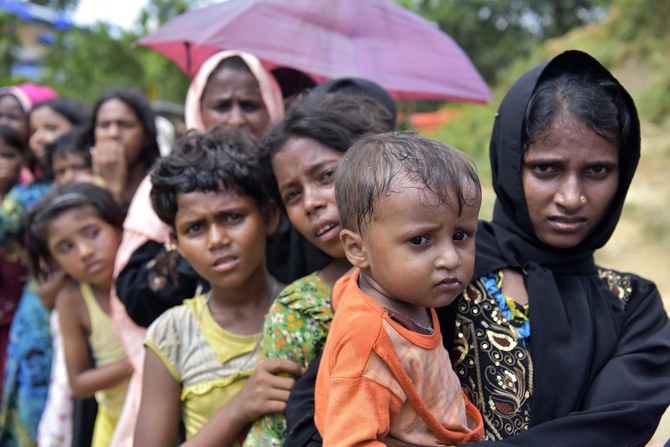
Bangladesh says it has built housing units and infrastructure on the island for 100,000 refugees to take the pressure off Cox’s Bazar, which already hosts more than 1.1 million Rohingya. (Shutterstock/File Photo)
Short Url
Updated 15 April 2021
Follow

Rohingya refugees observe lonely Ramadan on remote Bangladesh island

  • Over 18,500 Rohingya Muslims have been relocated to Bhasan Char since December
  • They say they are missing relatives as their first Ramadan has started on the isolated island 

DHAKA: Rohingya refugees have welcomed the beginning of the month of Ramadan with a sense of solitude and isolation on Bhashan Char island, where thousands were been moved by Bangladeshi authorities from the overcrowded camps of Cox’s Bazar.

Over 18,500 Rohingya Muslims have been relocated to the remote island in the Bay of Bengal since December last year, despite criticism from rights groups and the UN Refugee Agency over the site’s vulnerability to severe weather and flooding.

Bangladesh says it has built housing units and infrastructure on the island for 100,000 refugees to take the pressure off Cox’s Bazar, which already hosts more than 1.1 million Rohingya, a Muslim minority group who fled violence and persecution in Myanmar.

While authorities have on numerous occasions said that the relocation is voluntary and the Rohingya were happy to start their new lives on the island, some of them say they are missing their previous camps, especially as Ramadan, which is traditionally a time for community, started earlier this week.

“Here I feel very lonely as my siblings, parents and most of the relatives are living at Cox’s Bazar. During last year’s Ramadan, we all were together and had some memorable family get-togethers,” Mohammad Alam, a 37-year-old Rohingya refugee in Bhasan Char, told Arab News on Thursday.

“Now I maintain communications with the family members through mobile phone, but (I am) not sure when I can meet them again,” he said.

“Ramadan is a very special month for us as Muslims, and we all love to stay together with the friends and family during this holy month.”

Khaleda Begum, a 20-year-old mother of three, finds her Ramadan days more difficult at Bhashan Char compared to Cox’s Bazar.

READ MORE

Bangladesh, setting an example to the world, has given shelter to more than 730,000 Muslim Rohingya who were driven out of Myanmar by its genocidal government since 2017. Click here to read more.
“I used to work as a volunteer for an NGO at Cox’s Bazar where I received $150 as a monthly salary. In addition to relief aid, I was able to provide nutritious food to my family with the money I earned,” she said. “Here I have no earning scope at the moment, and I couldn’t arrange any special diet for my family during this month of fasting.”

Her family is now solely dependent on aid agencies.  

“We get rice, lentils, edible oil, onions, sugar, etc. as relief aid. But the children want to have fish or chicken. So, sometimes I sell a portion of my aid to the local market and try to buy some fish which is also scarce,” Begum said.

Mohammad Asad, 37, who relocated to Bhasan Char with eight family members, said that providing them with healthy food has become a big concern for him this Ramadan.

“In previous years, we used to receive a variety of food aid during Ramadan and the quantity was also sufficient. We could manage some other necessary things from the local market by selling some of our relief. But now we receive less, which puts my family into hardship,” he said, adding that freedom of movement was also greater at Cox’s Bazar.

“We are not allowed to move so far from our living place. Since it’s an island there is also not enough space. So, we remain almost confined within a certain area,” Asad told Arab News.

With assistance from NGOs such as Islamic Relief Bangladesh, Human Appeal, the Bangladesh Red Crescent Society, and Qatar Charity, the government says it has organized special Ramadan food packages for the refugees in Bhashan Char.

“This is a one-time special food package in addition with the regular monthly food aid. We have the data of all the families living here and each of the family received a Ramadan special package,” Mohammad Khalilur Rahman Khan, of the Refugee Relief and Repatriation Commission, who is in charge of the island camp, told Arab News.

“We are also considering special gifts on the occasion of Eid Al-Fitr for the Rohingyas on the island,” he said, adding that the agency is still looking for an Eid aid sponsor.


Afghanistan says it thwarted Pakistani airstrike on Bagram Air Base as fighting enters fourth day

Updated 01 March 2026
Follow

Afghanistan says it thwarted Pakistani airstrike on Bagram Air Base as fighting enters fourth day

  • The fighting has been the most severe between the neighbors for years
  • Pakistan accuses Taliban government of harboring militant groups that stage attacks against it

KABUL: Afghanistan thwarted attempted airstrikes on Bagram Air Base, the former US military base north of Kabul, authorities said Sunday, while cross-border fighting between Pakistan and Afghanistan stretched into a fourth day.
The fighting has been the most severe between the neighbors for years, with Pakistan declaring that it’s in “open war” with Afghanistan.
The conflict has alarmed the international community, particularly as the area is one where other militant organizations, including Al-Qaeda and the Daesh group, still have a presence and have been trying to resurface.
Pakistan accuses Afghanistan’s Taliban government of harboring militant groups that stage attacks against it and also of allying with its archrival India.
Border clashes in October killed dozens of soldiers, civilians and suspected militants until a Qatari-mediated ceasefire ended the intense fighting. But several rounds of peace talks in Turkiye in November failed to produce a lasting agreement, and the two sides have occasionally traded fire since then.
On Sunday, the police headquarters of Parwan province, where Bagram is located, said in a statement that several Pakistani military jets had entered Afghan airspace “and attempted to bomb Bagram Air Base” at around 5 a.m.
The statement said Afghan forces responded with “anti-aircraft and missile defense systems” and had managed to thwart the attack.
There was no immediate response from Pakistan’s military or government regarding Kabul’s claim of attempted airstrikes on Bagram or the ongoing fighting.
Bagram was the United States’ largest military base in Afghanistan. It was taken over by the Taliban as they swept across the country and took control in the wake of the chaotic US withdrawal from the country in 2021. Last year, US President Donald Trump suggested he wanted to reestablish a US presence at the base.
The current fighting began when Afghanistan launched a broad cross-border attack on Thursday night, saying it was in retaliation for Pakistani airstrikes the previous Sunday.
Pakistan had said its airstrike had targeted the outlawed Pakistani Taliban, also known as Tehreek-e-Taliban Pakistan, or TTP. Afghanistan had said only civilians were killed.
The TTP militant group, which is separate but closely allied with Afghanistan’s ruling Taliban, operates inside Pakistan, where it has been blamed for hundreds of deaths in bombings and other attacks over the years.
Pakistan accuses Afghanistan’s Taliban government of providing a safe haven within Afghanistan for the TTP, an accusation that Afghanistan denies.
After Thursday’s Afghan attack, Pakistani Defense Minister Khawaja Mohammad Asif declared that “our patience has now run out. Now it is open war between us.”
In the ongoing fighting, each side claims to have killed hundreds of the other side’s forces — and both governments put their own casualties at drastically lower numbers.
Two Pakistani security officials said that Pakistani ground forces were still in control on Sunday of a key Afghan post and a 32-square-kilometer area in the southern Zhob sector near Kandahar province, after having seized it during fighting Friday. The captured post and surrounding area remain under Pakistani control, they added. The officials spoke on condition of anonymity, because they weren’t authorized to speak publicly.
In Kabul, the Afghan government rejected Pakistan’s claims. Deputy government spokesman Hamdullah Fitrat called the reports “baseless.”
Afghan officials said that fighting had continued overnight and into Sunday in the border areas.
The police command spokesman for Nangarhar province, Said Tayyeb Hammad, said that anti-aircraft missiles were used from the provincial capital, Jalalabad, and surrounding areas on Pakistani fighter jets flying overhead Sunday morning.
Defense Ministry spokesman Enayatulah Khowarazmi said that Afghan forces had launched counterattacks with snipers across the border from Nangarhar, Paktia, Khost and Kandahar provinces overnight. He said that two Pakistani drones had been shot down and dozens of Pakistani soldiers had been killed.
Fitrat said that Pakistani drone attacks hit civilian homes in Nangarhar province late Saturday, killing a woman and a child, while mortar fire killed another civilian when it hit a home in Paktia province.
There was no immediate response to the claims from Pakistani officials.