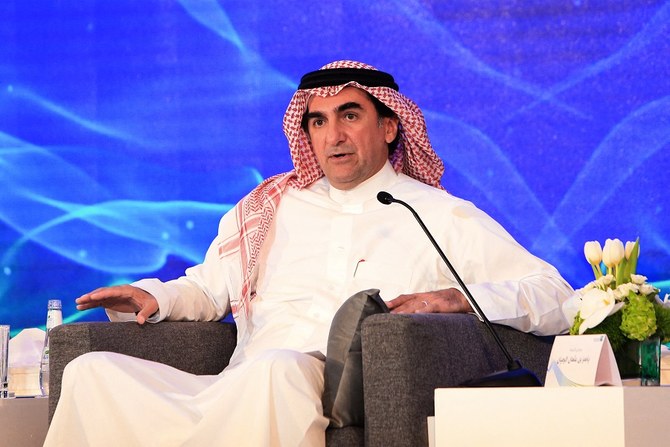

RIYADH: Saudi Arabia’s Public Investment Fund (PIF) Governor Yasir Al-Rumayyan said that environmental, social, and governance (ESG) programs made solid business sense in the Kingdom and worldwide.
“Such action not only helps in protecting climate but also helps economically,” he said during the Future Investment Initiative (FII) Institute’s ESG virtual event on Thursday.
The PIF has already incorporated ESG principles into its $400 billion worth of global investments as the sector gains in prominence throughout the region.
Al-Rumayyan, who also chairs the FII Institute, said that ESG investing should grow in tandem with the sustainable development goals (SDGs) which were adopted by UN member states in 2015 as a universal call to action to end poverty and protect the planet.
“We need to work together on mobilizing ESG for a sustainable future,” he told delegates.
Developing the renewable energy sector was crucial to reducing emissions, he said, highlighting the Fund’s work with ACWA Power, a leading global player in the renewables sector. The PIF in November increased its stake in the company to 50 percent, part of a move to support the wider renewables sector in the Kingdom.
ACWA Power is planning an initial public offering and heads a consortium that will build and operate renewable power-based utilities at the Kingdom’s flagship Red Sea tourism project.
Al-Rumayyan also referred to the Saudi Green Initiative and Middle East Green Initiative to reduce carbon and contribute to protecting the planet as an example of the Kingdom’s progress, which were announced by Crown Prince Mohammed bin Salman in late March.
The green initiatives aim to reduce carbon emissions by 60 percent in the region and deliver the world’s biggest afforestation project. The tree-planting project will be double the size of the Great Green Wall in the Sahel region, the second-biggest regional forestry initiative. The initiative will also work to increase the percentage of protected land to more than 30 percent, exceeding the global target of 17 percent per country.
It aims to reduce carbon emissions by more than four percent of global contributions through renewable energy projects that will provide 50 percent of the Kingdom’s electricity production by 2030.
The initiative is expected to eliminate more than 130 million tons of carbon emissions by using clean hydrocarbon technologies.
The PIF governor said such initiatives represented a clear and ambitious roadmap and would contribute to achieving global targets on combating climate change. He said the Kingdom will raise vegetation cover, reduce emissions, and preserve marine life as part of its efforts to deliver a more sustainable future.
Thought leaders in sustainable investment gathered virtually in Riyadh on Thursday to explore one of the hottest topics in the world of finance — the move to environmental, social and governance (ESG) benchmarks by big global investors.
The event, under the auspices of the Future Investment Initiative (FII) Institute, focuses attention on sustainable investment in the post-pandemic recovery, and the role of emerging markets like Saudi Arabia within the new investment philosophy.
ESG investing has recently taken off, attracting hundreds of billions of dollars into funds that pledge to weigh broader considerations when deciding where to put their money, rather than mere cash returns.
Richard Attias, chief executive of the FII Institute, said: “Although ESG has proven its worth, much remains to be done to ensure we use it to its full potential. The low level of inclusion and participation of emerging markets in the development of ESG frameworks is counterproductive to global sustainability.
“Perhaps the most challenging task, and one that we will address during this event, is how we push ourselves to think beyond ESG as a risk management tool and deploy it to create a truly sustainable future,” he added.