

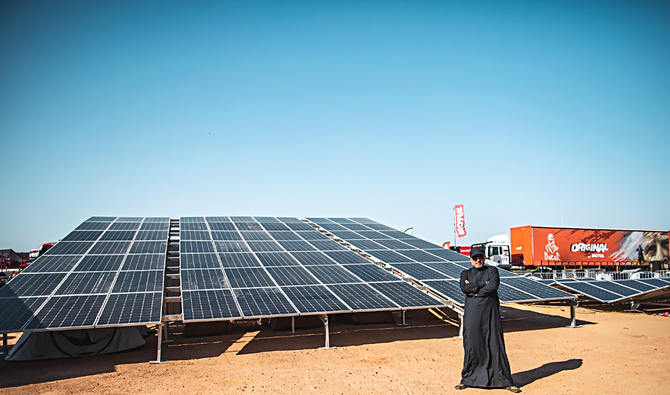
Saudi solar firm to scale up energy projects in Nigeria

Desert Technologies has significant experience in providing solar PV products and solutions to commercial and industrial clients, as well as governmental and non-governmental organizations.
Short Url
Updated 13 April 2021
Follow

Saudi solar firm to scale up energy projects in Nigeria

Saudi solar energy firm Desert Technologies (DT) revealed plans to provide large-scale financing to electrify villages in the sub-Saharan region, during its participation in a live online conference titled “Renpower Nigeria Investors 2021,” from March 31 to April 1.

Nour Mousa, founder and CEO of DT, discussed projects in solar PV and grid connected electricity access across Nigeria and other markets, among more than 200 high-level decision-makers, market participants and stakeholders from around the world.

The conference provided the participants with an opportunity to learn about the future of the renewable energy market and the Nigerian government’s plans to generate electricity using solar energy and encourage investment in solar energy projects in rural villages to improve education, water supply, health, agriculture, trade and security. 

During the conference, Mousa presented the experience of DT with inspiring insights and ideas. He said that the participation of DT in the virtual event came from its keenness and interest in the African and Nigerian markets, with DT having significant experience in providing solar PV products and solutions to commercial and industrial clients, as well as governmental and nongovernmental organizations. 

“DT is an independent, fully integrated PV solar energy platform with a proven track record as a PV developer, investor, EPC and operation and maintenance contractor, and PV solar panel and energy storage solutions manufacturer. Headquartered in the Kingdom of Saudi Arabia, operating across Africa, the Middle East and Emerging Asia, DT is a diversified company operating across the value chain of the solar sector,” Mousa said. 

He discussed the business case of Sahara, DT’s off-grid solution that grants sustainable access to electricity in remote and rural areas. Sahara is DT’s containerized solar generator, a very agile and versatile product designed to operate under different conditions. Through this system, small businesses will have the ability to light their shops and power their computers, while other businesses may require power to operate machinery and appliances such as refrigerators and electric sewing machines.

Mousa said that Sahara has been designed specifically in response to the critical need of enhancing electricity access in Africa, through micro-grid and off-grid solutions. Sahara is a plug-and-play, stand-alone system, which can support local communities and their development by relieving their dependency on power generated from the grid. 

“With the Sahara series, we are looking at a levelized cost of electricity at about 11 cUSD /kWh provided by the hybrid system, which is already half of what diesel is today. DT is planning to provide finance at a large scale and electrify villages in the sub-Saharan region,” he added.

Despite being the leading economy in the African continent in terms of GDP ($443 billion), the installed electrical capacity in Nigeria does not exceed 12,522 MW (2020), as only 36 percent of the population in rural areas has access to electricity. The federal government hopes to improve the situation through the Nigeria Electrification Project funded by the World Bank and the African Development Bank.


Jameel Research project at MIT tackles antimicrobial resistance

The ambitious project is led by Professor James J. Collins, third from left. Professor Collins and his team at MIT will develop
Updated 31 January 2026
Follow

Jameel Research project at MIT tackles antimicrobial resistance

Jameel Research, part of Abdul Latif Jameel International network, is sponsoring a research project in the Department of Biological Engineering and Institute for Medical Engineering and Science at the Massachusetts Institute of Technology, aimed at tackling the global public health crisis of antimicrobial resistance.
This ambitious, multi-disciplinary project is led by Professor James J. Collins, Termeer professor of medical engineering and science at MIT and faculty lead for life sciences at the MIT Jameel Clinic, the epicenter of artificial intelligence and health at MIT.
The project, spanning at least three years, will leverage the Collins’ lab’s cutting-edge strengths in synthetic biology and AI to create next-generation diagnostics.
The growing prevalence of antibiotic-resistant superbugs and a declining antibiotic pipeline has led to a global public health crisis. The US Centers for Disease Control and Prevention has predicted some 2 million infections and 23,000 deaths occur each year in the US alone, costing $55 billion. The World Bank predicts that up to $100 trillion of economic output may be at risk by 2050. The UK government-commissioned Review on Antimicrobial Resistance is projecting more than 10 million deaths worldwide per year by 2050 if the crisis is not addressed.
Professor Collins and his team at MIT are setting out to develop the next generation of antibacterials and rapid diagnostics to overcome AMR — using synthetic biology and advanced generative AI to deliver faster results and help control the use of antibiotics to where they can be effective.
With support from Jameel Research, the first phase of this project will develop and validate programmable antibacterials to overcome AMR in a range of bacterial pathogens. These AI-designed minibinders will be delivered by engineered microbes to neutralize key toxins and protein targets.
This directed design and engineering approach to antibiotic development technology advances a long-term vision to create programmable antibacterials to address the AMR crisis. This would then offer the potential for the more rapid development of medical countermeasures to emerging and re-emerging pathogens and a swifter response to future outbreaks and pandemics.
Mohammed Abdul Latif Jameel, KBE, chairman of Abdul Latif Jameel, said: “Antimicrobial resistance is one of the most urgent challenges we face today and addressing it will require ambitious science and sustained collaboration. We are pleased to support this new research, building on our long-standing relationship with MIT and our commitment to advancing research across the world, to strengthen global health and contribute to a more resilient future.”
“This project reflects my belief that tackling AMR requires both bold scientific ideas and a pathway to real-world impact,” Professor Collins said. “Jameel Research is keen to address this crisis by supporting innovative, translatable research at MIT.”
Jameel Research is advancing the work of pioneering pathfinders to create an extraordinary impact on a global scale.
This initial project holds the promise of rapidly developing medical countermeasures for emerging and re-emerging pathogens, offering a rapid response to future outbreaks and pandemics.
The new research project builds on the close and long-standing relationship between MIT and the Jameel family. This includes the MIT Jameel Clinic, which was co-founded in 2018 by MIT and Community Jameel, the international nonprofit organization founded by Mohammed Jameel, KBE, to advance science and learning for communities to thrive, and one of the Jameel family’s philanthropies.