

Indian opposition takes jab at Modi over vaccine shortage, COVID-19 crisis

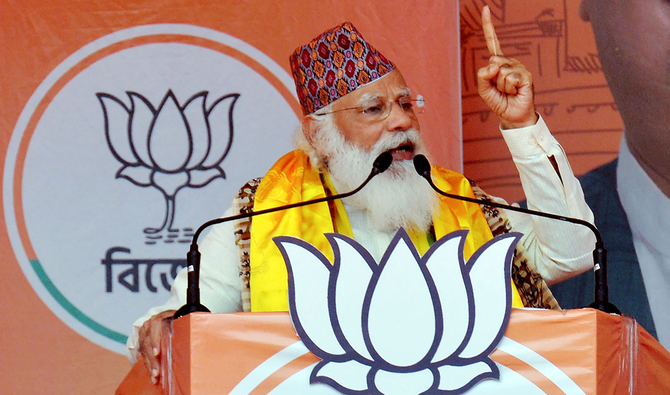
Indian Prime Minister Narendra Modi. (AFP)
Short Url
Updated 11 April 2021
Follow

Indian opposition takes jab at Modi over vaccine shortage, COVID-19 crisis

  • Most Mumbai vaccine centers closed, city mayor tells Arab News

NEW DELHI: Indian Prime Minister Narendra Modi has been accused of complacency and missteps in the handling of the pandemic by the country’s main opposition party, after six states reported a shortage of coronavirus vaccines and more than 145,000 new infections were recorded on Saturday.

The Congress Party also blamed the ruling Bharatiya Janata Party (BJP) for prioritizing “vaccine diplomacy” by exporting vaccine doses instead of reserving them for domestic use.

“The Modi government has mismanaged the situation – exported vaccines and allowed a shortage to be created in India,” Congress Party president Sonia Gandhi said during a special meeting on Saturday to address the COVID-19 crisis.

“We must focus on India’s vaccination drive first and foremost, then only export vaccines and gift them to other countries.”

She emphasized the need for “responsible behavior” and adhering to all laws and COVID-19 regulations “without exception.”

But the government insisted there were enough vaccines in stock, accusing the opposition of “playing politics” even as India grappled with a deadly second wave of infections.

“There is no shortage of vaccines,” BJP spokesperson Sudesh Verma told Arab News, adding that state governments were following the “procedure laid down by the center.”

Six opposition-ruled states said earlier this week that they were running out of vaccines and would be forced to discontinue the vaccination drive if the central government did not send supplies.

One of the worst affected states is western India’s Maharashtra, which recorded 58,993 new cases on Saturday out of the nationwide total of 145,384.

“There are 108 vaccines centers in Mumbai, but most of them have been closed due to a lack of vaccines,” Mumbai Mayor Kishori Kishore Pandekar told Arab News.

“The number of doses we have cannot last more than two days. If this is the situation in India’s financial capital Mumbai, imagine the case in remote areas of the state.”

Pune, one of Maharashtra’s biggest cities, has also run out of vaccines.

“We have not been vaccinating since Thursday in Pune, and we don’t know when the next lot of doses will arrive in the city,” Dr. Avinash V. Bhondwe, president of the Indian Medical Association’s Maharashtra wing, told Arab News.

The eastern state of Odisha has reported a shortage in doses, leading to the closure of 700 vaccination centers, according to media reports.

Verma said the current situation was due to the “desperate” measures taken by state governments.

“People above 45 years was the target group for the vaccination (drive). Some state governments are getting desperate, and they want to give vaccines to one and all. This is not possible for a (country with a) size like India. Vaccine production and export needs have been calibrated.”

But the BJP’s explanation did not satisfy Pankaj Vohra, from the New Delhi suburb of Noida, who went to hospital on Friday for his second jab but could not get vaccinated due to a shortage.

“A day before going to the hospital, I got a confirmation that I should come for the second dose,” he told Arab News. “But when I reached the hospital, I was told that the Covishield vaccine was available and not Covaxin. If the government cannot fulfil its domestic demand, why is it exporting vaccines?”

India has allowed permission for the emergency use of Covishield – the local name for the Oxford-AstraZeneca vaccine produced by the Pune-based Serum Institute of India – and Covaxin, directed by Bharat Biotech in the south Indian city of Hyderabad.

It launched its vaccination drive on Jan. 16 and has inoculated 94 million people, far below the initial target of 300 million.

Only 12.5 percent of the 94 million have received the second dose, based on an advisory by the Health Ministry, which recommends a 28-day gap between the first and second dose.

“The government did plan the vaccination drive,” Dr. Amar Jesani, a Mumbai-based public health expert, told Arab News. “Most of the developed countries made arrangements that they get enough doses of vaccines when they need them, but the Indian government did nothing about it.”

He wondered why just two companies in India were producing vaccines, and suggested the government use a compulsory licensing policy and allow other local companies to produce them.

“That way, you could have a large number of vaccines available,” he added.

There has been increased demand for COVID-19 vaccines in the past few weeks following a leap in cases, with Saturday’s daily infections rising by a record for the fifth time this week.

Last week experts told Arab News that India was on its way to becoming the “ground zero and global epicenter” for the coronavirus outbreak.

“The rising number of cases is due to the government’s failure to implement preventive measures,” Jesani said. “Political leadership is unhindered in their political campaigns addressing huge gatherings without following any COVID-19 protocol.”

Bhondwe urged the government to allow more companies to produce vaccines in India and to allow more foreign vaccines to come to India.

“People are in a state of panic, and they see some hope in vaccines. The government should not disappoint its people.”

UK veterans are ‘ticking time bomb’ after Iraq war chemical exposure

Updated 10 sec ago
Follow

UK veterans are ‘ticking time bomb’ after Iraq war chemical exposure

  • Fifteen former RAF personnel were deployed to the Qarmat Ali water plant in 2003, which was contaminated with sodium dichromate
  • Veterans say they were not screened or protected, and are now living with serious health conditions

LONDON: Fifteen British servicemen who worked on a carcinogen-contaminated water treatment site during the Iraq war say they were not offered biological screening despite official guidance saying they should have been.

The former Royal Air Force members, who have suffered from ailments including cancer, tumors and nosebleeds, told Sky News they were offered no medical assistance or subsequent treatment after having been exposed to toxic sodium dichromate at the Qarmat Ali water treatment plant in 2003.

The channel said it had seen a letter from the RAF’s medical authority stating that senior officers knew of the dangers posed by the substance.

Peter Lewis, 53, was one of 88 personnel deployed to guard the site, which was deemed vital for getting Iraq’s oil industry up and running. He told Sky: “I’ve had eight or nine operations to remove cancer.

“I’ve had so many lumps taken out of my neck, one on my face. This is something I’m literally fighting every year now. It’s constant.”

Qarmat Ali, the former troops say, was covered in ripped bags of bright orange sodium dichromate.

“We were never warned what the bags of chemicals were,” Jon Caunt, another former serviceman, said. “We were breathing this stuff in.”

His former comrade Tony Watters added: “I never thought about what it was. We were told the site is safe.”

Several months after deployment to the site, however, the servicemen were joined by two workers wearing protective gear who placed signs around it reading: “Warning. Chemical hazard. Full protective equipment and chemical respirator required. Sodium dichromate exposure.”

Watters said: “When you left the site, your uniform was contaminated, your webbing was contaminated.

“You went in your sleeping bag, and that was contaminated. And you were contaminating other people with it back at camp.”

Andy Tosh, who has led the group of veterans as they sought answers from the Ministry of Defence, said: “Even with the warning signs going up … they kept us there. They knowingly kept us exposed.”

The RAF gave some of the men a leaflet on their return to the UK, warning of the dangers of the substance, but not all were told.

The letter seen by Sky acknowledging the dangers posed to the veterans made a “strong” link to “increased risk of lung and nose cancer” as well as numerous other issues. It suggested personnel sent to Qarmat Ali should have their medical records altered to mention their exposure to sodium dichromate.

“Offer biological screening. This cannot be detailed until the numbers exposed are confirmed,” the letter also said.

An inquiry into US personnel deployed to Qarmat Ali found that 830 people were “unintentionally exposed” to sodium dichromate, giving them access to support from the US Department of Veterans Affairs. This came after the death of Lt. Col. James Gentry from cancer in 2009, which the US Army determined came “in line of duty for exposure to sodium dichromate.”

There has been no such inquiry by UK authorities despite British personnel being deployed at the site for longer than their American counterparts.

Thirteen of them have suffered from cancer and similar symptoms, including one who developed a brain tumor.

Jim Garth told Sky: “My skin cancer will never go away … It’s treatable, but when the treatment is finished, it comes back, so I’ve got that for life really.”

Lewis added: “I’m actually getting to the point now where I don’t care anymore … sooner or later, it’s going to do me.”

Caunt described his former colleagues’ conditions as a “ticking time bomb.”

He added: “We do not know what’s going to happen in the future."

The MoD insists medical screening was offered to personnel at the time, despite the men stating that it was not. In 2024, several met with Labour MPs about the issue. One, John Healey, who is now the UK defence secretary, said at the time the veterans should have “answers to their important questions.”

In a statement, the MoD said: “We take very seriously the concerns raised by veterans who were deployed to guard the Qarmat Ali Water Treatment Plant in 2003.

“As soon as we were alerted to the possible exposure of Sodium Dichromate, an environmental survey was conducted to evaluate typical exposure at Qarmat Ali. Results showed that the levels at the time were significantly below UK government guidance levels.”

A 2004 letter seen by Sky News suggested, however, that the MoD knew the levels of sodium dichromate were higher.

“Anyone who requires medical treatment can receive it through the Defence Medical Services and other appropriate services,” the MoD said.

“Veterans who believe they have suffered ill health due to service can apply for no-fault compensation under the War Pensions Scheme.”

Watters called on the government to hold an investigation into what happened at Qarmat Ali.

“We are the working class, we are ex-soldiers who have put our lives on the line and you’re turning a blind eye to us,” he said.

Garth added: “We felt let down at Qarmat Ali all those years ago, and we still feel let down now.”