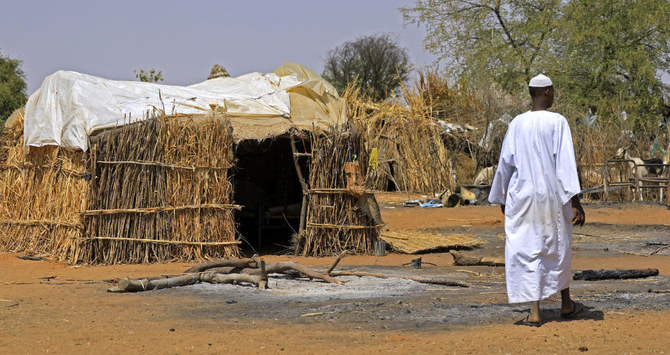
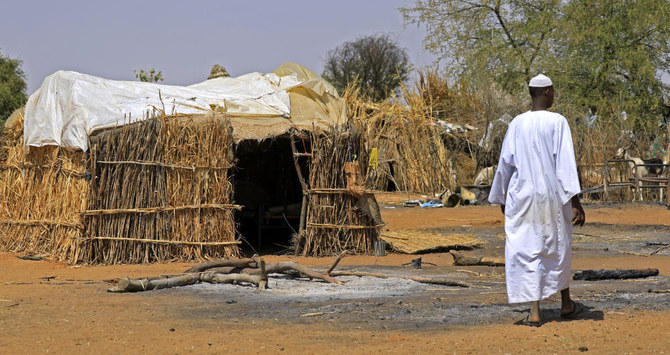
Intercommunal clashes in Sudan’s West Darfur state have left at least 132 people dead in recent days, its governor said on Thursday.
Members of the Massalit and Arab communities have fought since Saturday in and around the state capital El-Geneina, trading gun and heavy weapons fire.
Sudan’s government has declared a state of emergency in the region.
“According to medical reports, the number of dead is now 132,” Mohammed Abdallah Douma, the governor of the region bordering Chad, told a press conference in Khartoum.
“The situation is now relatively stable,” he said, adding that there was “looting” but “no more fighting.”
Douma blamed the fighting on militia fighters who had crossed over from neighboring Chad and Libya, and had used heavy weapons.
But the UN had said the conflict was between Sudan’s Massalit and the Arab communities, the latest in a string of clashes since January, which has forced over 100,000 people to flee their homes.
Sudan is in the midst of a rocky transition following the toppling of long-time president Omar Bashir in April 2019, following mass protests against his rule.
The transitional government has pushed to build peace with rebel groups in Sudan’s main conflict zones, including Darfur, where UN peacekeepers were recently withdrawn.
Thousands have fled the latest outbreak of violence, some escaping into Chad, according to the UN.
The clashes have seen a power station destroyed, an ambulance attacked and a rocket-propelled grenade hitting the key Sultan Tajeldin Hospital.
The vast Darfur region was previously ravaged by a civil war that erupted in 2003, leaving around 300,000 people dead and 2.5 million displaced, according to the UN.
It flared when ethnic minority rebels rose up against Bashir’s Arab-dominated government.
Khartoum responded by unleashing a notorious Arab-dominated militia known as the Janjaweed, recruited from among the region’s nomadic tribes.
The conflict has subsided over the years, and the latest in a string of peace deals was agreed in October.
But after years of conflict, the region is awash with automatic weapons and clashes still erupt, often over land and access to water.
Bashir is wanted by the International Criminal Court on charges of genocide during the Darfur conflict.

Death toll in Sudan- Darfur clashes rises to 132
Fledgling radio station aims to be ‘voice of the people’ in Gaza
- The electricity crisis is one of the most serious and difficult problems in the Gaza Strip, says Shereen Khalifa Broadcaster
DEIR EL-BALAH: From a small studio in the central city of Deir El-Balah, Sylvia Hassan’s voice echoes across the Gaza Strip, broadcast on one of the Palestinian territory’s first radio stations to hit the airwaves after two years of war.
Hassan, a radio host on fledgling station “Here Gaza,” delivers her broadcast from a well-lit room, as members of the technical team check levels and mix backing tracks on a sound deck. “This radio station was a dream we worked to achieve for many long months and sometimes without sleep,” Hassan said.
“It was a challenge for us, and a story of resilience.”
Hassan said the station would focus on social issues and the humanitarian situation in Gaza, which remains grave in the territory despite a US-brokered ceasefire between Israel and Hamas since October.
“The radio station’s goal is to be the voice of the people in the Gaza Strip and to express their problems and suffering, especially after the war,” said Shereen Khalifa, part of the broadcasting team.
“There are many issues that people need to voice.” Most of Gaza’s population of more than 2 million people were displaced at least once during the gruelling war.
Many still live in tents with little or no sanitation.
The war also decimated Gaza’s telecommunications and electricity infrastructure, compounding the challenges in reviving the territory’s local media landscape. “The electricity problem is one of the most serious and difficult problems in the Gaza Strip,” said Khalifa.
“We have solar power, but sometimes it doesn’t work well, so we have to rely on an external generator,” she added.
The station’s launch is funded by the EU and overseen by Filastiniyat, an organization that supports Palestinian women journalists, and the media center at the An-Najah National University in Nablus, in the occupied West Bank.
The station plans to broadcast for two hours per day from Gaza and for longer from Nablus. It is available on FM and online.
Khalifa said that stable internet access had been one of the biggest obstacles in setting up the station, but that it was now broadcasting uninterrupted audio.
The Gaza Strip, a tiny territory surrounded by Israel, Egypt, and the Mediterranean Sea, has been under Israeli blockade even before the attack on Oct. 7, 2023, which sparked the war. Despite the ceasefire, Israel continues to strictly control the entry of all goods and people to the territory.
“Under the siege, it is natural that modern equipment necessary for radio broadcasting cannot enter, so we have made the most of what is available,” she said.