

Plane carrying Pakistani delegation turned back as Kabul airport closed over security

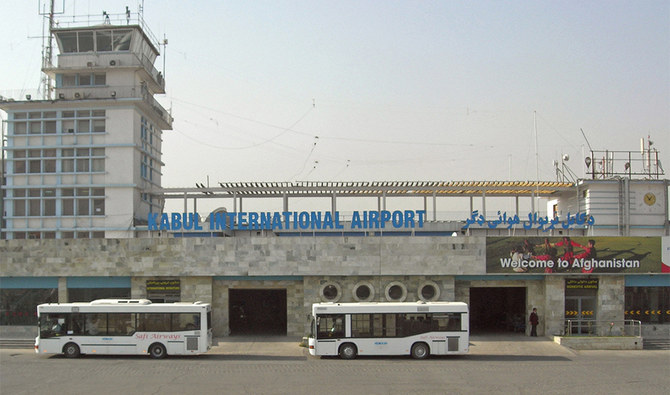
This photo taken on October 19, 2008, shows Hamid Karzai International Airport of Kabul, Afghanistan. (Photo courtesy: Flickr)
Short Url
Updated 08 April 2021
Follow

Plane carrying Pakistani delegation turned back as Kabul airport closed over security

  • Plane was near descent when it was asked to return, Pakistan’s special envoy to Kabul says
  • Pakistani national assembly speaker was leading 9-member delegation to Afghanistan for wide-ranging talks 

ISLAMABAD: The plane of a nine-member Pakistani parliamentary delegation returned from Afghanistan after it could not land at Kabul airport due to security reasons on Thursday.
Pakistani National Assembly speaker, Asad Qaiser, and his delegation left for Kabul from Islamabad on Thursday morning to hold wide-ranging discussions, including on Afghan peace and cross-border trade.
“Speaker’s visit to Kabul postponed as airport was closed due to security threat. The plane was about to descent when the control tower informed of the closure of airport,” Mohammad Sadiq, Pakistan’s Special Representative for Afghanistan, said in a tweet.

The Pakistani delegation was traveling on the invitation of Chairman Wolsi Jirga Afghanistan, Mir Rehman Rahmani.
During the visit, Qaiser was scheduled to meet his Afghan counterpart, as well as the chairman of the Afghan High Council for National Reconciliation, Dr. Abudullah Abdullah, the Afghan commerce minister, the chairman of the Afghanistan chamber of federation of commerce and industry and Afghan lawmakers.
New dates for the visit have not yet been announced.


At ECO meeting, Pakistan proposes ‘Regional Innovation Hub’ to curb natural disasters

Updated 21 January 2026
Follow

At ECO meeting, Pakistan proposes ‘Regional Innovation Hub’ to curb natural disasters

  • Pakistan hosts high-level 10th ECO Ministerial Meeting on Disaster Risk Reduction in Islamabad
  • Innovation hub to focus on early warning technologies, risk informed infrastructure planning

ISLAMABAD: Pakistan has proposed to set up a “Regional Innovation Hub on Disaster Risk Reduction” that focuses on early warning technologies and risk informed infrastructure planning, the Press Information Department (PID) said on Wednesday, as Islamabad hosts a high-level meeting of the Economic Cooperation Organization (ECO).

The ECO’s 10th Ministerial Meeting on Disaster Risk Reduction (DRR) is being held from Jan. 21-22 at the headquarters of the National Disaster Management Authority (NDMA) in Pakistan’s capital. 

The high-level regional forum brings together ministers, and senior officials from ECO member states, representatives of the ECO Secretariat and regional and international partner organizations. The event is aimed to strengthen collective efforts toward enhancing disaster resilience across the ECO region, the PID said. 

“Key agenda items include regional cooperation on early warning systems, disaster risk information management, landslide hazard zoning, inclusive disaster preparedness initiatives, and Pakistan’s proposal to establish a Regional Innovation Hub on Disaster Risk Reduction, focusing on early warning technologies, satellite data utilization, and risk-informed infrastructure planning,” the statement said. 

The meeting was attended by delegations from ECO member states including Pakistan, Türkiye, Azerbaijan, Iran, Kyrgyzstan, Tajikistan, Turkmenistan and Uzbekistan. Representatives of regional and international organizations and development partners were also in attendance.

Discussions focused on enhancing regional coordination, harmonizing disaster risk reduction frameworks, and strengthening collective preparedness against transboundary and climate-induced hazards impacting the ECO region, the PID said. 

ECO members states such as Pakistan, Türkiye, Afghanistan and others have faced natural calamities such as floods and earthquakes in recent years that have killed tens of thousands of people. 

Heavy rains triggered catastrophic floods in Pakistan in 2022 and 2025 that killed thousands of people and caused damages to critical infrastructure, inflicting losses worth billions of dollars. 

Islamabad has since then called on regional countries to join hands to cooperate to avert future climate disasters and promote early warning systems to avoid calamities in future.