

Turkey sells gold amid currency crisis

The Turkish lira was on the retreat again this week as annual inflation in the country neared two year highs. (File/Shutterstock)
Short Url
Updated 07 April 2021
Follow

Turkey sells gold amid currency crisis

  • Turkey bucked the upward trend as it sold 11.7 tons according to a report from the World Gold Council

DUBAI: Turkey sold almost 11.7 million tons of gold in February as its currency was hammered by an ongoing economic crisis, new data show.
While central banks were net buyers of the precious metal during February, Turkey bucked the upward trend as it sold 11.7 tons according to a report from the World Gold Council.
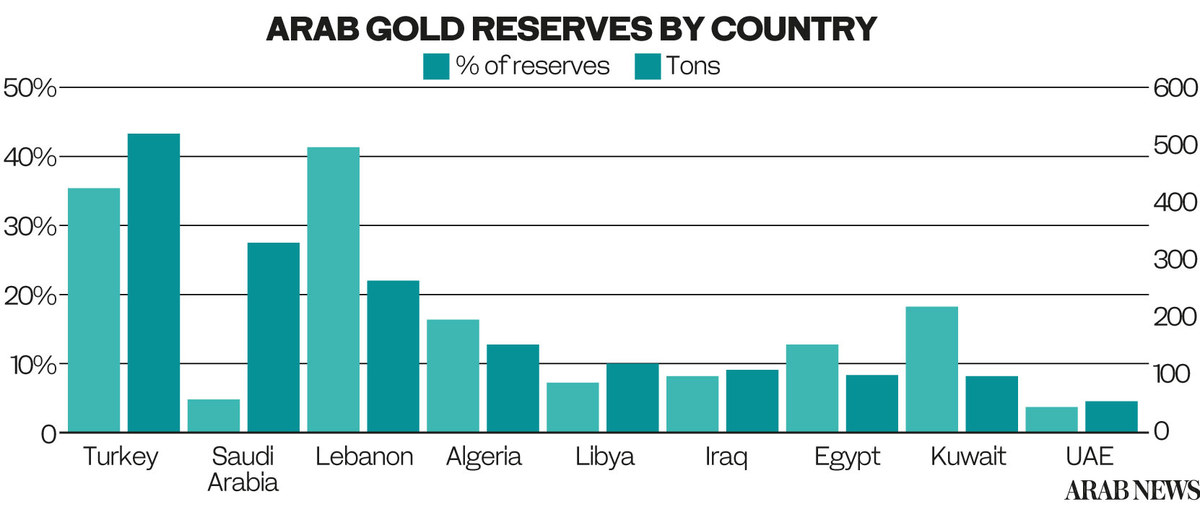

“Central banks tipped back into net purchases during February,” said Krishan Gopaul, market intelligence manager at the World Gold Council. “Buying from India, Uzbekistan, Kazakhstan and Colombia outweighed the only notable sale of gold by Turkey. Our expectation remains that central banks will be net purchasers in 2021, but the immediate outlook for central bank demand remains finely balanced.”
The Turkish lira was on the retreat again this week as annual inflation in the country neared two year highs.
Data on Monday showed annual inflation in March rose above 16 percent — some way off the central bank’s 5 percent target.
President Tayyip Erdogan has fired four bank chiefs in less than two years, hurting investor confidence.


Saudi tourism employment surpasses 1m as hospitality sector expands 

Updated 08 January 2026
Follow

Saudi tourism employment surpasses 1m as hospitality sector expands 

RIYADH: Saudi Arabia’s tourism workforce surpassed 1 million in the third quarter of 2025, underscoring the sector’s rapid expansion as the Kingdom continues to develop its hospitality infrastructure and visitor economy. 

According to the latest Tourism Establishments Statistics report released by the General Authority for Statistics, the total number of employees in tourism activities reached approximately 1,009,691 in the third quarter of 2025, marking a 6.4 percent increase compared to the same period in 2024, when employment stood at 948,629. 

The growth in employment comes alongside a significant rise in the number of licensed tourism hospitality facilities, which increased by 40.6 percent year on year to reach 5,622 in the third quarter. Of these, serviced apartments and other hospitality facilities accounted for 52.6 percent, while hotels represented 47.4 percent. 

The robust growth reflected in the latest tourism statistics aligns directly with the goals of Vision 2030, as the Kingdom aims to double tourism’s gross domestic product contribution to 10 percent. The sector is also seeking to create 1.6 million jobs, and attract 150 million visitors annually by 2030.

The report showed that non-Saudi employees made up the majority of the tourism workforce, numbering 764,520 and accounting for 75.7 percent of the total. Saudi nationals employed in the sector reached 245,171, representing 24.3 percent of all tourism workers. 

In terms of gender distribution, male employees dominated the sector with 875,658 workers, while female employees totaled 134,033, making up just 13.3 percent of the workforce. 

Hotel performance showed positive momentum, with the average room occupancy rate rising to 49.1 percent during the quarter, an increase of 2.9 percentage points from 46.1 percent in the same period a year earlier. 

In contrast, serviced apartments and other hospitality facilities experienced a slight dip in occupancy, recording 57.4 percent compared to 58 percent in the same quarter of 2024. 

The average daily room rate in hotels decreased by 3.6 percent to SR341 ($90.9), down from SR354 in the third quarter of 2024. Meanwhile, serviced apartments and similar facilities saw their average daily rate rise by 4.1 percent to SR208, up from SR200 a year earlier. 

The average length of stay in hotels was 4.1 nights, down 1 percent from 4.2 nights in the third quarter of 2024. For serviced apartments and other hospitality facilities, the average stay was 2.1 nights, reflecting a marginal decrease of 0.2 percent year-on-year. 

The statistics draw on administrative records, surveys and secondary data to capture activity across the Kingdom’s tourism sector, GASTAT said.