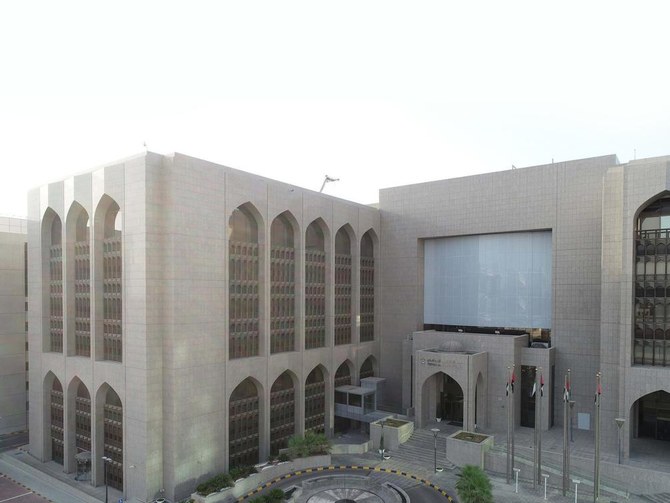
UAE replaces central bank governor after one year in role

The UAE’s monetary policy is closely linked to that of the US Federal Reserve due to a long-standing dirham currency peg to the dollar. (WAM)
Short Url
Updated 07 April 2021
Follow

UAE replaces central bank governor after one year in role

  • Tameemi, who was appointed central bank vice governor in February, will be replacing Abdulhamid Saeed

DUBAI: UAE President Sheikh Khalifa bin Zayed has appointed Khalid Al-Tameemi as governor of the UAE’s central bank, state news agency WAM said, citing a decree issued on Wednesday.
Tameemi, who was appointed central bank vice governor in February, will be replacing Abdulhamid Saeed.
Saeed, who was appointed governor a year ago, has decided to retire, WAM said.
WAM said Sheikh Mansour bin Zayed, deputy prime minister, praised Saeed’s efforts in “exceptional circumstances” during the COVID-19 pandemic, saying he had worked to ensure the monetary and financial system was not affected by the crisis.
The UAE’s monetary policy is closely linked to that of the US Federal Reserve due to a long-standing dirham currency peg to the dollar.
Tameemi has spent more than three decades serving in roles at government or government-linked entities, including as a board member of the central bank, General Pension and Social Security Authority and Emirates Integrate Telecommunications Company. He was also executive director of the Real Assets Department at Abu Dhabi Investment Council, WAM has said.


Saudi stock market opens its doors to foreign investors

Updated 06 January 2026
Follow

Saudi stock market opens its doors to foreign investors

RIYADH: Foreigners will be able to invest directly in Saudi Arabia’s stock market from Feb. 1, the Kingdom’s Capital Market Authority has announced.

The CMA’s board has approved a regulatory change which will mean the capital market, across all its segments, will be accessible to investors from around the world for direct participation.

According to a statement, the approved amendments aim to expand and diversify the base of those permitted to invest in the Main Market, thereby supporting investment inflows and enhancing market liquidity.

International investors' ownership in the capital market exceeded SR590 billion ($157.32 billion) by the end of the third quarter of 2025, while international investments in the main market reached approximately SR519 billion during the same period — an annual rise of 4 percent.

“The approved amendments eliminated the concept of the Qualified Foreign Investor in the Main Market, thereby allowing all categories of foreign investors to access the market without the need to meet qualification requirements,” said the CMA, adding: “It also eliminated the regulatory framework governing swap agreements, which were used as an option to enable non-resident foreign investors to obtain economic benefits only from listed securities, and the allowance of direct investment in shares listed on the Main Market.”

In July, the CMA approved measures to simplify the procedures for opening and operating investment accounts for certain categories of investors. These included natural foreign investors residing in one of the Gulf Cooperation Council countries, as well as those who had previously resided in the Kingdom or in any GCC country. 

This step represented an interim phase leading up to the decision announced today, with the aim of increasing confidence among participants in the Main Market and supporting the local economy.

Saudi Arabia, which ‌is more than halfway ‍through an economic plan ‍to reduce its dependence on oil, ‍has been trying to attract foreign investors, including by establishing exchange-traded funds with Asian partners in Japan and Hong Kong.