

Admiral crackdown ‘could signal the end of Erdogan’s Eurasianist shift’: Experts

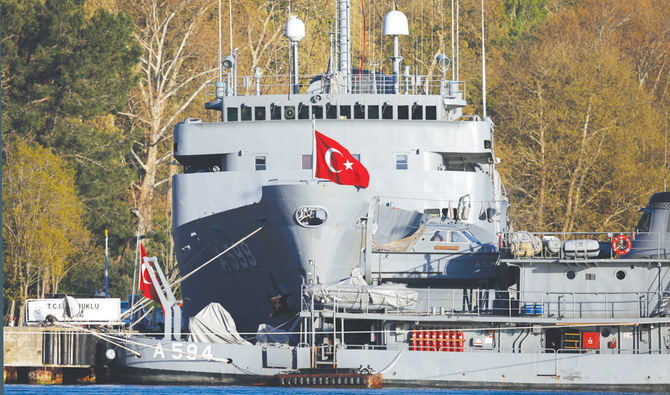
Turkish Navy vessels, in this 2017 file photo, are docked at a port base in the Bosporus strait, on the outskirts of Istanbul, close to the Black Sea. (AP)
Short Url
Updated 07 April 2021
Follow

Admiral crackdown ‘could signal the end of Erdogan’s Eurasianist shift’: Experts

  • The predominant ideology of the Eurasianists, who originated in the Turkish far-left, is based on an anti-Western foreign policy coupled with ultra-nationalism in the domestic sphere
  • Anti-Western policy of Turkish regime ‘may soon come to an end’

ANKARA: Turkey’s latest arrest wave targeting former admirals who signed a critical night-time declaration has stirred debate over whether the crackdown is a result of the country’s “Eurasianist shift.”

On Monday, Turkish President Recep Tayyip Erdogan accused 104 former navy commanders of trying to stage a “political coup” through an open letter that criticized the government’s new 45 kilometer-long artificial waterway, dubbed Kanal Istanbul, and its immediate impact on the 1936 Montreux Convention that regulates the traffic of warships in the Istanbul strait.

Among the signatories, the most notable name was Cem Gurdeniz, the mastermind of Turkey’s controversial maximalist maritime doctrine, known as Blue Homeland.

Gurdeniz, who has been held in police custody since Monday, is a well-known member of the prominent Eurasianist faction within the Turkish military. The group advocates an anti-Western strategy, and stronger relations with Russia and China.

Dr. Berk Esen, a political scientist from Sabanci University in Istanbul, said that the admirals’ statement came at a critical juncture when the Erdogan administration is recalibrating its position in the international arena.

“Over the last few years, the Turkish government has sought closer ties with authoritarian regimes like Russia and Qatar to draw support for its revisionist steps in the wider region,” he told Arab News.

In response to Western criticism against undemocratic Turkish politics, Esen said that some Turkish government officials have gathered support from retired officers and analysts belonging to the Eurasianist faction.

For several years, the Eurasianist movement has pushed Turkey’s leadership toward a rapprochement with Russia and China. It has been rumored that the faction has acquired significant clout in the government, letting it shape the direction of Turkey’s foreign and security policies.

The predominant ideology of the Eurasianists, who originated in the Turkish far-left, is based on an anti-Western foreign policy coupled with ultra-nationalism in the domestic sphere.

They advocate for leaving NATO and abandoning the EU candidacy process in favor of membership of the Shanghai Cooperation Organization.

According to Esen, the anti-Western policy of the Turkish government may soon come to an end, judging from reports of an agreement between Turkey and the EU.

“To strengthen this trend, Erdogan is seeking to curry favors from the Biden administration by supporting the recent US offensive against Russia. The admirals’ statement came against the backdrop of this shifting geopolitical situation,” he said.

The latest Russian troop movements in zones bordering eastern Ukraine have enraged the Biden administration, leading the US State Department to demand that Moscow explain the reported “provocations.”

However, Russia sees the the proposed Kanal Istanbul project as a threat because it would provide NATO members with free access to the Black Sea and Crimean peninsula, including the strategic port of Sevastopol, which Moscow annexed in 2014.

Therefore, the group of admirals fear that the new canal could anger Russia, as Turkey might break from the Montreux Convention that governs the transit of naval vessels during times of peace and war.

The length of stay and tonnage of warships from non-Black Sea naval forces are restricted by the convention. They cannot stay in the region for more than 21 days, while there is a maximum vessel weight limit of 45,000 tons.

However, in a televised speech on Monday, Erdogan said that the government is not considering a withdrawal from the convention, adding: “But if the need emerges in the future, we could revise every convention to help our country get better.”

According to Esen, although not all the signatories to the letter subscribe to the Blue Homeland doctrine, the admirals are likely worried that Erdogan will use the Montreux Convention as a bargaining chip with the US, which has for decades tried to undermine the agreement in order to gain access to the Black Sea.

“After seeking a tacit alliance with the Eurasianists for the last couple of years, Erdogan may have gotten a convenient excuse to eliminate the retired officers affiliated with the Blue Homeland doctrine as he considers strengthening ties with the US,” Berk said.

Meanwhile, the Chinese embassy in Ankara condemned the capital’s mayor Mansur Yavas and Good Party leader Meral Aksener for penning messages commemorating the massacre of Uighurs by the Chinese military in 1990.

“China reserves the right to proportionately respond,” the embassy tweeted, adding: “The Xinjiang Uighur Autonomous Region is an integral part of Chinese territory. This is an internationally accepted and indisputable fact.”

Turkey’s opposition has long criticized the government for remaining silent on China’s oppression of Uighur Muslims.


Syrian army pushes into Aleppo district after Kurdish groups reject withdrawal

Updated 10 January 2026
Follow

Syrian army pushes into Aleppo district after Kurdish groups reject withdrawal

  • Two Syrian security officials told Reuters the ceasefire efforts had failed and that the army would seize the neighborhood by force

ALEPPO, Syria: The Syrian army said it would push into the last Kurdish-held district of Aleppo ​city on Friday after Kurdish groups there rejected a government demand for their fighters to withdraw under a ceasefire deal.
The violence in Aleppo has brought into focus one of the main faultlines in Syria as the country tries to rebuild after a devastating war, with Kurdish forces resisting efforts by President Ahmed Al-Sharaa’s Islamist-led government to bring their fighters under centralized authority.
At least nine civilians have been killed and more than 140,000 have fled their homes in Aleppo, where Kurdish forces are trying to cling on to several neighborhoods they have run since the early days of the war, which began in 2011.

HIGHLIGHTS

• Standoff pits government against Kurdish forces

• Sharaa says Kurds are ‘fundamental’ part of Syria

• More than 140,000 have fled homes due to unrest

• Turkish, Syrian foreign ministers discuss Aleppo by phone

ِA ceasefire was announced by the defense ministry overnight, demanding the withdrawal of Kurdish forces to the Kurdish-held northeast. That would effectively end Kurdish control over the pockets of Aleppo that Kurdish forces have held.

CEASEFIRE ‘FAILED,’ SECURITY OFFICIALS SAY
But in a statement, Kurdish councils that run Aleppo’s Sheikh Maksoud and Ashrafiyah districts ‌said calls to leave ‌were “a call to surrender” and that Kurdish forces would instead “defend their neighborhoods,” accusing government forces ‌of intensive ⁠shelling.
Hours ​later, the ‌Syrian army said that the deadline for Kurdish fighters to withdraw had expired, and that it would begin a military operation to clear the last Kurdish-held neighborhood of Sheikh Maksoud.
Two Syrian security officials told Reuters the ceasefire efforts had failed and that the army would seize the neighborhood by force.
The Syrian defense ministry had earlier carried out strikes on parts of Sheikh Maksoud that it said were being used by the Kurdish-led Syrian Democratic Forces (SDF) to launch attacks on the “people of Aleppo.” It said on Friday that SDF strikes had killed three army soldiers.
Kurdish security forces in Aleppo said some of the strikes hit a hospital, calling it a war crime. The defense ministry disputed that, saying the structure was a large arms depot and that it had been destroyed in the resumption of strikes on Friday.
It ⁠posted an aerial video that it said showed the location after the strikes, and said secondary explosions were visible, proving it was a weapons cache.
Reuters could not immediately verify the claim.
The SDF is ‌a powerful Kurdish-led security force that controls northeastern Syria. It says it withdrew its fighters from ‍Aleppo last year, leaving Kurdish neighborhoods in the hands of the Kurdish ‍Asayish police.
Under an agreement with Damascus last March the SDF was due to integrate with the defense ministry by the end of 2025, ‍but there has been little progress.

FRANCE, US SEEK DE-ESCALATION
France’s foreign ministry said it was working with the United States to de-escalate.
A ministry statement said President Emmanuel Macron had urged Sharaa on Thursday “to exercise restraint and reiterated France’s commitment to a united Syria where all segments of Syrian society are represented and protected.”
A Western diplomat told Reuters that mediation efforts were focused on calming the situation and producing a deal that would see Kurdish forces leave Aleppo and provide security guarantees for Kurds who remained.
The diplomat ​said US envoy Tom Barrack was en route to Damascus. A spokesperson for Barrack declined to comment. Washington has been closely involved in efforts to promote integration between the SDF — which has long enjoyed US military support — and Damascus, with which the ⁠United States has developed close ties under President Donald Trump.
The ceasefire declared by the government overnight said Kurdish forces should withdraw by 9 a.m. (0600 GMT) on Friday, but no one withdrew overnight, Syrian security sources said.
Barrack had welcomed what he called a “temporary ceasefire” and said Washington was working intensively to extend it beyond the 9 a.m. deadline. “We are hopeful this weekend will bring a more enduring calm and deeper dialogue,” he wrote on X.

TURKISH WARNING
Turkiye views the SDF as a terrorist organization linked to the outlawed Kurdistan Workers’ Party and has warned of military action if it does not honor the integration agreement.
Turkish Foreign Minister Hakan Fidan, speaking on Thursday, expressed hope that the situation in Aleppo would be normalized “through the withdrawal of SDF elements.”
Though Sharaa, a former Al-Qaeda commander who belongs to the Sunni Muslim majority, has repeatedly vowed to protect minorities, bouts of violence in which government-aligned fighters have killed hundreds of Alawites and Druze have spread alarm in minority communities over the last year.
The Kurdish councils in Aleppo said Damascus could not be trusted “with our security and our neighborhoods,” and that attacks on the areas aimed to bring about displacement.
Sharaa, in a phone call with Iraqi Kurdish leader Masoud Barzani on Friday, affirmed that the Kurds were “a fundamental part ‌of the Syrian national fabric,” the Syrian presidency said.
Neither the government nor the Kurdish forces have announced a toll of casualties among their fighters from the recent clashes.