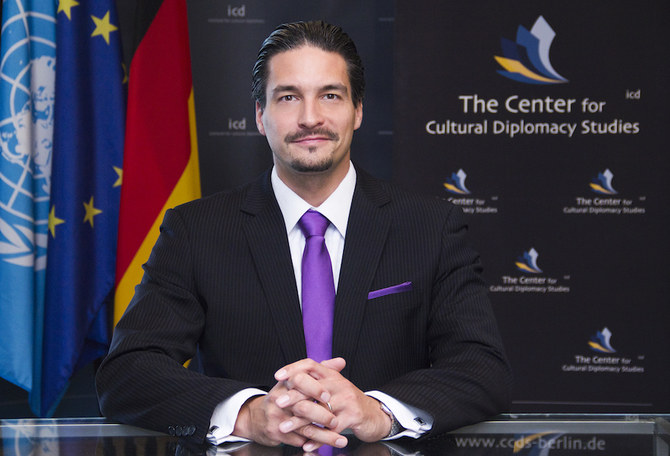


LONDON: During a childhood trip to Israel and Palestine, Mark Donfried witnessed, for the first-time, serious violence between peoples who share their roots within one culture.
From that moment on, he decided to commit his personal and professional life to building cultural bridges with the goal of preventing further conflicts – and in 1999 he founded the Institute for Cultural Diplomacy (ICD) in New York, before moving it to Berlin.
“At the time when the ICD was founded, cultural diplomacy had fallen by the wayside and had been thrown away by most governments who did not see the benefit of using it,” Donfried told Arab News.
Over the past two decades the ICD has grown to become one of Europe’s leading cultural exchange organizations, with programs extending to every continent of the world.
Read the full report co-published with the Academy of Cultural Diplomacy on Arab News Research & Studies here
In that time, the organization has dedicated its time to running research projects and hosting forums around the world to promote the strategies of cultural diplomacy among the current and next generation of global leaders.
“With the emergence of digital revolutions and rapidly evolving social network platforms, the simple private citizens were able to now immediately publicly critique any politician, government, or corporation,” Donfried said.
“Suddenly governments and corporations started to look for new tools to build better relations with their citizens and their consumers.”
It was no wonder that, parallel to the evolution of the social media, “corporate social responsibility” departments have emerged in almost all major global companies, he said.
In 2011, Donfried decided that cultural diplomacy needed to break into mainstream academia – and so the Academy for Cultural Diplomacy was established offering first ever master programs in cultural diplomacy resulting in training thousands of students from around the world including ambassadors, members of parliament, CEOs and academics.
Read the full report co-published with the Academy of Cultural Diplomacy on Arab News Research & Studies here
The academy, quickly expanded to a major campus in Berlin in 2014, and then in 2020 opened its second campus in a castle, Schloss Bornheim, outside of the former capital of Germany, Bonn.
“Cultural diplomacy can ease and slow the deterioration of human and international relations and can serve as a kind of ‘vaccine’ to help protect individuals, nations and companies from attacks or conflicts,” he said.
“Cultural diplomacy cannot directly save lives; however, indirectly it has proven over the last decades that it does have the power to transcend international borders, tear down walls and change the way the hearts and minds of entire groups and nations think and act.”