

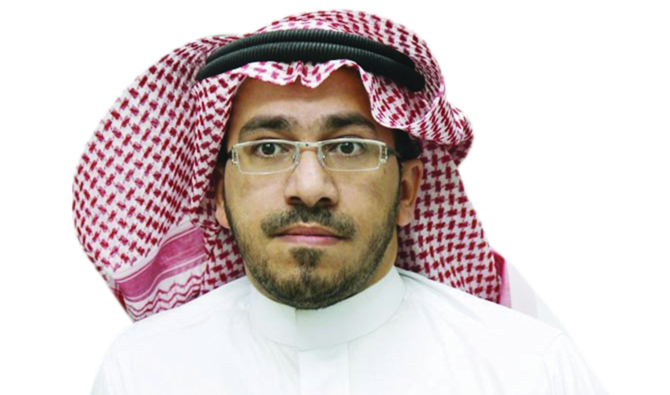
Who’s Who: Dr. Abdullah bin Saleh Al-Washmi, acting secretary-general of the King Salman International Complex for the Arabic Language

Dr. Abdullah bin Saleh Al-Washmi
Short Url
Updated 05 April 2021
Follow

Who’s Who: Dr. Abdullah bin Saleh Al-Washmi, acting secretary-general of the King Salman International Complex for the Arabic Language

Dr. Abdullah bin Saleh Al-Washmi has been acting secretary-general of the King Salman International Complex for the Arabic Language since February.

The complex is part of the Kingdom’s wide-ranging program to promote the Arabic language. It promotes activities including publications, research, AI applications, events and conferences, and the establishment of Arabic teaching centers.

It also supports the use of modern linguistic applications and promotes the Kingdom’s interest in serving the language of the Holy Qur’an.

Al-Washmi holds a master’s degree in literary criticism and a Ph.D. in rhetoric and literary criticism from the faculty of Arabic language at Imam Muhammad bin Saud Islamic University in Riyadh.

He is an author and an award-winning poet. Some of his poems have been translated into different languages. He won first place in the Prince Faisal Award for Arabic Poetry in 2001 and has published several academic papers, books and books of verses.

He has been a professor of Arabic at the Riyadh-based College of Arabic Language since 2020. Al-Washmi also served as secretary-general of the King Abdullah bin Abdul Aziz International Center for the Arabic Language (KAICA) for seven years beginning in 2012. He was also a member of the consultative committee of KAICA.

Al-Washmi has represented Saudi Arabia in several conferences and forums. He was awarded an honorary doctorate degree from an Indonesian state university for his efforts in teaching and language planning. He has also received dozens of appreciation letters for his services to the Arabic language and its literature.


Princess Reema’s Wave unveils ocean regeneration platform

Updated 6 sec ago
Follow

Princess Reema’s Wave unveils ocean regeneration platform

  • Upgraded platform provides deeper, more comprehensive data on the state of the world’s oceans and the impact of human activity
  • Features an enhanced user experience, including an integrated tool powered by artificial intelligence

JEDDAH: Wave, powered by the Future Investment Initiative Institute and founded by Princess Reema Bandar Al-Saud, has unveiled version 2.0 of its Ocean Central data platform, oceancentral.org.

The upgraded platform provides deeper, more comprehensive data on the state of the world’s oceans and the impact of human activity.

It features an enhanced user experience, including an integrated tool powered by artificial intelligence, to guide users through queries and analysis. A new ocean news section also offers English-language summaries of the latest ocean-related developments and reports from around the world.

“The evolution of Ocean Central moves us a step closer to our collective goal of ‘Ocean Regeneration within a Human Generation’,” said Princess Reema.

“The future of our oceans depends on advances in accurate data, allocating resources more strategically and making informed decisions that protect marine environments, and Ocean Central plays an important role in enabling us to focus efforts.”

The enhanced platform will be on show at the 13th annual World Ocean Summit, organized by Economist Impact, which takes place in Montreal from March 4-5. The event brings together international government ministers, policymakers, investors and business leaders from sectors including shipping, energy and tourism.

The platform integrates global targets from the UN Sustainable Development Goals, the Kunming-Montreal Global Biodiversity Framework and the Paris Agreement. It monitors progress towards these goals, highlights successful initiatives and identifies critical knowledge gaps.

Wave is a collective action platform dedicated to restoring a thriving ocean by 2050. Powered by the Future Investment Initiative Institute, it delivers targeted interventions across four pillars — engagement, insights, sectoral activation and innovation — to advance ocean regeneration.