PARIS: In the COVID-19 intensive care unit of the Antony Private Hospital south of Paris, no bed stays free for long and medics wonder when their workload will finally peak.
As one recovered elderly patient is being wheeled out of the ward, smiling weakly, boss Jean-Pierre Deyme is on the phone arranging the next arrival and calling out instructions to staff.
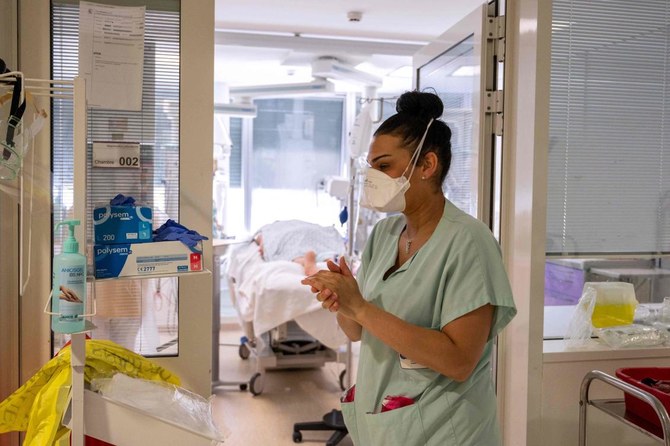
Louisa Pinto, a nurse of nearly 20 years’ experience, gestures to the vacated room where a cleaner is already at work, scrubbing down the mattress for the next arrival.
“The bed won’t even have time to cool down,” she says as the patient monitoring system beeps constantly in the background.
For now, everything is stable in the 20-odd beds around her where COVID-19 victims lie inanimate, in a silent battle with the virus.
Paris is going through a third wave of the pandemic which risks putting even more strain on saturated hospitals than the first wave in March and April last year.
“With what’s coming in April, it’s going to be very complicated,” says Pinto, a mother of three who hasn’t had a holiday since last summer and like other staff will be canceling a planned break this month.
Even with a new round of restrictions coming into force this week, Health Minister Olivier Veran predicts that infections in France will peak only in mid-April, while hospital admissions will continue climbing until the end of the month.
Alarming forecasts leaked to the French media from the Paris public hospital authority AP-HP last week showed anywhere from 2,800-4,400 people in intensive care in the Paris region by the end of April even with a strict lockdown.
In the first wave, the number peaked at 2,700.
The director of the Antony hospital, Denis Chandesris, says intensive care capacity has already been increased by drastically reducing all surgery except for critical cancer, cardiological and emergency cases.
Hospitals everywhere in the region have taken similar measures, re-deploying beds and creating new wards, but they are reaching their limits.
“The difficulty is not so much beds or material, it’s a question of finding medical and paramedical staff to be able to take in patients,” Chandesris explained.
Last Sunday, a group of emergency care directors in Paris warned in an open letter that the situation was so bad that medics would soon have to start “triage” – selecting patients for care based on their chances of survival.
This prospect horrifies staff – and President Emmanuel Macron has always promised to shield hospitals and avoid the sort of scenes witnessed in Italy last March when patients piled up in corridors.
In a televised speech to the nation on Wednesday night, he promised to increase intensive care capacity nation-wide from 7,665 beds currently to 10,000 – a jump of 30 percent.
“I want to thank medical students, retired people, the army health service and medical reserve volunteers. All of them will be mobilized in a larger way,” he announced.
Opposition politicians and some experts reacted with skepticism while an Ifop poll for the Journal du Dimanche weekly found only 35 percent of French people had confidence in their government “to deal effectively with the coronavirus.”
Pinto, the nurse, underlined how working in intensive care is “very technical,” requiring specialized training and knowledge.
Macron is banking on a limited lockdown over the next month turning the rising tide of cases which have roughly doubled to 40,000 a day compared with their level a month ago.
The sharp acceleration is down to the spread of the more contagious so-called British variant which has become dominant in France.
New measures include nation-wide travel restrictions, which limit people to 10 kilometers (six miles) from their homes, and the closure of schools and non-essential shops.
Only a significant increase in the vaccination campaign – which started sluggishly but is now picking up pace – fills any of the medics at Antony Private Hospital with any hope.
After months of lacking doses, the government is promising a major rollout this month and an increase in the rate of jabbing.
Samir Taik, a taxi driver from Paris, walked out of the Antony hospital last week as the 1,000th COVID-19 patient to have benefited from oxygen therapy in the COVID-19 intensive care unit.
The 43-year-old, who enjoys boxing and sport, is still short of breath and reeling from the trauma of seeing his health deteriorate so fast.
He says he knows three or four people with a similar profile to him who have been hospitalized recently.
“Young people need to know that we’re not talking about 80-year-olds, it’s people who are 30, 40, 45-year-olds and have no health problems. The British variant is not like the old one,” he said.

Paris medics fear worst of COVID-19 wave still to come
Short Url
https://arab.news/v9seb
Paris medics fear worst of COVID-19 wave still to come
- Paris is going through a third wave of the pandemic which risks putting even more strain on saturated hospitals
- The sharp acceleration is down to the spread of the more contagious so-called British variant
More than 200 political prisoners in Venezuela launch hunger strike
GUATIRE: More than 200 Venezuelan political prisoners were on hunger strike Sunday to demand their release under a new amnesty law that excludes many of them.
The inmates at the Rodeo I prison, about 40 kilometers (25 miles) east of capital Caracas, shouted to their loved ones as part of the protest, an AFP journalist witnessed.
“Freedom!,” “release us all!” and “Rodeo I on strike” were among the cries from the prisoners that were audible from outside the facility.
The amnesty law was approved by Venezuela’s congress on Thursday as part of a wave of reforms encouraged by the United States after it ousted and captured former president Nicolas Maduro on January 3.
The hunger strike, which began Friday night, came about after inmates complained they would not benefit from the law because it excludes cases involving the military, which are the most common ones at that facility.
“Approximately 214 people in total, including Venezuelans and foreigners, are on hunger strike,” said Yalitza Garcia, mother-in-law of a prisoner named Nahuel Agustin Gallo.
Gallo, an Argentine police officer, is accused of terrorism, another category that is excluded.
“They decided Friday to go on hunger strike because of the scope of the amnesty law, which excludes many of them,” said Shakira Ibarreto, the daughter of a policeman arrested in 2024.
On Sunday, a team from the International Committee of the Red Cross (ICRC) visited the Rodeo I prison.
“This is the first time they have allowed us to approach that prison,” Filippo Gatti, the ICRC’s health coordinator for Venezuela, told family members. “It’s a first step, and I think we’re on the right track.”
Not all the inmates at the prison were joining the hunger strike, the relatives said.
- Amnesty law criticized -
The amnesty law was engineered by interim leader Delcy Rodriguez under pressure from Washington after US commandos attacked Venezuela on January 3, snatched Maduro and his wife and took them to the United States for trial on drug trafficking charges.
Opposition figures have criticized the new legislation, which appears to include carve-outs for some offenses previously used by authorities to target Maduro’s political opponents.
The law also excludes members of the security forces convicted of activities related to what the government considered terrorism.
But the amnesty extends to 11,000 political prisoners who, over nearly three decades, were paroled or placed under house arrest.
More than 1,500 political prisoners in Venezuela have already applied for amnesty under the bill, the head of the country’s legislature said Saturday.
Hundreds of others had already been released by Rodriguez’s government before the amnesty bill was approved.
On Sunday, a handful of inmates were released from Rodeo I, carrying release papers in their hands. They were greeted with applause.
“I’m out, I love you so much, my queen! I’m doing well,” Robin Colina, one of the freed prisoners, said excitedly into a mobile phone.
Armando Fusil, another released prisoner, told AFP: “Right now there are quite a few people on hunger strike because they want to get out.”
The 55-year-old police commissioner from the western state of Maracaibo said he was “arrested for no reason” in October 2024.
He said loved ones came to visit him every Friday since his arrest, taking a nearly 40-hour trip just for a little bit of face time each week.
Now, they’re coming to pick him up for good.
“We all help each other,” Fusil said about his fellow detainees. “It’s created a beautiful brotherhood.”
The NGO Foro Penal, dedicated to the defense of political prisoners, reported 23 releases on Sunday.
Maduro ruled Venezuela between March 2013 and January 2026, silencing opposition and activists under his harsh leftist rule.
Maduro and his wife are in US custody awaiting trial. Maduro, 63, has pleaded not guilty to drug trafficking charges and declared that he is a prisoner of war.
The inmates at the Rodeo I prison, about 40 kilometers (25 miles) east of capital Caracas, shouted to their loved ones as part of the protest, an AFP journalist witnessed.
“Freedom!,” “release us all!” and “Rodeo I on strike” were among the cries from the prisoners that were audible from outside the facility.
The amnesty law was approved by Venezuela’s congress on Thursday as part of a wave of reforms encouraged by the United States after it ousted and captured former president Nicolas Maduro on January 3.
The hunger strike, which began Friday night, came about after inmates complained they would not benefit from the law because it excludes cases involving the military, which are the most common ones at that facility.
“Approximately 214 people in total, including Venezuelans and foreigners, are on hunger strike,” said Yalitza Garcia, mother-in-law of a prisoner named Nahuel Agustin Gallo.
Gallo, an Argentine police officer, is accused of terrorism, another category that is excluded.
“They decided Friday to go on hunger strike because of the scope of the amnesty law, which excludes many of them,” said Shakira Ibarreto, the daughter of a policeman arrested in 2024.
On Sunday, a team from the International Committee of the Red Cross (ICRC) visited the Rodeo I prison.
“This is the first time they have allowed us to approach that prison,” Filippo Gatti, the ICRC’s health coordinator for Venezuela, told family members. “It’s a first step, and I think we’re on the right track.”
Not all the inmates at the prison were joining the hunger strike, the relatives said.
- Amnesty law criticized -
The amnesty law was engineered by interim leader Delcy Rodriguez under pressure from Washington after US commandos attacked Venezuela on January 3, snatched Maduro and his wife and took them to the United States for trial on drug trafficking charges.
Opposition figures have criticized the new legislation, which appears to include carve-outs for some offenses previously used by authorities to target Maduro’s political opponents.
The law also excludes members of the security forces convicted of activities related to what the government considered terrorism.
But the amnesty extends to 11,000 political prisoners who, over nearly three decades, were paroled or placed under house arrest.
More than 1,500 political prisoners in Venezuela have already applied for amnesty under the bill, the head of the country’s legislature said Saturday.
Hundreds of others had already been released by Rodriguez’s government before the amnesty bill was approved.
On Sunday, a handful of inmates were released from Rodeo I, carrying release papers in their hands. They were greeted with applause.
“I’m out, I love you so much, my queen! I’m doing well,” Robin Colina, one of the freed prisoners, said excitedly into a mobile phone.
Armando Fusil, another released prisoner, told AFP: “Right now there are quite a few people on hunger strike because they want to get out.”
The 55-year-old police commissioner from the western state of Maracaibo said he was “arrested for no reason” in October 2024.
He said loved ones came to visit him every Friday since his arrest, taking a nearly 40-hour trip just for a little bit of face time each week.
Now, they’re coming to pick him up for good.
“We all help each other,” Fusil said about his fellow detainees. “It’s created a beautiful brotherhood.”
The NGO Foro Penal, dedicated to the defense of political prisoners, reported 23 releases on Sunday.
Maduro ruled Venezuela between March 2013 and January 2026, silencing opposition and activists under his harsh leftist rule.
Maduro and his wife are in US custody awaiting trial. Maduro, 63, has pleaded not guilty to drug trafficking charges and declared that he is a prisoner of war.
© 2026 SAUDI RESEARCH & PUBLISHING COMPANY, All Rights Reserved And subject to Terms of Use Agreement.


