Masks imposed on Paris; 20% of France in coronavirus red zone

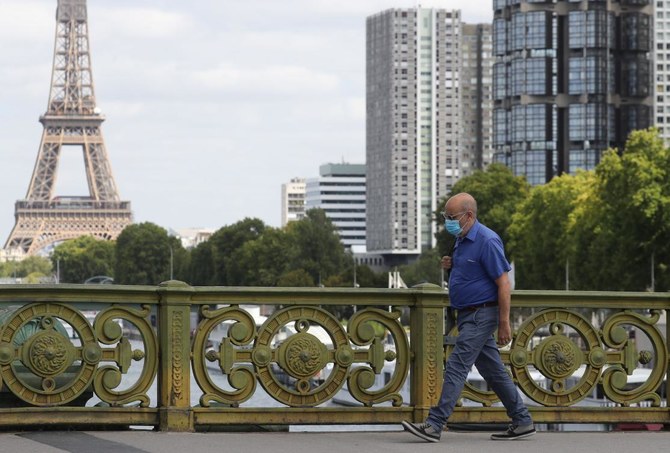
A man wears a protective face mask while walking across Pont Mirabeau bridge, near the Eiffel Tower, on August 27, 2020, in Paris. France's prime minister on August 27 announced face masks will become compulsory throughout Paris. (AFP)
Short Url
Updated 27 August 2020
Follow

Masks imposed on Paris; 20% of France in coronavirus red zone

  • Showing a map of the country’s new “red zones,” French Prime Minister Jean Castex on Thursday urged local authorities to impose new restrictions
  • France has reported more than 30,500 deaths related to the virus, the third-highest toll in Europe after Britain and Italy

PARIS: The virus is actively circulating in about 20% of France’s regions and masks will now be required for everyone in Paris — but the government is determined to reopen schools next week, get workers back on the job and kick off the Tour de France cycling race on Saturday.
Showing a map of the country’s new “red zones,” French Prime Minister Jean Castex on Thursday urged local authorities to impose new restrictions to slow infections and prevent another economically devastating national lockdown.
“The epidemic is gaining ground, and now we must intervene,” Castex said. France “must do everything to avoid a new confinement.”
He acknowledged that the rising cases this summer — attributed mostly to people going on vacation with family and friends — came earlier than authorities expected.
France is now seeing more than 50 positive tests per 100,000 people in Paris, Marseille and other areas. The government announced Thursday that 21 of 101 administrative regions, or departments, are now in the “red zone” where the virus is actively circulating, and where local authorities can impose stricter rules on gatherings and movements.
Castex asked Paris authorities to start requiring mask use everywhere, instead of in just select neighborhoods. Marseille already mandates masks.
Government ministers insisted that the once-renowned French hospital system is better prepared to handle new COVID-19 cases than it was when the virus raced across the country in March and April, saturating intensive care units. France has reported more than 30,500 deaths related to the virus, the third-highest toll in Europe after Britain and Italy, but experts say all confirmed figures understate the true toll of the pandemic due to limited testing and other factors.
France was registering only a few hundred new infections a day in May and June but the number started ticking up in July as the country ramped up testing. Daily cases surged past 5,000 on Wednesday for the first time since May.
The number of virus patients in French hospitals remains low so far despite the jump in infections but it has been steadily rising in recent days.
The government’s message Thursday was mixed — while expressing alarm about growing cases, Castex insisted that “living with the virus” is the new national mantra and he wants people to resume work in September as broadly as possible.
To protect vulnerable populations, the prime minister urged people not to hold family parties and said “grandpa and grandma” shouldn’t pick up their grandchildren from school.
Education Minister Jean-Michel Blanquer said there’s no reason to dial back plans to send France’s 12.9 million students back to class next week or to reopen cafeterias.
“All children should return to school,” he said.
Blanquer also said letting the Tour de France cycling race go ahead is “a sign that we can continue to live, and the resilience of our society.”
Already delayed from its traditional early July start, cycling’s premier event sets off from Nice on Saturday and will crisscross the country for more than three weeks. Fans, tourists and residents usually mass along the route for a beloved event that is a prime advertisement for France’s beauty and traditions, organizers this year are urging all spectators to wear masks.


Pakistani fighter jet crashes in Jalalabad, pilot captured: Afghan military, police

Updated 42 min 34 sec ago
Follow

Pakistani fighter jet crashes in Jalalabad, pilot captured: Afghan military, police

  • Fighting between Pakistan and Afghanistan’s Taliban military entered its third day on Saturday
  • Pakistan’s strikes on Friday hit Taliban military installations and posts, including in Kabul and Kandahar

JALALABAD: A Pakistani jet has crashed in Jalalabad city and the pilot captured alive, the Afghan military and police said Saturday, with residents telling AFP the man parachuted from the plane before being detained.
"A Pakistani fighter jet was shot down in the sixth district of Jalalabad city, and its pilot was captured alive," police spokesman Tayeb Hammad said.
Wahidullah Mohammadi, spokesman for the military in eastern Afghanistan, confirmed the Pakistani jet was downed by Afghan forces "and the pilot was captured alive".

The AFP journalist heard a jet overhead before blasts from the direction of the airport in Jalalabad, the capital of Nangarhar province, which sits on the road between Kabul and the Pakistani border.

Fighting between Pakistan and Afghanistan’s Taliban military entered its third day on Saturday, following overnight clashes as the international community expressed increasing concern about the conflict and called for urgent talks.

Pakistan’s strikes on Friday hit Taliban military installations and posts, including in Kabul and Kandahar, in one of the deepest Pakistani incursions into its western neighbor in years, officials said.

Islamabad accuses the Taliban of harboring Tehreek-e-Taliban Pakistan (TTP) militants, who it claims are waging an insurgency inside Pakistan, a charge the Taliban denies.

Pakistan described its actions as a response to cross-border assaults, while Kabul denounced them as a breach of its sovereignty, saying it remained open to dialogue but warned any wider conflict would result in serious consequences.

The fighting has raised ‌the risk ‌of a protracted conflict along the rugged 2,600-kilometer frontier.

Diplomatic efforts gathered ‌pace ⁠late on Friday ⁠as Afghanistan said its foreign minister, Amir Khan Muttaqi, spoke by telephone with Saudi Arabia’s Prince Faisal bin Farhan about reducing tensions and keeping diplomatic channels open.

The European Union called for both sides to de-escalate and engage in dialogue, while the United Nations urged an immediate end to hostilities.

Russia urged both sides to halt the clashes and return to talks, while China said it was deeply concerned and ready to help ease tensions.

The United States supports Pakistan’s right to defend itself against attacks by ⁠the Taliban, a State Department spokesperson said.

Border fighting continues

Exchanges of fire continued along ‌the border overnight.

Pakistani security sources said an operation dubbed “Ghazab Lil Haq” was ongoing and that Pakistani forces had destroyed multiple Taliban posts and camps in several sectors. Reuters could not independently verify the claims.

Both sides have reported heavy losses with conflicting tolls that Reuters could not verify. Pakistan said 12 of its ‌soldiers and 274 Taliban were killed while the Taliban said 13 of its fighters and 55 Pakistani soldiers died.

Taliban deputy spokesman Hamdullah Fitrat ⁠said 19 civilians were ⁠killed and 26 wounded in Khost and Paktika. Reuters could not verify the claim.

Pakistan’s Defense Minister Khawaja Muhammad Asif said “our cup of patience has overflowed” and described the fighting as “open war,” warning that Pakistan would respond to further attacks.

Taliban Interior Minister Sirajuddin Haqqani said in a speech in Khost province that the conflict “will be very costly,” and that Afghan forces had not deployed broadly beyond those already engaged.

He said the Taliban had defeated “the world, not through technology, but through unity and solidarity,” and through “great patience and perseverance,” rather than superior military power.

Pakistan’s military capabilities far exceed those of Afghanistan, with a standing army of hundreds of thousands and a modern air force.

In stark contrast, the Taliban lacks a conventional air force and relies largely on light weaponry and ground forces.

However, the Islamist group is battle-hardened after two decades of insurgency against US-led forces before returning to power in 2021.