

Pharaohs rule again as mummies parade through Cairo

1 / 9
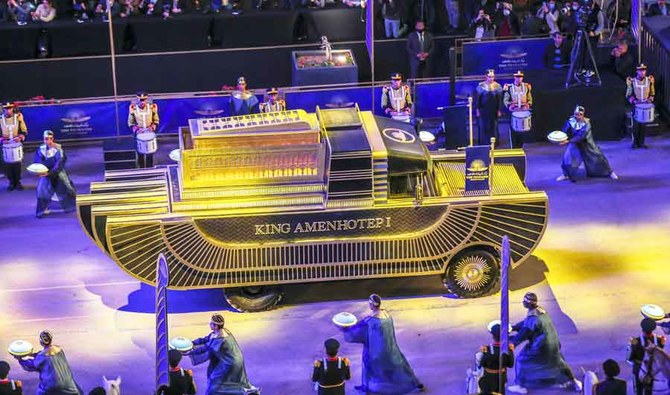
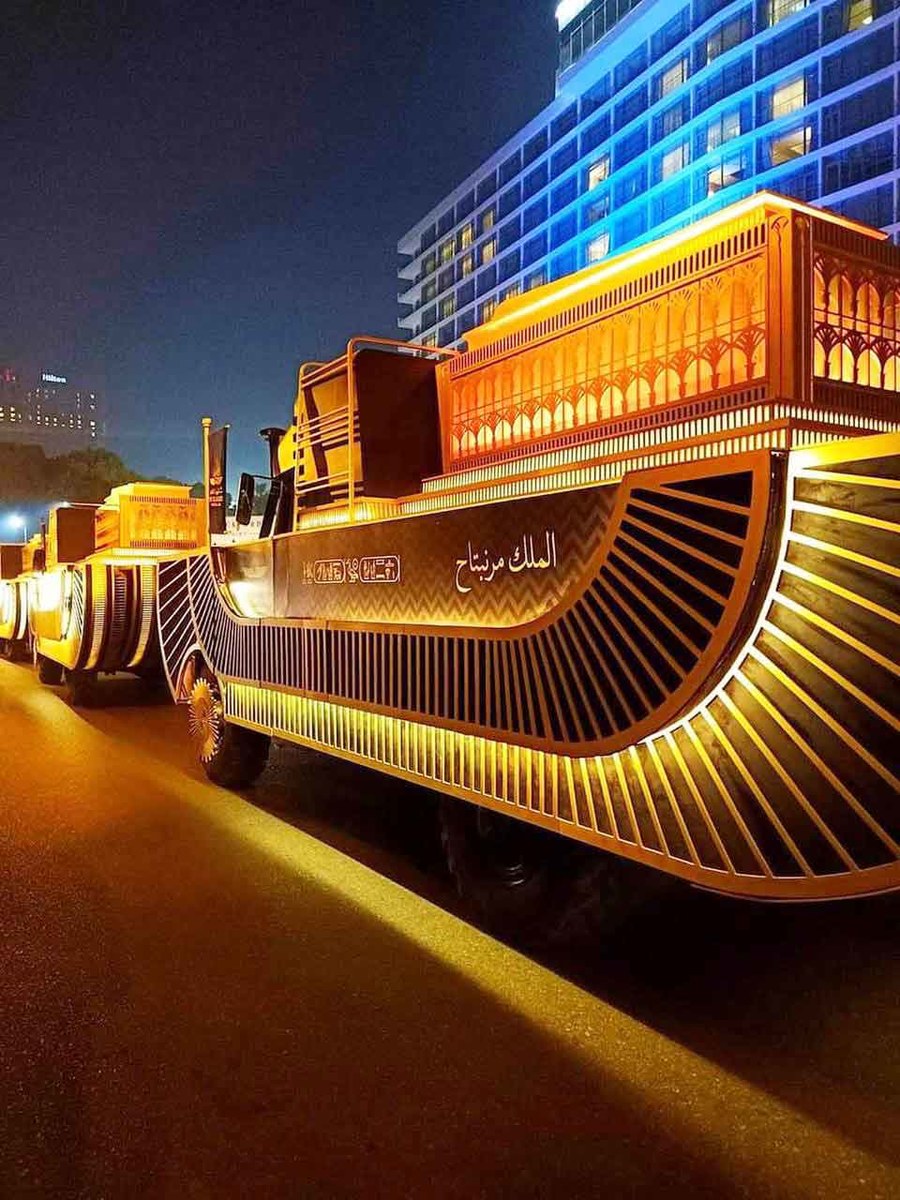
A convoy of vehicles transporting royal mummies is seen in Cairo, Egypt, Saturday, April 3, 2021. (AP)
2 / 9
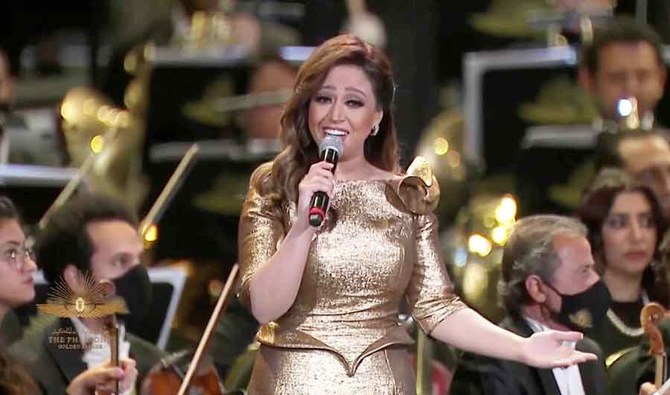
A singer performs at a ceremony of a transfer of Royal mummies from the Egyptian Museum in Tahrir to the National Museum of Egyptian Civilization in Fustat, in Cairo, Egypt April 3, 2021. (REUTERS)
3 / 9
Riham Abdel Hakim performs at a ceremony of a transfer of Royal mummies from the Egyptian Museum in Tahrir to the National Museum of Egyptian Civilization in Fustat, in Cairo, Egypt April 3, 2021. (REUTERS)
4 / 9
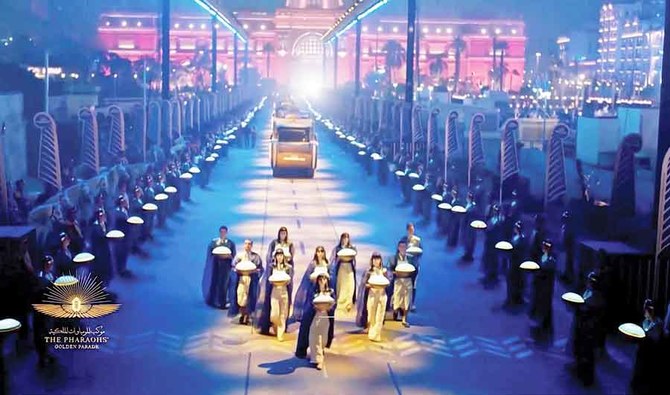
A general view of a parade at Saturday’s ceremony of a transfer of royal mummies to the National Museum of Egyptian Civilization in Fustat, Cairo. (Reuters)
5 / 9
Royal mummies are transported to the National Museum of Egyptian Civilization in Fustat, in Cairo, Egypt April 3, 2021. (Reuters)
6 / 9
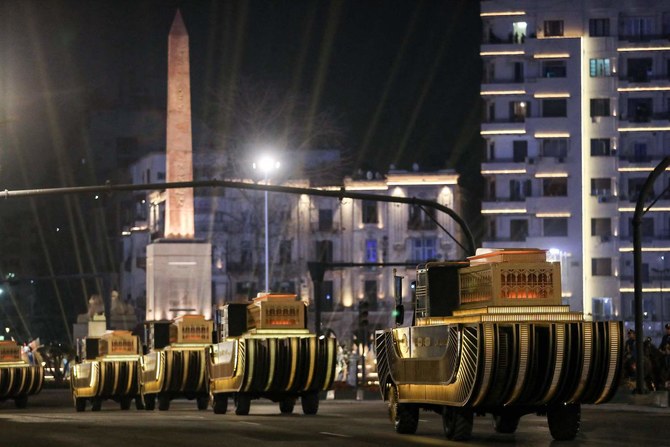
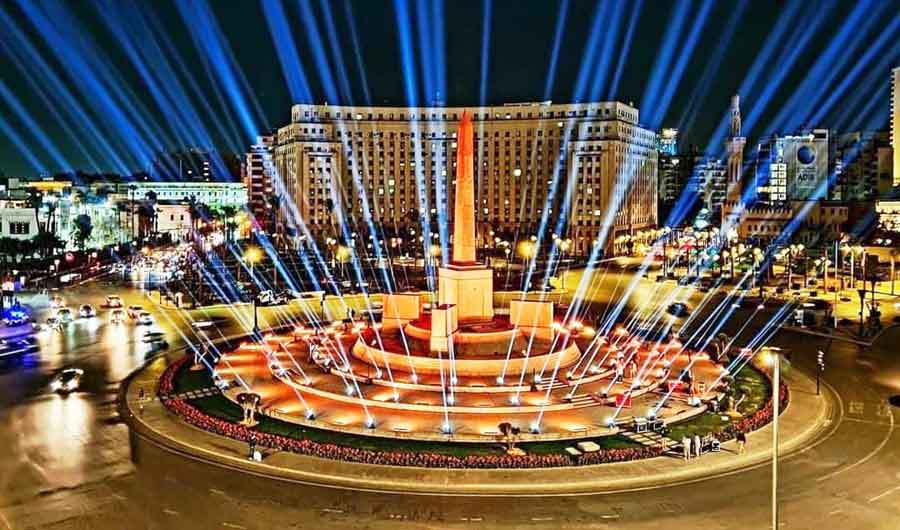
Carriages carrying 22 ancient Egyptian royal mummies advance past the Obelisk of Ramses II along Tahrir Square. (AFP)
7 / 9
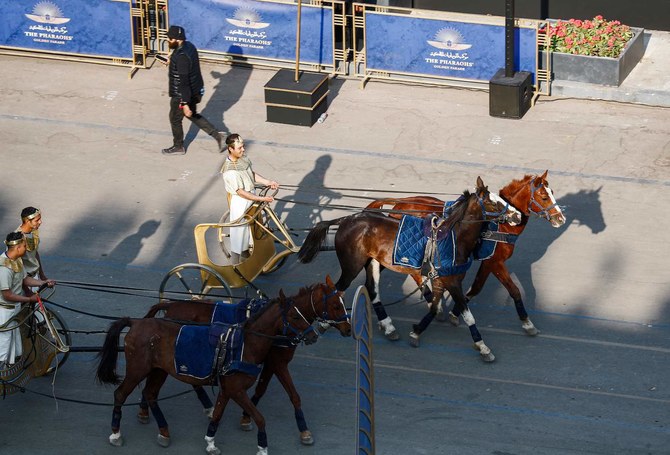
Re-enactors ride two-horse chariots in Tahrir Square, in the centre of Egypt's capital Cairo on April 3, 2021. (AFP)
8 / 9
A view of the Obelisk of Ramses II in the centre of the main roundabout of Tahrir Square in Cairo. (AFP)
9 / 9
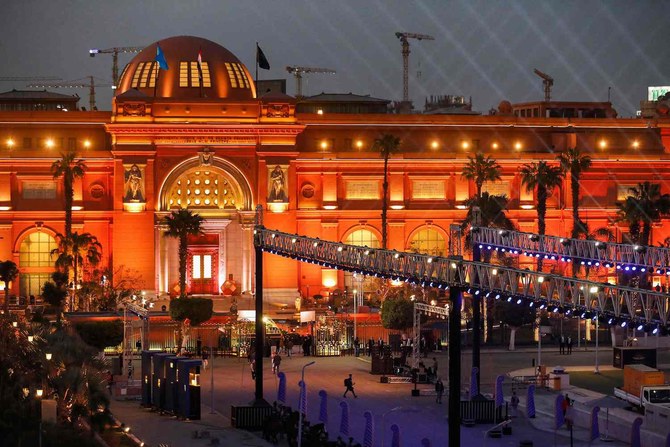
The Egyptian Museum is lit up on April 3, 2021, ahead of the parade of 22 ancient Egyptian royal mummies. (AFP)
Short Url
Updated 04 April 2021
Follow

Pharaohs rule again as mummies parade through Cairo

  • The convoy will transport 18 kings and four queensfrom the Egyptian Museum to the National Museum of Egyptian Civilization in Fustat
  • Laser show, dramatic royal procession highlight Egypt’s ‘gift to the world’

CAIRO: Cairo stepped back in time on Saturday with a four-hour pharaonic procession as a collection of royal mummies was moved from the Egyptian Museum in Tahrir to the National Museum of Egyptian Civilization in Fustat.

Laser lights and flashlights were used to decorate the night sky above the capital with the names of 22 pharaoh kings and 17 royal sarcophagi.

The National Museum of Egyptian Civilization received the royal mummies of 18 kings and four queens.

In July 2020, 17 royal coffins were taken to the museum.

The royal procession began at 5 p.m. and continued more more than four hours, passing along Cairo’s main roads.

Egyptian President Abdel Fattah El-Sisi and a group of international figures were in attendance as the mummies were taken inside the museum. The event was also broadcast live on 18 international channels.
The procession set off from the Egyptian Museum in Tahrir Square, then passed by the Tahrir Square, before heading to Simon Bolivar Square, and moving along the Nile Corniche in the neighborhoods of Sayyidah Zaynab and Old Egypt.

Festivities included horse parades and performances, while the pharaonic chariots were decorated with the names of 22 famous ancient kings.

Artillery welcomed the parade with a 21-gun salute.

HIGHLIGHTS

• Egyptian President Abdel Fattah El-Sisi and a group of international figures were in attendance as the mummies were taken inside the museum.

• The event was also broadcast live on 18 international channels.

The royal carriages carried famous actors in pharaonic dress, headed by Hussein Fahmy, Sawsan Badr, Asir Yassin and Mona Zaki.

Representatives from archaeological sites in Luxor, Aswan and the pyramids carried messages in different languages inviting tourists to visit Egypt.

Military bands, also dressed in pharaonic costume, played national music and songs led by Nader Abbasi, with a film showing the boom in Egyptian antiquities.
Security was stepped up in Fustat ahead of the royal procession.

Workers began cleaning and decorating the streets surrounding the museum early on Friday, placing roses and trees along the procession route.

In front of the museum, the Ministry of Tourism and Antiquities installed large gates decorated with pharaonic images and symbols, along with colored lighting as part of the display.

Zahi Hawass, former minister of antiquities, said that the procession of royal mummies will be viewed by people across the world.

The procession “shows the magic of mummies,” he added.

Hawass said that King Seqnen Ra, who led the procession, started the liberation war against the Hyksos, who colonized Egypt for more than 150 years.

Other royal rulers included Ahmose-Nefertari, the queen who married King Ahmose, followed by King Amenhotep I and Thutmose I.

Hawass said that a CT scan on King Thutmose III showed the deceased king had been found wearing gold bracelets.

Khaled Al-Anani, minister of tourism and antiquities, said that the Museum of Civilization tells the story of the Egypt from prehistoric times until the present.

The royal mummies, coffins and a large collection of Islamic antiquities represent a “great gift from Egypt to the world,” he said.

Al-Anani said that the cost of the Great Hall and the Royal Mummies Hall in the National Museum of Civilization exceeded 600 million Egyptian pounds ($38 million), equivalent to half the government funding to complete the stalled archaeological projects.

The total cost of establishing the museum exceeds 2 billion Egyptian pounds, he said.


Mini op-ed: Coffee, fasting and finding your rhythm this Ramadan

Updated 17 February 2026
Follow

Mini op-ed: Coffee, fasting and finding your rhythm this Ramadan

DUBAI: Ramadan is a month of reflection, balance and listening more closely to our bodies. It is also a time when everyday rituals, including coffee, naturally shift. Rather than giving it up completely, many people simply change how, when and what they drink. And that is where a little understanding can go a long way.

There is no single “right” way to enjoy coffee during Ramadan. Taste preferences, caffeine sensitivity, work schedules and sleep patterns are deeply personal. The key is finding what supports you during the fast.

Suhoor, the pre-dawn meal before fasting begins, is often where people think carefully about caffeine. Some find a small coffee helps them feel alert through the morning. Others prefer to avoid it so they can return to sleep more easily after the meal. How you metabolize caffeine plays a big role here, some people feel energized for hours, while others crash quickly or feel jittery.

Choosing a lower-caffeine option can help. Coffees made from 100 percent Arabica beans naturally contain less caffeine than Robusta, while still offering plenty of flavor and aroma.

Iftar, traditionally broken with water and dates, is usually followed by a light meal or soup. Coffee often comes later, once the body has rehydrated and blood sugar levels have stabilized. Enjoyed mindfully, it can be part of a beautiful evening ritual rather than a stimulant.

There is no single “right” way to enjoy coffee during Ramadan. Taste preferences, caffeine sensitivity, work schedules and sleep patterns are deeply personal. (Shutterstock) 

One of the most important things to remember during Ramadan is hydration. Coffee should never replace water, especially when fasting hours are long. Drinking enough water between iftar and suhoor helps reduce fatigue and headaches far more effectively than extra caffeine.

Added sugar in coffee can also cause blood sugar spikes, followed by dips in energy. If you enjoy sweetness, try reducing it slightly or pairing coffee with food to soften the impact.

If you are worried about caffeine withdrawal during Ramadan, decaffeinated coffee can be a very helpful bridge. High-quality decaf, such as coffee processed using the Swiss water method (which avoids chemical solvents), retains flavor while removing most of the caffeine.

Ramadan is not about restriction for restriction’s sake. It is about awareness, intention and care, including care for your own body. Coffee can absolutely remain part of that journey, as long as it’s enjoyed thoughtfully.

Whether you choose to drink less, switch origins, reduce caffeine or simply slow down and savor it more, the best coffee choice this Ramadan is the one that supports your rhythm, your rest and your well-being.

Here are a few RAW coffees that feel gentle, balanced and comforting during Ramadan:

RITUAL Blend
Created at the request of many customers from the Levant, this is our only blend that combines Arabica with a small amount of Robusta. The result is a bold, full body with very low acidity. Smooth and grounding, it works beautifully as espresso, Moka pot or Turkish coffee, and pairs well with milk.

Brazil — Serra Dos Ciganos (Single Origin)
A beautifully approachable coffee with tasting notes of roasted hazelnuts, nougat, baker’s chocolate and pear. Comforting and elegant, especially when brewed.

Guatemala — Pampojila Natural
Often chosen as a “breakfast coffee”, this is gently sweet with notes of brown sugar, nuts and orange, offering a medium body and soft fruit character.

Mexico — Mazateca
Another favourite for earlier in the day, with flavors of orange, malted barley and cacao, balanced, warm and easy to drink.

Kim Thompson is the founder and director of Culture & Brand at RAW Coffee Co.