RIYADH: Egypt is studying potential expansion of the Suez shipping channel to prevent a recurrence of the accident that disrupted navigation there for about a week, said Suez Canal Authority Chairman Osama Rabie, Al Arabiya reported.
Losses and compensation due to the closure of the canal may reach $1 billion, Rabie said, without specifying who is liable.
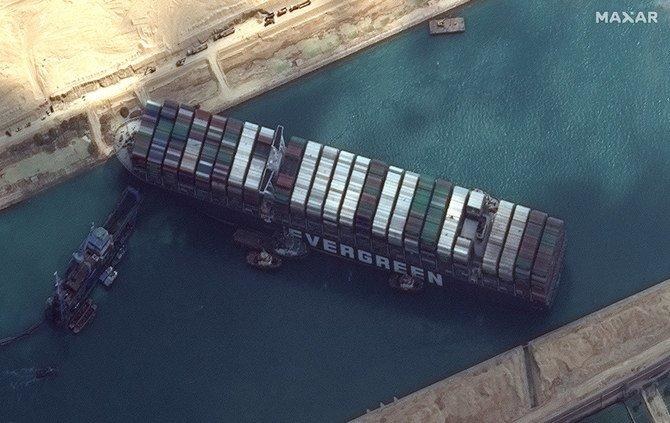
The captain of the Ever Given, which blocked the canal, made a mistake that led to the ship deviating from its course before getting wedged in the bank, according to two rescuers who work for the canal authority, Al Arabiya quoted the Italian Nova Agency as saying.
"The wrong maneuver coincided with the dust storm and strong winds, all of which led to the loss of visibility and the ship stranding, but the weather factors were not fully responsible for the accident," the rescuers said. “Around 12 ships have passed before the Ever Given in the same weather conditions, which did not constitute an obstacle to the movement of navigation in the canal.”
The giant container ship, which was taken out of the canal on Monday, was transported north, and exited from the main channel of the canal to inspect it for damage.
The Suez Canal handles about 12 percent of global trade, and the Ever Given closure has delayed hundreds of ships from passing through.
Suez Canal Authority Chairman estimated that sea traffic on the Canal would likely return to normal on Monday or Tuesday.

Egypt considers widening Suez Canal after Ever Given accident
https://arab.news/yw8sg
Egypt considers widening Suez Canal after Ever Given accident
- $1 billion of compensation may be owed due to closure
- Accident was due to captain error, Canal employees say
Saudi banking sector outlook stable on higher non-oil growth: Moody’s
RIYADH: Saudi Arabia’s banking sector outlook remains stable as stronger non-oil economic growth and solid capital buffers support lending and profitability, Moody’s Ratings said, forecasting continued expansion despite liquidity constraints.
In its latest report, credit rating agency Moody’s said the Kingdom’s non-oil gross domestic product is projected to expand by 4.2 percent this year, up from 3.7 percent recorded in 2025.
In January, S&P Global echoed a similar view, saying banks operating in Saudi Arabia are expected to sustain strong lending growth in 2026, driven by financing demand tied to Vision 2030 projects.
Fitch Ratings also underscored the healthy state of Saudi Arabia’s banking system last month, stating that credit growth and high net interest margins are supporting bank profitability in the Kingdom.
Commenting on the latest report, Ashraf Madani, vice president and senior credit officer at Moody’s Ratings, said: “We expect credit demand to remain robust, but tight liquidity conditions will continue to limit the sector’s lending capacity.”
Madani added that operating conditions in Saudi Arabia will continue to support banks’ strong asset quality and profitability.
“The operating environment for banks remains buoyant, underpinned by a forecast increase in non-oil GDP growth, robust solvency and continued progress toward the government’s economic diversification goals,” he added.
Moody’s said authorities in the Kingdom are introducing business-friendly reforms to bolster investment and private sector activity, while implementing key development projects and preparing for major global events.
Saudi Arabia continues to advance reforms including full foreign ownership rights, simplified capital market registration procedures and improved investor protections, which could accelerate credit growth to 8 percent this year.
Problem loans are expected to remain near historical lows at around 1.3 percent of total loans, supported by ongoing credit growth, favorable operating conditions and lower interest rates, which collectively strengthen borrowers’ repayment capacity.
Retail credit risk remains controlled in Saudi Arabia because most borrowers are government employees with stable income streams.
“Concentration of single borrowers and specific sectors remains high although the growing proportion of consumer loans — now nearing 50 percent of overall sector lending — continues to reduce aggregate concentration risk,” added Moody’s.
The report said profitability is expected to remain solid among Saudi banks, supported by sustained loan growth and fee income.
Margins are expected to remain stable despite lower asset yields as banks take advantage of credit demand to widen loan spreads on existing and new lending.
Moody’s expects net income to tangible assets to remain stable at 1.8 percent to 1.9 percent this year.
The report added that Saudi banks benefit from a very high likelihood of government support in the event of any failures.
“We assume a very high likelihood of government support in the event of a bank failure. This is based on the government’s track record of timely intervention,” Moody’s said.
It added that Saudi Arabia remains the only G-20 country that has not adopted a banking resolution framework. However, it is the only Gulf Cooperation Council member to have introduced a law for systemically important financial institutions.


