

Lebanese cleric steps up criticism of Hezbollah

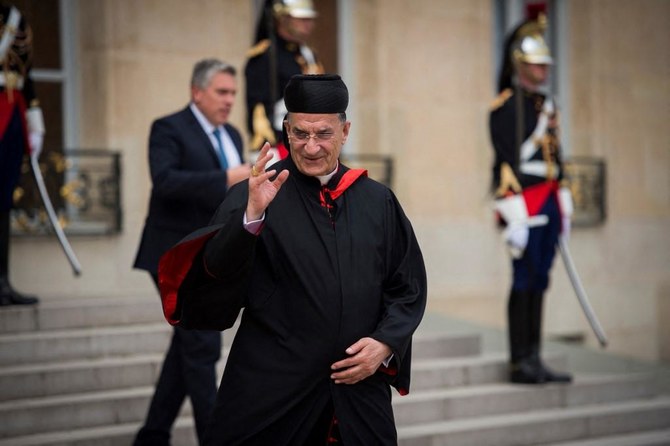
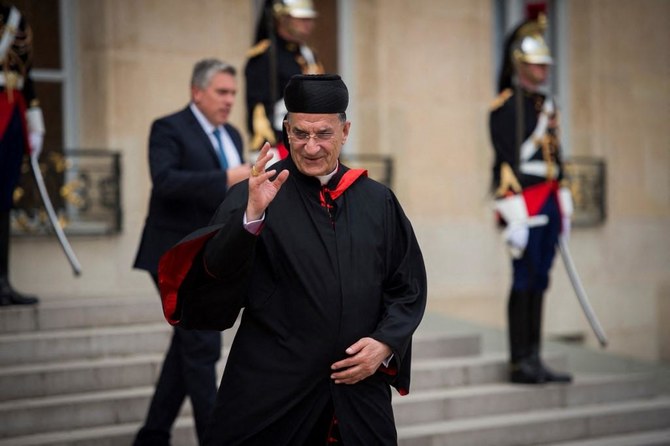
Maronite Patriarch Bechara Boutros Al-Rai has called for Lebanon to remain neutral, referring to Hezbollah’s role fighting in neighboring Syria. (AFP)
Short Url
Updated 02 April 2021
Follow

Lebanese cleric steps up criticism of Hezbollah

  • ‘I want to tell them ... Do you want to force (Lebanon) to go to war?’

BEIRUT: Maronite Patriarch Bechara Boutros Al-Rahi has made unusually direct comments criticizing the Hezbollah movement, accusing it of harming Lebanon by dragging it into regional conflicts.

Addressing the Lebanese in the Eparchy of Saint Maron of Brooklyn, Al-Rahi asked Hezbollah in a hypothetical dialogue: “Why are you standing against neutrality? Do you want to force me to go to war? Do you want to keep Lebanon in a state of war? Would you ask for my opinion when you do go to war? Did you ask for my approval to go to Syria, Iraq and Yemen? Would you ask for the government’s opinion when declaring war and peace with Israel? Although the constitution says that declaring war and peace is upon the decision of two-thirds of the government’s votes.”

"You’re not looking out for (our) interests, nor the interests of your people," he said, apparently addressing Hezbollah.

Al-Rahi said he had received visits from Hezbollah supporters who were privately critical of the group as they felt the effects of Lebanon’s financial collapse.

He said: “Delegations from Hezbollah are visiting me in Bkerke to complain that they are also suffering . . . and this means that they, in Hezbollah, are hungry like us.”

The patriarch's comments come at a time when domestic and foreign pressure continues on those accused of obstructing the formation of the Lebanese government.

Al-Rahi’s progressive stance has previously received support from Lebanese groups.

His comments coincided with a speech by Hezbollah’s Secretary-General Hassan Nasrallah on Wednesday evening, when he warned that “the country has run out of time, and the time has come to put everything aside and go for a real solution to the situation in the country.”

Nasrallah spoke about the “complications” in the formation of the government.

On Thursday, there was a discussion of an initiative led by Parliament Speaker Nabih Berri to abandon a government of 18 ministers and form a de facto government of 22 to 24 ministers to manage internal affairs pending a comprehensive solution in the region.

The seriousness of the efforts made reflected on the dollar exchange rate on the black market, reducing it to 11,300 Lebanese pounds for purchase and 11,400 Lebanese pounds for sale.

A political source close to the prime minister-designate told Arab News: “The essence of Berri’s initiative is based on the French initiative, and this means that there is no blocking third in the government, and the ministers should be non-partisan.”

Regarding the possibility of Hariri agreeing to a government of more than 18 ministers, as he demands, the political source said: “Regardless of the number, if the president of the republic says that he approves a government without a blocking third and a government of specialists, it will be formed quickly.”

Meanwhile, the Banque du Liban announced its cooperation “with Alvarez & Marsal, putting accounts related to all state accounts and bank accounts at the disposal of the minister of finance” for forensic audit.

A virtual meeting will be held on April 6, bringing together the company, the Banque du Liban and the Ministry of Finance.

In a statement on Thursday, the Banque du Liban stressed its “readiness to secure the facilities that would allow the concerned company to start the audit process.”

However, the optimistic outlook promoted on Thursday was doubted by protesters on the streets.

Groups of them returned to blocking roads in Beirut and some areas.

Bechara Al-Asmar, leader of the General Labor Union, highlighted that preparations will continue for a wave of protests aimed at forming a rescue government to save the country from its accumulated crises.

He said that the first protest would take place on Wednesday.

Tunisia’s famed blue-and-white village threatened after record rains

Updated 31 January 2026
Follow

Tunisia’s famed blue-and-white village threatened after record rains

  • The one-time home of French philosopher Michel Foucault and writer Andre Gide, the village is protected under Tunisian preservation law, pending a UNESCO decision on its bid for World Heritage status

SIDI BOU SAID, Tunisia: Perched on a hill overlooking Carthage, Tunisia’s famed blue-and-white village of Sidi Bou Said now faces the threat of landslides, after record rainfall tore through parts of its slopes.
Last week, Tunisia saw its heaviest downpour in more than 70 years. The storm killed at least five people, with others still missing.
Narrow streets of this village north of Tunis — famed for its pink bougainvillea and studded wooden doors — were cut off by fallen trees, rocks and thick clay. Even more worryingly for residents, parts of the hillside have broken loose.
“The situation is delicate” and “requires urgent intervention,” Mounir Riabi, the regional director of civil defense in Tunis, recently told AFP.
“Some homes are threatened by imminent danger,” he said.
Authorities have banned heavy vehicles from driving into the village and ordered some businesses and institutions to close, such as the Ennejma Ezzahra museum.

- Scared -

Fifty-year-old Maya, who did not give her full name, said she was forced to leave her century-old family villa after the storm.
“Everything happened very fast,” she recalled. “I was with my mother and, suddenly, extremely violent torrents poured down.”
“I saw a mass of mud rushing toward the house, then the electricity cut off. I was really scared.”
Her Moorish-style villa sustained significant damage.
One worker on site, Said Ben Farhat, said waterlogged earth sliding from the hillside destroyed part of a kitchen wall.
“Another rainstorm and it will be a catastrophe,” he said.
Shop owners said the ban on heavy vehicles was another blow to their businesses, as they usually rely on tourist buses to bring in traffic.
When President Kais Saied visited the village on Wednesday, vendors were heard shouting: “We want to work.”
One trader, Mohamed Fedi, told AFP afterwards there were “no more customers.”
“We have closed shop,” he said, adding that the shops provide a livelihood to some 200 families.

- Highly unstable -

Beyond its famous architecture, the village also bears historical and spiritual significance.
The village was named after a 12th-century Sufi saint, Abu Said Al-Baji, who had established a religious center there. His shrine still sits atop the hill.
The one-time home of French philosopher Michel Foucault and writer Andre Gide, the village is protected under Tunisian preservation law, pending a UNESCO decision on its bid for World Heritage status.
Experts say solutions to help preserve Sidi Bou Said could include restricting new development, building more retaining walls and improving drainage to prevent runoff from accumulating.
Chokri Yaich, a geologist speaking to Tunisian radio Mosaique FM, said climate change has made protecting the hill increasingly urgent, warning of more storms like last week’s.
The hill’s clay-rich soil loses up to two thirds of its cohesion when saturated with water, making it highly unstable, Yaich explained.
He also pointed to marine erosion and the growing weight of urbanization, saying that construction had increased by about 40 percent over the past three decades.
For now, authorities have yet to announce a protection plan, leaving home and shop owners anxious, as the weather remains unpredictable.