Pakistan among four worst nations for women on Global Gender Gap report 

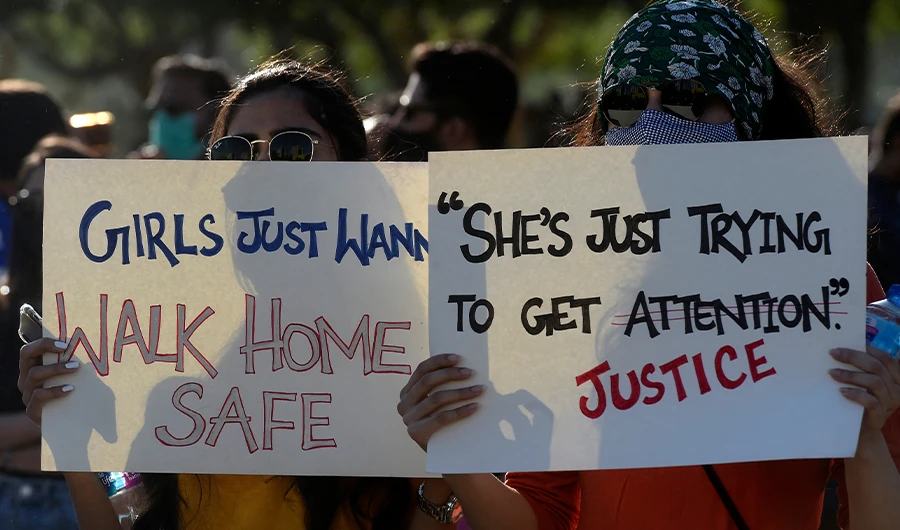
Activists of the Aurat March hold placards as they gather during a rally to mark International Women's Day in Karachi, Pakistan, on March 8, 2021. (AFP/File)
Short Url
Updated 01 April 2021
Follow

Pakistan among four worst nations for women on Global Gender Gap report 

  • Women make up 7% of Pakistan’s labor force, the third-lowest figure globally, according to the World Bank
  • World Economic Forum says Pakistan’s gender gap has widened, some improvement in share of women in professional, technical roles

Islamabad: Pakistan has slipped two spots since last year to rank 153rd out of 156 countries on the World Economic Forum’s (WEF) Global Gender Gap Report 2021, published this week. 
Women make up 7% of Pakistan’s labor force, the third-lowest figure globally, according to the World Bank, which has pushed for more childcare and a crackdown on sexual harassment to get more women out to work and boost economic growth.
The South Asian nation was ranked as the sixth most dangerous country for women in a Thomson Reuters Foundation poll in 2018, with hundreds of women and girls killed each year by family members angered at perceived damage to their “honor.”
In the WEF’s 2021 report, Pakistan featured among the bottom 10 countries in two of the four sub-indexes: economic participation and opportunity (152nd) and health and survival (153rd).
“Pakistan ranks 153rd out of 156 countries assessed on the index this year, with its gender gap having widened in this edition by 0.7 percentage points, to 55.6%,” the report said, recording large income disparities between women and men in the South Asian nation. 
“On average, a Pakistani woman’s income is 16.3% of a man’s. Further, women do not have equal access to justice, ownership of land and non-financial assets or inheritance rights,” the report added. 
However, it also noted some improvement in the share of women who were in professional and technical roles, 25.3%, up from 23.4% in a previous edition of the index. 
The WEF said only 46.5 percent Pakistani women were literate, 61.6 percent attended primary school, 34.2 percent attended high school and 8.3 percent were enrolled in tertiary education courses.
“Pakistan has closed 94.4% of its Health and Survival gender gap, negatively impacted by wide sex ratio at birth (92%) due to gender-based sex-selective practices, and 85% of women have suffered intimate partner violence,” the report read.
The report showed Pakistan’s rank as relatively higher for political empowerment but women’s representation among parliamentarians (20.2%) and ministers (10.7%) remained low.
Pakistani, Bangladeshi officials discuss trade, investment and aviation as ties thaw

Updated 10 sec ago
Follow

Pakistani, Bangladeshi officials discuss trade, investment and aviation as ties thaw

  • Pakistan and Bangladesh were once one nation, but they split in 1971 as a result of a bloody civil war
  • Ties between Pakistan, Bangladesh have warmed up since last year and both nations have resumed sea trade

ISLAMABAD: Pakistan's High Commissioner to Bangladesh Imran Haider on Sunday met Chief Adviser Muhammad Yunus in Dhaka, the latter's office said on, with the two figures discussing trade, investment and aviation.

Pakistan and Bangladesh were once one nation, but they split in 1971 as a result of a bloody civil war, which saw the part previously referred to as East Pakistan seceding to form the independent nation of Bangladesh.

Ties between Pakistan and Bangladesh have warmed up since former prime minister Sheikh Hasina’s ouster as a result of a student-led uprising in August 2024. Relations remain frosty between Dhaka and New Delhi over India’s decision to grant asylum to Hasina.

Pakistan has attempted to forge closer ties with Bangladesh in recent months and both South Asian nations last year began sea trade, followed by efforts to expand government-to-government commerce.

"During the meeting, both sides discussed ways to expand cooperation in trade, investment, and aviation as well as scaling up cultural, educational and medical exchanges to further strengthen bilateral relations between the two South Asian nations," Yunus's office said in a statement on X.

In 2023-24 Pakistan exported goods worth $661 million to Bangladesh, while its imports were only $57 million, according to the Trade Development Authority of Pakistan. In Aug. this year, the Pakistani and Bangladeshi commerce ministries signed a memorandum of understanding to establish a Joint Working Group on Trade, aiming to raise their bilateral trade volume to $1 billion in the financial year that began in July.

The Pakistani high commissioner noted that bilateral trade has recorded a 20 percent growth compared to last year, with business communities from both countries actively exploring new investment opportunities, according to the statement.

He highlighted a significant increase in cultural exchanges, adding that Bangladeshi students have shown strong interest in higher education opportunities in Pakistan, particularly in medical sciences, nanotechnology, and artificial intelligence. Haider also said that Dhaka-Karachi direct flights are expected to start in January.

"Chief Adviser Professor Muhammad Yunus welcomed the growing interactions between the two countries and emphasized the importance of increased visits as well as cultural, educational and people-to-people exchanges among SAARC (South Asian Association for Regional Cooperation) member states," the statement read.

"Professor Yunus also underscored the need to further boost Bangladesh–Pakistan trade and expressed hope that during Mr. Haider’s tenure, both countries would explore new avenues for investment and joint venture businesses."