Violating Egypt’s waters a ‘red line,’ says president

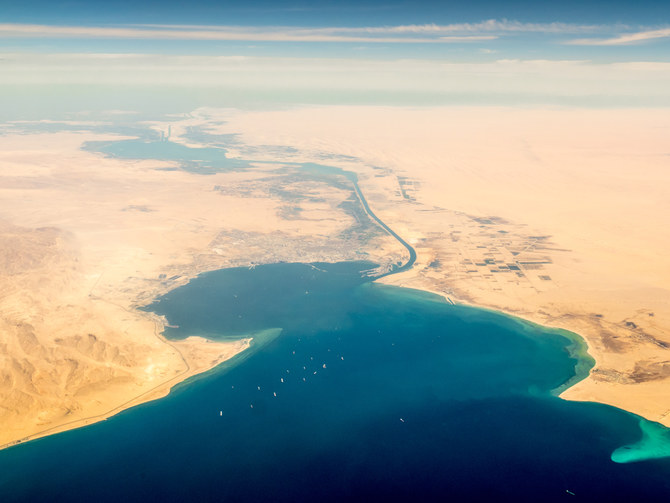
Violating Egypt’s waters was a “red line” that would affect the stability of the entire region, President Abdel Fattah El-Sisi said on the sidelines of an inspection visit to the Suez Canal. (Shutterstock/File Photo)
Short Url
Updated 30 March 2021
Follow

Violating Egypt’s waters a ‘red line,’ says president

  • El-Sisi warned nobody would be able to “take a drop of water” from the country
  • El-Sisi thanked the countries that had offered assistance in re-floating the “Ever Given”

CAIRO: Violating Egypt’s waters was a “red line” that would affect the stability of the entire region, President Abdel Fattah El-Sisi said on the sidelines of an inspection visit to the Suez Canal.

The country has been in protracted and so far unsuccessful talks regarding the $4 billion Grand Ethiopian Renaissance Dam. Ethiopia hopes the dam will turn it into Africa’s top hydropower supplier, but Egypt and Sudan fear it will substantially reduce their water share and affect development prospects.

El-Sisi, who said Egypt was capable of facing down any threat, warned that nobody would be able to “take a drop of water” from the country. He also said Egypt had been very rational, very patient and that there would be regional instability if its water rights were violated.

“Our battle is a battle of negotiation and hostile action is unacceptable, but if our water supplies are affected, Egypt’s response will echo in the region.”

El-Sisi said there would be progress on the dam issue in the coming weeks, and that Egypt hoped to reach an agreement.

He said the country was seeking to reach a fair and binding legal deal to fill and operate the dam, which has been a source of regional diplomatic tension since its construction began in Ethiopia in 2011.

The president also spoke about the Suez Canal, which was thrust into the global spotlight last week when a massive container ship got wedged in it and caused the vital waterway to back up.  

“We did not want an accident in Suez, but it was dealt with effectively,” El-Sisi said. “The Suez Canal is a global site for the movement of trade and the passage of ships. Egypt is making tremendous efforts in more than one aspect. We salute the Suez Canal Authority and all those who participated in resolving the crisis, despite the size of the challenges and difficulties, but the flotation of the ship took place without losses.”

He said the canal was responsible for 13 percent of the global trade volume and, for 60 years, it had remained a significant aspect of the global trade and maritime industry.

El-Sisi thanked the countries that had offered assistance in re-floating the “Ever Given.”


Israel defense minister vows to stay in Gaza, establish outposts

Updated 23 December 2025
Follow

Israel defense minister vows to stay in Gaza, establish outposts

  • His remarks, reported across Israeli media, come as a fragile US-brokered ceasefire between Israel and Hamas holds in Gaza

JERUSALEM: Defense Minister Israel Katz on Tuesday vowed Israel will remain in Gaza and pledged to establish outposts in the north of the Palestinian territory, according to a video of a speech published by Israeli media.
His remarks, reported across Israeli media, come as a fragile US-brokered ceasefire between Israel and Hamas holds in Gaza.
Mediators are pressing for the implementation of the next phases of the truce, which would involve an Israeli withdrawal from the territory.
Speaking at an event in the Israeli settlement of Beit El in the occupied West Bank, Katz said: “We are deep inside Gaza, and we will never leave Gaza — there will be no such thing.”
“We are there to protect, to prevent what happened (from happening again),” he added, according to a video published by Israeli news site Ynet.
Katz also vowed to establish outposts in the north of Gaza in place of settlements that had been evacuated during Israel’s unilateral disengagement from the territory in 2005.
“When the time comes, God willing, we will establish in northern Gaza, Nahal outposts in place of the communities that were uprooted,” Katz said, referring to military-agricultural settlements set up by Israeli soldiers.
“We will do this in the right way and at the appropriate time.”
Katz’s remarks were slammed by former minister and chief of staff Gadi Eisenkot, who accused the government of “acting against the broad national consensus, during a critical period for Israel’s national security.”
“While the government votes with one hand in favor of the Trump plan, with the other hand it sells fables about isolated settlement nuclei in the (Gaza) Strip,” he wrote on X, referring to the Gaza peace plan brokered by US President Donald Trump.
The next phases of Trump’s plan would involve an Israeli withdrawal from Gaza, the establishment of an interim authority to govern the territory in place of Hamas and the deployment of an international stabilization force.
It also envisages the demilitarization of Gaza, including the disarmament of Hamas, which the group has refused.
On Thursday, several Israelis entered the Gaza Strip in defiance of army orders and held a symbolic flag-raising ceremony to call for the reoccupation and resettlement of the Palestinian territory.