

UK aid cuts to refugee legal support threaten ‘utter destitution’ for Syrians

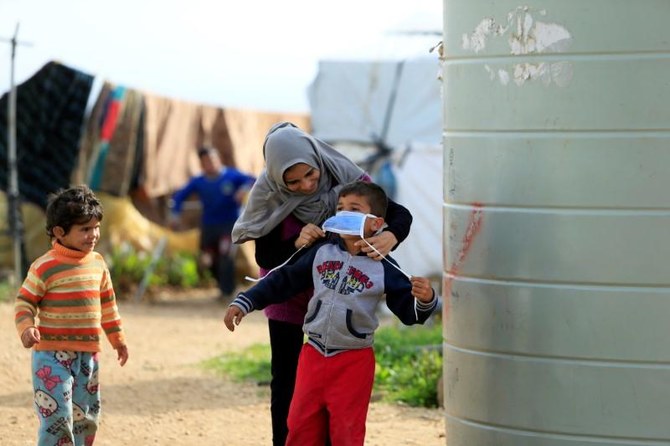
A Syrian refugee woman puts a face mask on a boy as a precaution against the spread of coronavirus, Al-Wazzani, southern Lebanon, March 14, 2020. (Reuters)
Short Url
Updated 29 March 2021
Follow

UK aid cuts to refugee legal support threaten ‘utter destitution’ for Syrians

  • Various forms of legal assistance will end for 65,000 displaced people in Syria, Lebanon
  • Massive cuts to British aid budget will hit a number of Arab states

LONDON: Tens of thousands of Syrians will be left without legal support, leaving many “in utter destitution” without documents they need to work, travel or return home, after the UK government cut £4 million ($5.52 million) in funding from a charity program, according to its director.

The gutting of the Norwegian Refugee Council (NRC) legal support program comes amid reports of significant reductions in Britain’s Syria and overall humanitarian aid budget.

“This cut means we need to stop legal and protection assistance for 65,000 displaced people in Syria and Lebanon,” said NRC Secretary-General Jan Egeland.

“Syrian children will no longer get help to get birth certificates, students and schoolchildren will no longer get help to get exam or training documents, and we can no longer help people with housing, land and property rights,” he added.

“For some people, who hoped to be integrated into Lebanon, that hope has gone. It’s utter destitution when you are paperless.”

Projected cuts to the Syria budget could be as high as 67 percent — that means British contributions could fall from the £137 million pledged in 2020 to £45 million for 2021.

Egeland said the cuts to the NRC program run counter to British values and interests. “The UK has been a champion of legal advice for refugees for many years, so that people can one day return to working life as productive citizens,” he added.

The NRC’s Bahia Zrikem said staff had reported increased child labor, and families reduced to eating two meals per day. “Humanitarian needs are increasing, not falling,” she added.

Laurie Lee of Care International said her organization had already seen its work in Syria cut by 36 percent in the past year.

“Though budgets are not yet confirmed, if there are further cuts, important work which has been funded by people in the UK will be in jeopardy, including resilience-building efforts, which help Syrians rebuild their lives following 10 years of conflict,” she added.

Ahead of a donor conference on Monday, the UN has urged donors including Britain, the third-largest donor to Syria, to continue supporting the war-torn country.

“As we approach the Brussels conference, we are calling on all donors to continue to stand by those who rely on our support after 10 years of conflict,” said a spokesperson.

Persistent violence, a near-total economic collapse and skyrocketing food prices are compounding the hardship faced by Syrians.

According to the World Health Organization, the war has left almost 90 percent of the population below the poverty line. 

Reports suggest that Britain is poised to slash its total aid budget to £9 billion from £15 billion — from 0.7 to 0.5 percent of gross domestic product.

The proposed cuts could mean aid to Somalia will be reduced by 60 percent, to Yemen by 59 percent, and to Libya by as much as 64 percent.

A UK government spokesperson said: “We have been delivering life-saving aid and support direct to the Syrian people — including over 28 million food rations, over 20 million medical consultations and over 14 million vaccines — since 2012.

“The seismic impact of the pandemic on the UK economy has forced us to take tough but necessary decisions, including temporarily reducing the overall amount we spend on aid.

“We are still working through what this means for individual programmes, and decisions have not yet been made.”


Iraqi lawmakers to elect president Tuesday, PM appointment next

Updated 25 January 2026
Follow

Iraqi lawmakers to elect president Tuesday, PM appointment next

  • Parliamentary speaker Haibat Al-Halbussi announced on Sunday that the new parliament will convene on Tuesday to elect a president

BAGHDAD: Iraq’s parliament will meet on Tuesday to elect the country’s new president, who will then appoint a prime minister expected to be Nouri Al-Maliki after he was endorsed by the largest Shiite bloc.
By convention, a Shiite Muslim holds the post of prime minister, the parliament speaker is Sunni and the largely ceremonial presidency goes to a Kurd.
Parliamentary speaker Haibat Al-Halbussi announced on Sunday that the new parliament will convene on Tuesday to elect a president, according to the official INA press agency.
The president will then have 15 days to appoint a prime minister, who is usually nominated by the largest Shiite bloc formed through post-election alliances.
On Saturday, the Coordination Framework alliance — whose Shiiite factions have varying links to Iran — endorsed former prime minister and powerbroker Al-Maliki as the country’s next premier.
The alliance, to which Al-Maliki belongs, spoke of his “political and administrative experience and his record in running the state.”
Kurdish parties have yet to agree on a presidential candidate, who must be endorsed by other blocs and win a two-thirds majority in parliament.
The presidency is usually held by the Patriotic Union of Kurdistan (PUK). This year, the rival Kurdistan Democratic Party (KDP) named its own candidate: Foreign Minister Fuad Hussein.
Although Maliki’s endorsement effectively guarantees him the post, forming a new government remains a daunting challenge that could drag on for months and still fail.
The designated premier has one month to form a government and present it to parliament for a vote of confidence.
The 75-year-old Maliki, a shrewd politician, is set to return to power at a time of seismic changes in the Middle East, as Tehran’s regional influence wanes and tensions with Washington rise.
Government formation in Iraq must balance internal political dynamics and power-sharing among major parties, all under the continued influence of Iraq’s two main allies: Iran and the United States.
A close Iran ally, Al-Maliki will be expected to address Washington’s longstanding demand that Baghdad dismantle Tehran-backed factions, many of which are designated terrorist groups by the US.
Last month, Iraqi officials and diplomats told AFP that Washington demanded the eventual government exclude Iran-backed armed groups, even though most of them hold seats in parliament, and have seen their political and financial clout increase.
But Iraq is struggling with weak economic growth and cannot risk punitive measures by the US, which has already sanctioned several Iraqi entities, accusing them of helping Tehran evade sanctions.