

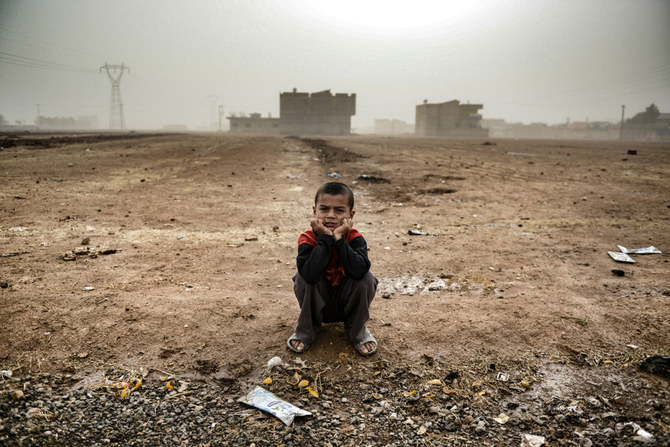

LONDON: The UN has urged the UK to abandon its planned cuts in aid to Syria next week, warning that the move could further destabilize the war-torn country and ultimately backfire on Britons.
Mark Lowcock, the UN’s chief humanitarian coordinator, issued the warning ahead of a high-profile donor conference on Syria in which organizers hope to raise $10 billion — the largest ever appeal for the country.
“This is absolutely not the moment for donors to downgrade Syria in their priorities. Millions of Syrians are resorting to desperate measures to survive. To cut aid now would be massively destabilizing. It would be a grave step in the wrong direction,” said Lowcock.
Earlier this month, leaked documents revealed that the UK was planning a reduction in aid to Syria from the £137 million ($189 million) pledged in 2020 to just £45 million for 2021.
The aid money is used to help refugees in Syria by funding their education, housing and employment across borders in Turkey, Lebanon and Jordan. The UK is said to be the only major donor that is threatening to make a large cut.
“A decision to turn away from Syria today will come back to bite us all tomorrow,” said Lowcock, who headed Britain’s Department for International Development before taking up his role at the UN.
“In 2014, our appeal was poorly funded. In 2015 there was a huge exodus of people from Syria to Europe.”
The UK should remember its historical responsibilities to Syria, Lowcock told the Guardian.
“On Tuesday in Brussels we are asking donors — out of generosity and in their own interests — to stay the course and continue supporting the people of Syria. Particularly those like the UK who have played a prominent role at points in the past.”
An estimated 13.4 million people need humanitarian assistance in Syria, up 20 percent compared with 2020. In the surrounding region, the UN and partners aim to help 10.5 million people, including 5.6 million refugees and the communities that host them.
Due to economic hardship amid the pandemic, the UK has been reducing its contributions to international aid across the board, and has cut its aid budget from 0.7 percent of gross national income to 0.5 percent — representing a £5 billion reduction in real terms.
Yemen, Somalia and South Sudan are among the countries also expected to receive significantly less British aid in 2021 compared with the previous year.
Syria’s collapsing economy, skyrocketing food prices and persistent violence in parts of the country means that about 90 percent of Syrians now live below the poverty line.
Lowcock said: “The majority of people can’t afford to eat. Millions of Syrians are resorting to desperate measures to survive.”
David Miliband, CEO of the International Rescue Committee, said: “British aid is saving thousands of lives for people living in areas outside government control. This is only possible because British diplomatic efforts have sustained border crossings — but they have been reduced to just one. In northern Syria, 3 million depend on humanitarian aid through this mechanism — it is a vital lifeline that Britain has worked hard to protect.
“Now is not the time for the UK to abandon this legacy. During this conference, I sincerely hope that the UK will sustain its humanitarian support to Syria. The human cost of aid cuts at this critical time is unthinkable.”


