

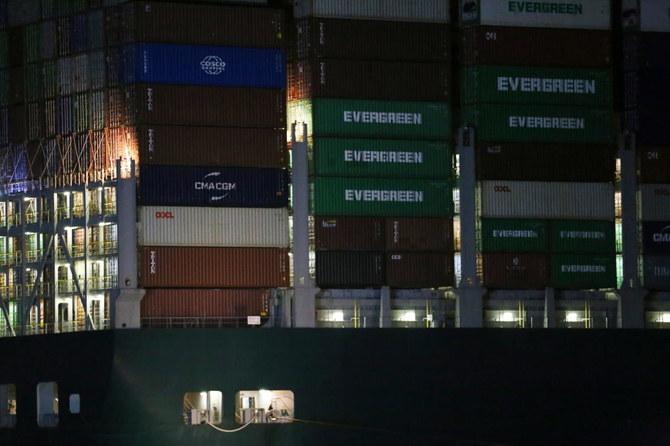

SUEZ: Two additional tugboats sped Sunday to Egypt’s Suez Canal to aid efforts to free a skyscraper-sized container ship wedged for days across the crucial waterway, even as major shippers increasingly divert their boats out of fear the vessel may take even longer to free.
The massive Ever Given, a Panama-flagged, Japanese-owned ship that carries cargo between Asia and Europe, got stuck Tuesday in a single-lane stretch of the canal. In the time since, authorities have been unable to remove the vessel and traffic through the canal — valued at over $9 billion a day — has been halted, further disrupting a global shipping network already strained by the coronavirus pandemic.
The Dutch-flagged Alp Guard and the Italian-flagged Carlo Magno, called in to help tugboats already there, reached the Red Sea near the city of Suez early Sunday, satellite data from MarineTraffic.com showed. The tugboats will nudge the 400-meter-long (quarter-mile-long) Ever Given as dredgers continue to vacuum up sand from underneath the vessel and mud caked to its port side, said Bernhard Schulte Shipmanagement, which manages the Ever Given.
Workers planned to make two attempts Sunday to free the vessel coinciding with high tides, a top pilot with the canal authority said.
“Sunday is very critical,” the pilot said. “It will determine the next step, which highly likely involves at least the partial offloading of the vessel.”
Taking containers off the ship likely would add even more days to the canal’s closure, something authorities have been desperately trying to avoid. It also would require a crane and other equipment that have yet to arrive.
The pilot spoke to The Associated Press on condition of anonymity as he wasn’t authorized to brief journalists.
The UAE praised Egypt’s efforts and said it “greatly appreciates the diligent work done by the Egyptian authorities to end this crisis and maintain the stability of water trade routes.”
The Ministry of Foreign Affairs and International Cooperation affirmed the UAE’s full solidarity with Egypt, and said it was ready to provide the necessary support to strengthen Cairo’s efforts.
On Saturday, the head of the Suez Canal Authority told journalists that strong winds were “not the only cause” for the Ever Given running aground, appearing to push back against conflicting assessments offered by others. Lt. Gen. Osama Rabei said an investigation was ongoing but did not rule out human or technical error.
Bernhard Schulte Shipmanagement maintains that their “initial investigations rule out any mechanical or engine failure as a cause of the grounding.” However, at least one initial report suggested a “blackout” struck the hulking vessel carrying some 20,000 containers at the time of the incident.
Rabei said he remained hopeful that dredging could free the ship without having to resort to removing its cargo, but added that “we are in a difficult situation, it’s a bad incident.”
Asked about when they expected to free the vessel and reopen the canal, he said: “I can’t say because I do not know.”
Shoei Kisen Kaisha Ltd., the company that owns the vessel, said it was considering removing containers if other refloating efforts failed.
The Ever Given is wedged about 6 kilometers (3.7 miles) north of the canal’s Red Sea entrance near the city of Suez.
A prolonged closure of the crucial waterway would cause delays in the global shipment chain. Some 19,000 vessels passed through the canal last year, according to official figures. About 10 percent of world trade flows through the canal. The closure could affect oil and gas shipments to Europe from the Middle East. Already, Syria has begun rationing the distribution of fuel in the war-torn country amid concerns of delays of shipments arriving amid the blockage.
As of early Sunday, over 320 ships waited to travel through the Suez, either to the Mediterranean or the Red Sea, according to canal services firm Leth Agencies. Dozens of others still listed their destination as the canal, though shippers increasingly appear to be avoiding the passage.
The world’s biggest shipping company, Denmark’s A.P. Moller-Maersk, warned its customers that it would take anywhere from three to six days to clear the backlog of vessels at the canal. Already, the firm and its partners have 22 ships waiting there.
“The current number (of) redirected Maersk and partner vessels is 14 and expected to rise as we assess the salvage efforts along with network capacity and fuel on our vessels currently en route to Suez,” the shipper said.
Mediterranean Shipping Co., the world’s second-largest, said it already had rerouted at least 11 ships around Africa’s Cape of Good Hope to avoid the canal. It turned back two other ships and said it expected “some missed sailings as a result of this incident.”
“MSC expects this incident to have a very significant impact on the movement of containerized goods, disrupting supply chains beyond the existing challenges posed by the COVID-19 pandemic,” it said.


