

DUBAI/CAIRO: The Arab and global communities have offered their condolences to Egypt following the death of 32 people in the deadly train crash near the southern city of Sohag. There were also 165 people injured.
Rail traffic resumed Saturday, authorities said, a day after two trains collided.
Saudi Arabia’s King Salman and Crown Prince Mohammed bin Salman sent their condolences to Egyptian President Abdel Fattah El-Sisi and the families of those who were involved in the train collision.
Gulf countries Bahrain, Kuwait and the UAE together with Iraq, Palestine, Lebanon and Jordan also expressed their sadness following the tragic crash.
Pakistan similarly solidarity ‘with brotherly Egypt in this hour of grief.’
TV news network Al Arabiya published security camera footage which appears to have captured the moment the crash happened.
The blurred video shows one train coming to a standstill – seconds later it is hit by what appears to be a second train.
The British ambassador to Egypt, Geoffrey Adams, tweeted his condolences.
“Very sad to hear of the tragic train collision in Sohag today. My sincere condolences to the families and loved ones of those affected,” the envoy said.
El-Sisi vowed ‘deterrent punishment’ for the culprits of the deadly train collision, stressing determination to end a “pattern of such disasters.”
“Whoever caused this tragic accident, whether through negligence or corruption or other reasons, will face deterrent punishment with no exceptions, reluctance or deferment,” El-Sisi posted on his Facebook page.
According to Egypt’s railway authorities, the accident happened when “unknown individuals” activated the emergency brakes of a passenger train heading to the Mediterranean city of Alexandria. Once that train had stopped, it was struck from behind by another train.
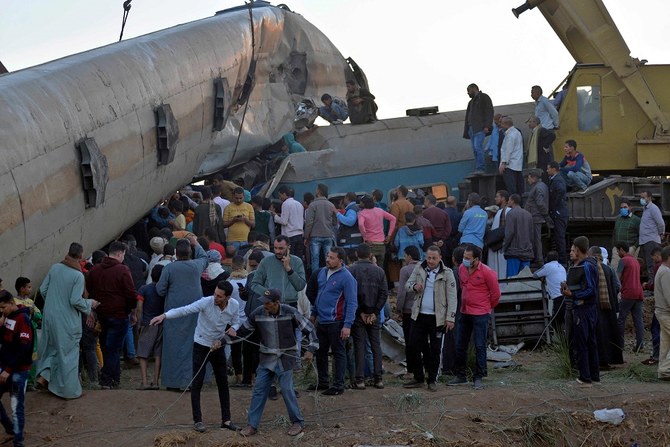
“The trains collided while going at not very high speeds, which led to the destruction of two carriages and (caused) a third to overturn,” a security source told Reuters. The two trains involved were the number 157 and the number 2011.
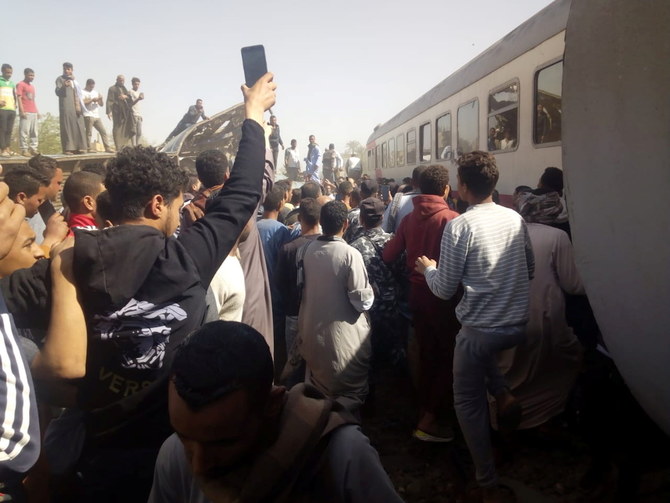
The collision occurred near Al-Sawamiah village in Sohag province in Upper Egypt — 460 kiometers from Cairo. Videos from the scene show the wrecked carriages with passengers trapped inside and surrounded by rubble. Bystanders carried bodies and laid them out on the ground near the site, AP reported.
Prime Minister Mostafa Madbouly set up a crisis room at the Cabinet's Information and Decision Support Center to monitor the situation, and to facilitate coordination between the concerned ministries and departments. He later visited the scene along with five ministers.
The public prosecutor ordered an urgent investigation. The train drivers have been taken in for questioning and a separate probe has been ordered by Transport Minister Kamel Al-Wazir. A security source said further details will be announced once the cause of the accident is confirmed.
#BREAKING | 32 people killed, 84 injured in Upper Egypt’s Sohag train collision- Health Ministry#EgyptToday #BreakingNews #Egypt #Sohag #Africa | # pic.twitter.com/FDT2vSBPL3
— Egypt Today Magazine (@EgyptTodayMag) March 26, 2021
Health Ministry spokesman Khaled Mujahid said that, immediately after the incident, 36 ambulances had been dispatched to transport the injured to hospitals.
He added that the ministry has set up a crisis and emergency room in Sohag to ensure that the injured are taken care of and that there is no shortage of medical supplies.
#BREAKING: 50 people injured in collision of two trains in Upper Egypt: official from the Health Ministry to local media#EgyptToday #BreakingNews | # pic.twitter.com/pf6TJAuxj5
— Egypt Today Magazine (@EgyptTodayMag) March 26, 2021
Images captured by local media showed buckled train carriages derailed above a river.
#Egypt : Crash involving passenger trains in Sohag governorate - unclear how many casualties # pic.twitter.com/7NUzVGVCJe
— sebastian usher (@sebusher) March 26, 2021
El-Sisi earlier wrote on Twitter that he was monitoring the situation closely and that anyone responsible for the crash would be held to account.
“Anyone who caused this painful accident through negligence or corruption, or anything similar, must receive a deterrent punishment without exception or delay,” he tweeted.
"I have directed the prime minister and all agencies concerned to be present at the site of the accident, to continuously follow up, and to inform me of all developments and reports related to the situation … I extend my full condolences to the families of the victims,” he added.
In March last year, at least 13 people were injured when two passenger trains collided in Cairo, triggering a brief suspension of rail services nationwide.
At the time rail managers blamed the crash on signals not functioning in bad weather.
And in February 2019, a train derailed and caught fire at Cairo's main railway station, killing at least 22 people and injuring 41, and prompting the transport minister, Hisham Arafat, to resign.