

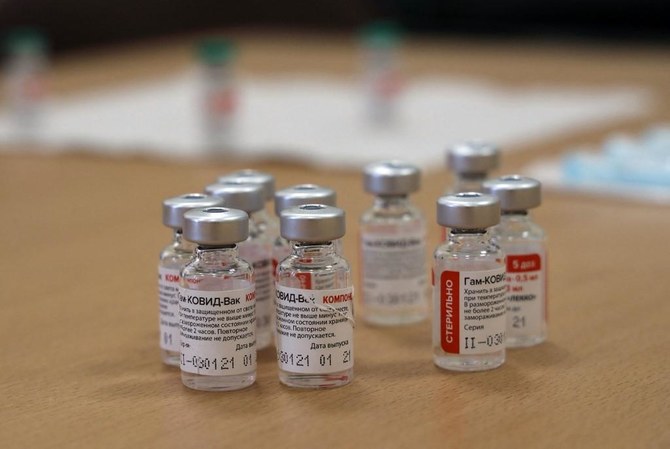

BEIRUT: Lebanon’s private sector has stepped in to bolster the country’s faltering coronavirus vaccination campaign by importing more than a million doses of Russian vaccine.
The first batch of 50,000 doses of the Sputnik V vaccine arrived at Beirut airport early on Friday.
Karol Abu Karam, a representative of the Lebanese company Pharmaline, which imported the Russian vaccine, said that “in conjunction with the arrival of the medicine, an electronic platform has been launched so that those who wish to receive it can register.”
Registration will be limited to companies and institutions, he added.
Jennifer Sarraf, a representative of Malia Group, which owns Pharmaline, said that 600 private firms have registered and over 60,000 employees are expected to be inoculated with the vaccine.
The private sector intervention comes as Lebanon’s medical system faces growing strain amid a widening financial and social crisis.
Dar Al-Amal University Hospital in Baalbek said on Friday that oxygen supplies for about 70 COVID-19 patients and others in the intensive care unit would last only a few hours.
Lebanon’s two-month lockdown has failed to halt the spread of the virus, and the national vaccination process is well behind schedule.
As emergency oxygen stocks dwindle, Lebanon is relying on two companies to provide supplies to hospitals.
One of the firms is Lebanese, and provides 60-80 tons of oxygen per day, while the second — owned by a Lebanese-Syrian company, S.O.A.L, and based in Syria — delivered about 50 tons of oxygen per day.
However, the Syrian regime recently halted exports to Lebanon due to the high demand for emergency oxygen in Syria.
President of the Syndicate of Private Hospitals, Suleiman Haroun, said that hospitals in the country need 120 tons of oxygen per day, and a Lebanese ship is due to arrive from Turkey with 14 trucks, each carrying 22 tons of oxygen.
According to the Ministry of Health’s vaccination platform, about 120,000 medical employees and elderly people have received the first dose as part of the national campaign. About 60,000 people have received the second dose.
FASTFACT
The private sector intervention comes as Lebanon’s medical system faces growing strain amid a widening financial and social crisis
Lebanon has received 224,640 doses of the Pfizer vaccine, financed by the World Bank, and will receive 1.5 million doses of AstraZeneca from R-Pharma, with the first batch due to arrive in early April.
A shipment of AstraZeneca vaccine was among 1.75 million doses allocated through the UN-supported COVAX initiative.
Lebanon is also waiting on a shipment of Chinese vaccine to inoculate military personnel.
The health ministry insists that vaccines supplied through companies be “free of charge and intended for institutions, not individuals.”
Abdel Rahman Bizri, head of the national committee for the administration of the COVID-19 vaccine, said: “The backbone for fighting this epidemic is the public sector, and the private sector’s initiating vaccination is a plus.”
He said that about 1 million people — 20 percent of the population — registered through health ministry platform.
Bizri expects that with private sector help Lebanon will be able to vaccinate 30 percent of the population within two months.
In a meeting on Friday, the Supreme Defense Council warned of a possible rise in cases in coming weeks, with the advent of the Easter holiday and the month of Ramadan.
The council extended the general mobilization for six months and decided to close all sectors during the holidays for three days.
Assem Araji, head of the parliamentary health committee, said: “The reason behind the high number of (COVID-19) cases is the reopening of the country in a chaotic manner in addition to the people’s lack of commitment to preventive measures.”




