100-year-old Pakistani vaccinated in Karachi has lived through two pandemics

A 100-year-old man, Israil Ahmed Menai, speaks to Arab News at his residence in Karachi, Pakistan, on March 23, 2021. (AN Photo)
Short Url
Updated 07 July 2021
Follow

100-year-old Pakistani vaccinated in Karachi has lived through two pandemics

  • Israil Ahmed Menai survived 1936 plague, says commonality with coronavirus pandemic is humans’ will to live and protect themselves
  • Menai received his first dose of the vaccine on March 12 and will get his second shot on April 5

KARACHI: A 100-year-old Pakistani, who received a coronavirus jab earlier this month, urged people this week to take necessary precautions against COVID-19 and get themselves inoculated to prevent the spread of the disease, saying there was no ‘rational’ reason to mistrust vaccines.
It is believed that Israil Ahmed Menai is the oldest person in Pakistan to get vaccinated so far. 
“Such pandemics come and go,” Menai told Arab News in an interview at his residence in Karachi. “People should exercise caution like they have done in the past in similar situations. There is no need to be scared.” 
“Life is a blessing,” he added, while praising the government’s vaccination drive. “I see no rational basis for people to be doubtful about coronavirus vaccines. For every ailment there is a cure which is administered by health experts.” 
Pakistan’s southern Sindh province has received 337,000 doses of the coronavirus vaccine for frontline health workers and senior citizens of 60 years and above. According to official data, 175,266 people were immunized in the province as of this Monday, including 22,687 elderly people. 
Menai received his first dose on March 12 and will get a second shot on April 5.



100-year-old Israil Ahmed Menai, receives first dose of coronavirus vaccine in Karachi, Pakistan on March 12, 2021. (AN Photo)

“I got the first instalment of the vaccine and it did not cause a reaction,” he said. “It was like a normal injection. I will advise all my friends and well-wishers to get this medicine [vaccine] without hesitation.” 
Born in Rampur in present-day India on September 30, 1920, Menai celebrated his 100th birthday last year. His grandfather was the famous 19th century Urdu poet, Ameer Menai, and he received his early education in his hometown before going to Osmania University, Madras, for higher education.
After his family moved to Pakistan in 1950, Menai went to the Fletcher School of Law and Diplomacy and to Harvard University on a Fulbright Scholarship. He started practicing law upon his return to his family’s newly adopted country and stayed in the profession for 70 long years before suffering a cardiac arrest about six years ago.
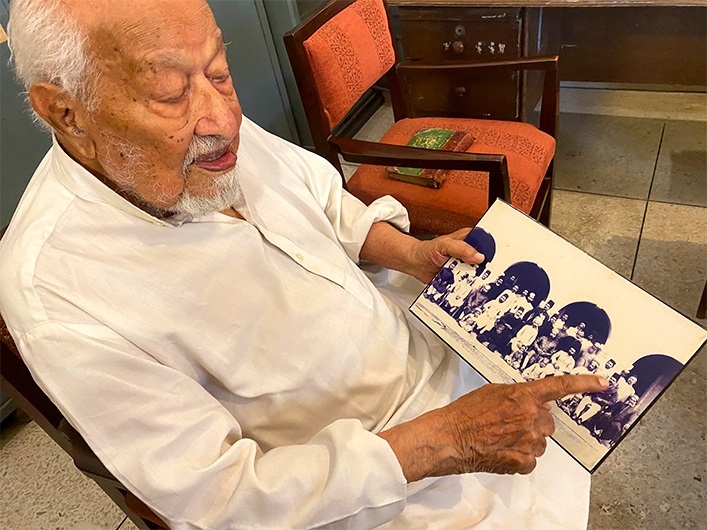


100-year-old Israil Ahmed Menai, who received his first dose of the coronavirus vaccine two weeks ago, shows an old photo from his family album on March 23, 2021, in Karachi, Pakistan. (AN Photo) 

He still occasionally visits courts and spends his free time in bar rooms. 
When the coronavirus pandemic struck last year, it was not the first time Menai’s life has been threatened by an infectious disease. 
“My first experience with a pandemic was in 1936 when a plague started spreading,” he recalled. “Since there were limited communications means and news did not travel as fast as it does now, it looked like a local phenomenon. The world has now transformed into a global village. Things that happen here get immediately reported in places as distant as New York or Seattle.” 
Menai said his experience of the two pandemics was different for many reasons, but one commonality was the will of people to live and use all available resources to protect themselves.
“We may witness yet another pandemic in the future,” he added. “But man has always strived for his existence and health. These efforts [to produce and administer vaccines] are a continuation of the same thing and will also endure in the future.”

Pakistani, Bangladeshi officials discuss trade, investment and aviation as ties thaw

Updated 28 December 2025
Follow

Pakistani, Bangladeshi officials discuss trade, investment and aviation as ties thaw

  • Pakistan and Bangladesh were once one nation, but they split in 1971 as a result of a bloody civil war
  • Ties between Pakistan, Bangladesh have warmed up since last year and both nations have resumed sea trade

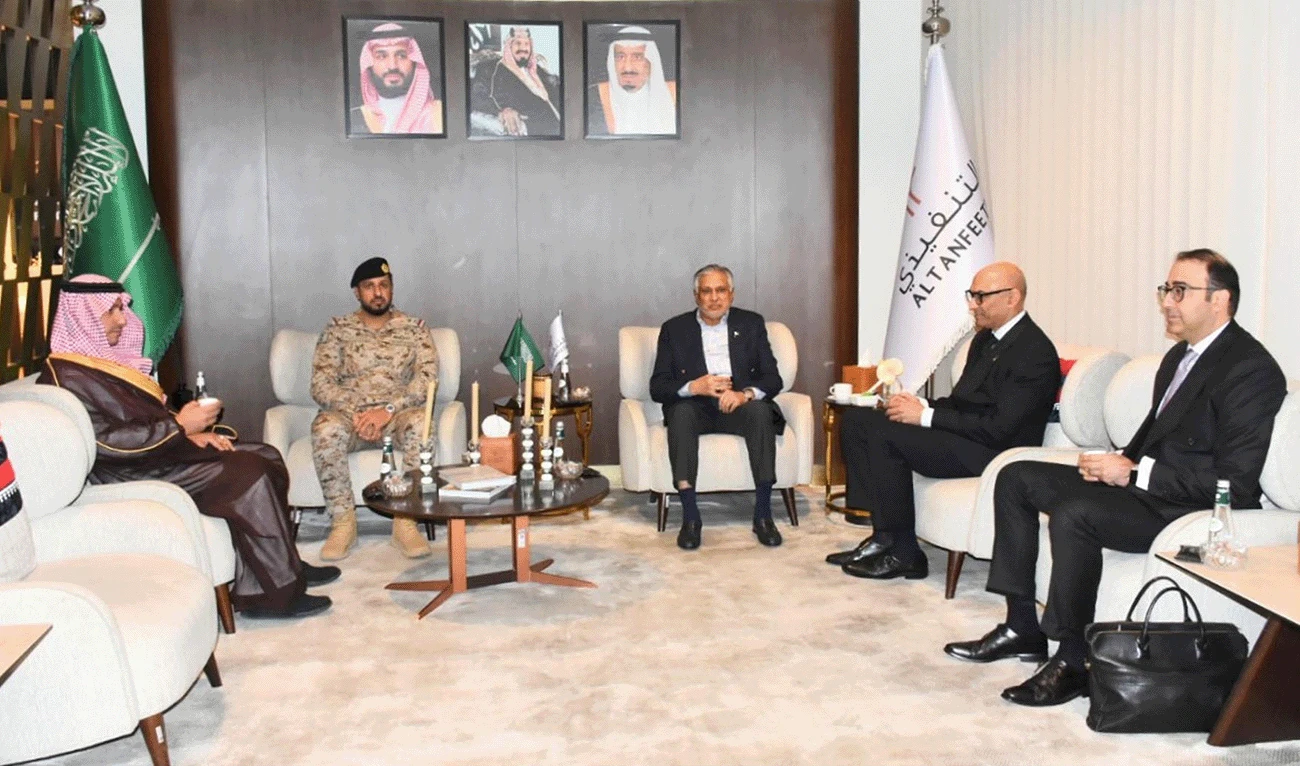
ISLAMABAD: Pakistan's High Commissioner to Bangladesh Imran Haider on Sunday met Chief Adviser Muhammad Yunus in Dhaka, the latter's office said on, with the two figures discussing trade, investment and aviation.

Pakistan and Bangladesh were once one nation, but they split in 1971 as a result of a bloody civil war, which saw the part previously referred to as East Pakistan seceding to form the independent nation of Bangladesh.

Ties between Pakistan and Bangladesh have warmed up since former prime minister Sheikh Hasina’s ouster as a result of a student-led uprising in August 2024. Relations remain frosty between Dhaka and New Delhi over India’s decision to grant asylum to Hasina.

Pakistan has attempted to forge closer ties with Bangladesh in recent months and both South Asian nations last year began sea trade, followed by efforts to expand government-to-government commerce.

"During the meeting, both sides discussed ways to expand cooperation in trade, investment, and aviation as well as scaling up cultural, educational and medical exchanges to further strengthen bilateral relations between the two South Asian nations," Yunus's office said in a statement on X.

In 2023-24 Pakistan exported goods worth $661 million to Bangladesh, while its imports were only $57 million, according to the Trade Development Authority of Pakistan. In Aug. this year, the Pakistani and Bangladeshi commerce ministries signed a memorandum of understanding to establish a Joint Working Group on Trade, aiming to raise their bilateral trade volume to $1 billion in the financial year that began in July.

The Pakistani high commissioner noted that bilateral trade has recorded a 20 percent growth compared to last year, with business communities from both countries actively exploring new investment opportunities, according to the statement.

He highlighted a significant increase in cultural exchanges, adding that Bangladeshi students have shown strong interest in higher education opportunities in Pakistan, particularly in medical sciences, nanotechnology, and artificial intelligence. Haider also said that Dhaka-Karachi direct flights are expected to start in January.

"Chief Adviser Professor Muhammad Yunus welcomed the growing interactions between the two countries and emphasized the importance of increased visits as well as cultural, educational and people-to-people exchanges among SAARC (South Asian Association for Regional Cooperation) member states," the statement read.

"Professor Yunus also underscored the need to further boost Bangladesh–Pakistan trade and expressed hope that during Mr. Haider’s tenure, both countries would explore new avenues for investment and joint venture businesses."