

Houthis stuck in Marib military quagmire, experts say

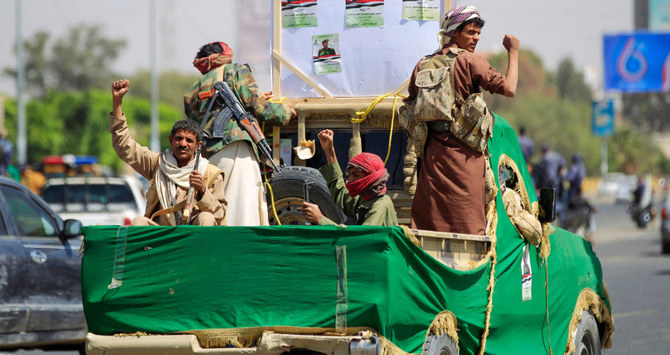
More than a month since the offensive began, the Houthis have lost hundreds of fighters and failed to make major advances toward the city of Marib. (AFP)
Short Url
Updated 23 March 2021
Follow

Houthis stuck in Marib military quagmire, experts say

  • Rebels could use stalemate as leverage for behind-the-scenes negotiations in Yemen

AL-MUKALLA: The Iran-backed Houthis find themselves embroiled in a costly military quagmire in Yemen’s central province of Marib as their month-long offensive has stalled and they have not been able to recapture the province's capital.

The military deadlock has prompted the rebels into shifting their goal from taking Marib city to potentially using the offensive as a bargaining chip in future peace talks, Yemeni experts say.

“While the Houthis initially had momentum in their offensive on Marib, the battle has descended into a familiar stalemate,” Samuel Ramani, an international relations researcher at Oxford University, told Arab News.

“On March 14, reports from the Yemeni government suggested that the Houthis were losing ground and that the government forces were turning the tide.”

Earlier last month, thousands of Houthi fighters, including elite forces, rolled into Marib province from three directions: Sana’a, Jouf and Al-Bayda. The rebels’ plan was to capture Marib, its oil and gas fields and expel the Yemeni government from its last bastion in the northern part of the country.

More than a month since the offensive began, the Houthis have lost hundreds of fighters and failed to make major advances toward the city of Marib, located about 75 miles east of Yemen's capital Sana'a.

“Houthis stumbled in Marib. Their offensive has been repelled,” Nadwa Al-Dawsari, a Yemeni conflict analyst and a non-resident scholar at the US-based Middle East Institute told Arab News.

Yemen experts argue that the Houthis, stuck deep in a military stalemate and increased fatalities, have dropped their goal of seizing Marib and could use the offensive as leverage at behind-the-scenes negotiations.

“There's a possibility the Houthis knew the probability of taking Marib was low, especially given the power of the tribes and the terrain, which exposes them to Saudi airstrikes,” Katherine Zimmerman, a fellow at the American Enterprise Institute, told Arab News.

“They may be seeking to use their new positions as a bartering chip at future negotiations.”

Despite pushing back consecutive Houthi assaults and inflicting heavy losses on them, the Yemeni government troops could not completely flush out the rebels from the city and surrounding areas.

The rebels are still close and pose a threat to the city, experts say.

“They are still sending reinforcements. While their offensive was stalled by the tribes and government forces, they are still a threat to Marib,” Al-Dawsari said.

The city’s geographical and societal natures, in addition to massive military support from the Arab coalition, have played roles in foiling the Houthi offensive.

The rebels’ assaults have pushed Marib’s powerful tribesmen into joining the battlefields and standing by the Yemeni army.

The province’s mountainous terrain has exposed rebel fighters to Saudi airstrikes, Zimmerman said. Experts and local government officials say that warplanes from the Arab coalition have disrupted Houthi attacks, targeting military reinforcements to the battlefields.

The coalition even published videos showing warplanes attacking Houthi military fighters, tanks and military equipment in Marib’s mountain and desert regions.

Marib’s governor, Sultan Al-Arada, said the Houthis would have successfully invaded the city if the warplanes did not take part in the fighting.

“The situation would have been different,” Al-Aradah said during an online press conference arranged by the Sana’a Center For Strategic Studies earlier this month.

Yemen experts predict three scenarios for the post-Houthi offensive on Marib: the Yemeni government forces and the Houthis plunge deeper into a military stalemate, the rebels break through and take full control of Marib, or the government forces completely push the rebels out of the Marib province.

The outcome of the offensive could decide the trajectory of the country’s political and military courses.

“If Houthis take Marib, the political process will officially collapse,” Al-Dawsari said. “Already, the rebels have demonstrated a lack of interest in political negotiations. They want an end to Saudi airstrikes and military intervention but they are not really interested in reaching a political agreement with other actors.”

But if the Houthis fail to capture Marib, they might pause the offensive and engage in talks with their opponents to buy time and regroup forces before renewing strikes.

“The unreliability of the rebels as peace partners makes it difficult to predict their response to a failed offensive in Marib,” Ramani said. “They might engage in dialogue with Saudi Arabia, perhaps facilitated by Oman, just to buy time and then escalate again.”


Sudan’s war puts charity kitchen workers feeding displaced families at risk

Updated 34 min 41 sec ago
Follow

Sudan’s war puts charity kitchen workers feeding displaced families at risk

  • The real number of workers killed is likely far higher than the estimated 100, he says, but the war has prevented reliable data collection and record-keeping

CAIRO: Enas Arbab fled Sudan’s western region of Darfur after her hometown fell to Sudanese paramilitary forces, taking only her year-old son with her and the memory of her father, who was killed, she said, simply for working at a charity kitchen serving people displaced by the fighting.
The Rapid Support Forces — or RSF, a paramilitary group that has been at war with the Sudanese army since April 2023 — had laid siege on el-Fasher in the western Darfur region, starving people out before it overran the city.
UN officials say several thousand civilians were killed in the RSF takeover of el-Fasher last October. Only 40 percent of the city’s 260,000 residents managed to flee the onslaught, thousands of whom were wounded, the officials said. The fate of the rest remains unknown.
During the fighting, Arbab says RSF fighters took her father, Mohamed ِArbab, from their home after beating him in front of the family, and demanded a ransom. When the family couldn’t pay, they told them they had killed him, she says. To this day, the family doesn’t know where his body is.
When her husband disappeared a month later, Enas Arbab decided to flee north, to Egypt. “We couldn’t stay in el-Fasher,” she said. “It was no longer safe and there was no food or water.”
Her father was one of more than 100 charity kitchen workers who have been killed since the war began, according to workers who spoke with The Associated Press and the Aid Workers Security database, a group that tracks major incidents around the world impacting aid workers.
In areas of intense fighting — especially in Darfur — famine is spreading and food and basic supplies are scarce. The community-led public kitchens have become a lifeline but many working there have been abducted, robbed, arrested, beaten or killed.
Grim numbers in a brutal war
Volunteer Salah Semsaya with the Emergency Response Rooms — a group that emerged as a local initiative and now operates in 13 provinces across Sudan, with 26,000 volunteers — acknowledges the dangers faced by workers in charity kitchens.
The real number of workers killed is likely far higher than the estimated 100, he says, but the war has prevented reliable data collection and record-keeping.
Semsaya shared records showing that 57 percent of the documented killings of charity kitchen workers occurred in Khartoum, mainly while the Sudanese capital was under RSF control, before the army retook it last March. At least 21 percent of the killings were in Darfur.
More than 50 of those killed in Khartoum worked with his group, Semsaya said.
Sudan’s war erupted after tensions between the army and the RSF escalated into fighting that began in Khartoum and spread nationwide, killing thousands and triggering mass displacement, disease outbreaks and severe food insecurity. Aid workers were frequently targeted.
Dan Teng’o, communications chief at the UN office for humanitarian affairs, says it’s unclear whether charity kitchen workers are targeted because of their work or because of their perceived affiliation with one side or other in the war.
The kitchen workers are prominent in their communities because of the work they do, making them obvious targets, activists say. Ransom demands typically range from $2,000 to $5,000, often rising once families make initial payments.
“A clear deterioration in the security context ... has significantly affected local communities, including volunteers supporting community kitchens,” Teng’o said.
Kitchen workers face risks
Farouk Abkar, a 60-year-old from el-Fasher, spent a year handing out sacks of grain at a charity kitchen in Zamzam camp, just 15 kilometers (9 miles) south of the city. He survived drone strikes and remembers the day RSF fighters attacked his kitchen. One of them punched him in the face, knocking some of his teeth out.
Abkar said he fled el-Fasher at night with his daughter, walking for 10 days. Along the way, some RSF fighters fired birdshot, which hit him in the head, leaving a chronic headache.
Now in Egypt, he shares an apartment with at least 10 other Sudanese refugees and can’t afford medical care. The harrowing images from his hometown still haunt him.
“Many things happened in el-Fasher,” he said. “There was death. There was starvation.”
Mustafa Khater, a 28-year-old charity kitchen worker, fled with his pregnant wife to Egypt a few days before el-Fasher fell to the RSF.
During the 18-month siege, some el-Fasher residents collaborated with the RSF, telling the paramilitary fighters who the kitchen workers were, Khater said. Many disappeared.
“They would take you to an area where there is a dry riverbed and kill you there,” Khater said.
A volunteer working with Semsaya’s aid group in Darfur said some of his colleagues were beaten, arrested and interrogated, with their attackers accusing them of receiving “illicit funds” for the kitchen. The volunteer spoke on condition of anonymity for fear of reprisals.
Despite the challenges, many charity kitchens remain the only reliable food source in areas gripped by conflict and a place people can come to and give each other support, Semsaya said.
Struggling to feed thousands
The town of Khazan Jedid in East Darfur province has three charity kitchens feeding about 5,000 people daily, said Haroun Abdelrahman, a spokesperson for the Emergency Response Rooms’ branch in the area.
Abdelrahman says he was once interrogated by RSF fighters, while several of his colleagues have been robbed at knifepoint. Despite the fear and harassment, many kitchen workers are still volunteering and working, he said.
In Kassala in eastern Sudan, military agents questioned a volunteer with the branch there and his colleagues in January 2024, he said, after their kitchen started serving food and providing shelter to people who escaped nearby Wad Madani when RSF seized that town. He also spoke anonymously for fear of reprisals.
Khater, the 28-year-old who fled el-Fasher, said he heard from friends back home that after the RSF takeover, all charity kitchens in the city closed and his colleagues were either “killed or fled.”
Teng’o says the closures in areas of fighting have left “vulnerable households with no viable alternatives” and forced people to shop at local “markets where food prices are unaffordable.”
Arbab, the pregnant 19-year-old who fled with her baby boy, had hoped to rebuild her life in Egypt, her friends and a humanitarian worker said, speaking on condition of anonymity to talk about the young mother.
But while on the road to the northern city of Alexandria last month, she and her son were stopped by Egyptian authorities and deported back to Sudan.