

Islamabad school offers transgender community place to worship, learn about religion

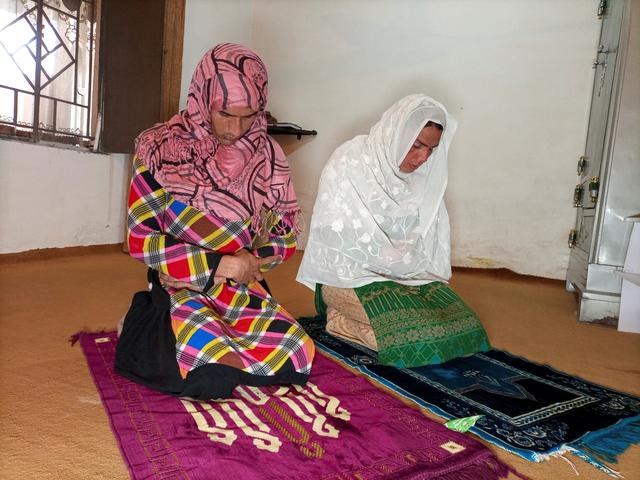
Rani Khan, a transgender woman who teaches the Qur’an at Pakistan's first transgender only madrasa or a religious school, prays with one of her students in Islamabad, Pakistan March 10, 2021. (REUTERS)
Short Url
Updated 22 March 2021
Follow

Islamabad school offers transgender community place to worship, learn about religion

  • The school is an important milestone for the community in Pakistan where transgender people face ostracism
  • Pakistan’s parliament recognized the third gender in 2018, giving such individuals rights such as ability to vote

ISLAMABAD: A long white shawl on her head, Rani Khan gives daily Qur’an lessons at Pakistan’s first transgender-only madrasa, or Islamic religious school, which she set up herself using her life savings.

The madrasa is an important milestone for the community in Muslim-majority Pakistan where transgender people face ostracism, even though there is no official restriction on them attending religious schools or praying at mosques.
“Most families do not accept transgender people. They throw them out of their homes. Transgender people turn to wrongdoing,” Khan, 34, said, as other transgender people, their heads similarly covered, swayed back and forth behind her, reciting Qur’an verses. “At one time, I was also one of them.”
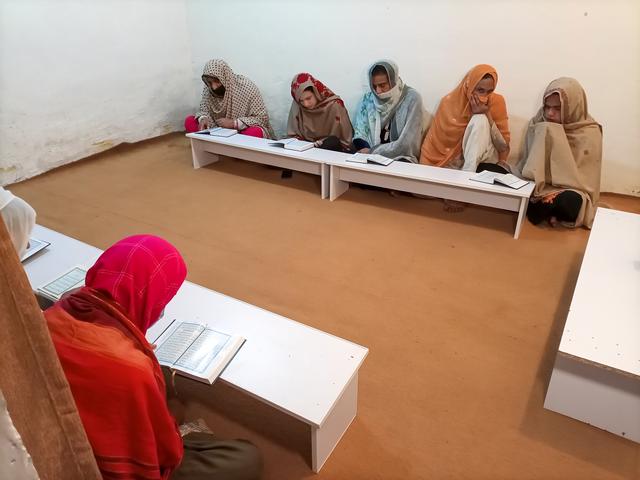


A group of transgender women learn the Qur’an at Pakistan's first transgender only madrasa or a religious school in Islamabad, Pakistan February 25, 2021. (REUTERS)

Holding back tears, Khan recalled how she was disowned by her family at 13 and forced into begging.
At 17, she joined a transgender group, dancing at weddings and other functions, but quit it to connect with her religion after a dream in which a deceased transgender friend and fellow dancer pleaded with her to do something for the community.
Khan studied the Qur’an at home, and attended religious schools, before opening the two-room madrasa in October.
“I’m teaching the Qur’an to please God, to make my life here and in the hereafter,” Khan said, explaining how the madrasa offered a place for transgender people to worship, learn about Islam and repent for past actions.
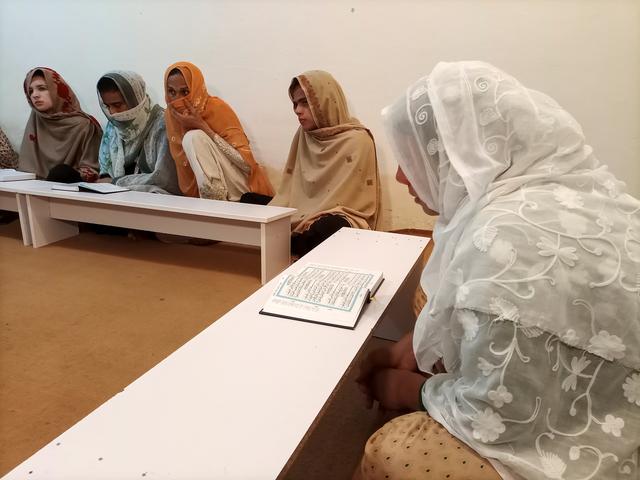


A group of transgender women learn the Qur’an at Pakistan's first transgender only madrasa or a religious school, in Islamabad, Pakistan February 25, 2021. (REUTERS)

She says the school has not received aid from the government, although some officials promised to help students find jobs.
Along with some donations, Khan is teaching her students how to sew and embroider, in hopes of raising funds for the school by selling clothing.
Pakistan’s parliament recognized the third gender in 2018, giving such individuals fundamental rights such as the ability to vote and choose their gender on official documents.
Nonetheless, the transgender remain on the margins in the country, and often have to resort to begging, dancing and prostitution to make a living.
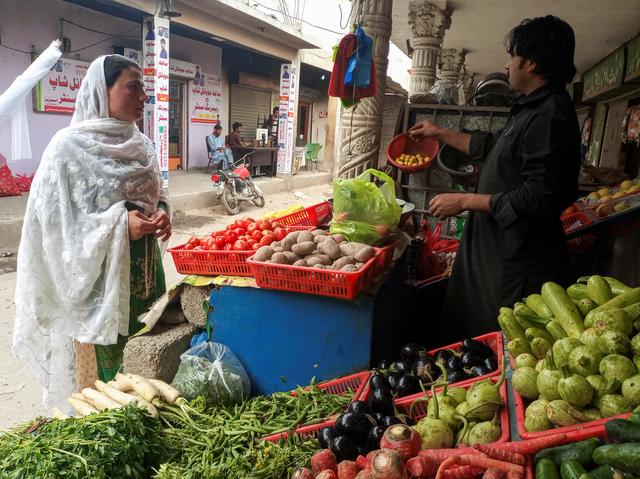


Rani Khan, a transgender woman who teaches the Qur’an at Pakistan's first transgender only madrasa or a religious school, buys vegetables at a market in Islamabad, Pakistan March 10, 2021. (REUTERS)

The madrasa could help trans people assimilate into mainstream society, Islamabad Deputy Commissioner Hamza Shafqaat told Reuters.
“I’m hopeful that if you replicate this model in other cities, things will improve,” he said.
A religious school for transgender people has opened in Dhaka, the capital of nearby Bangladesh, and last year a Christian transgender group started its own church in Pakistan’s bustling southern port city of Karachi.
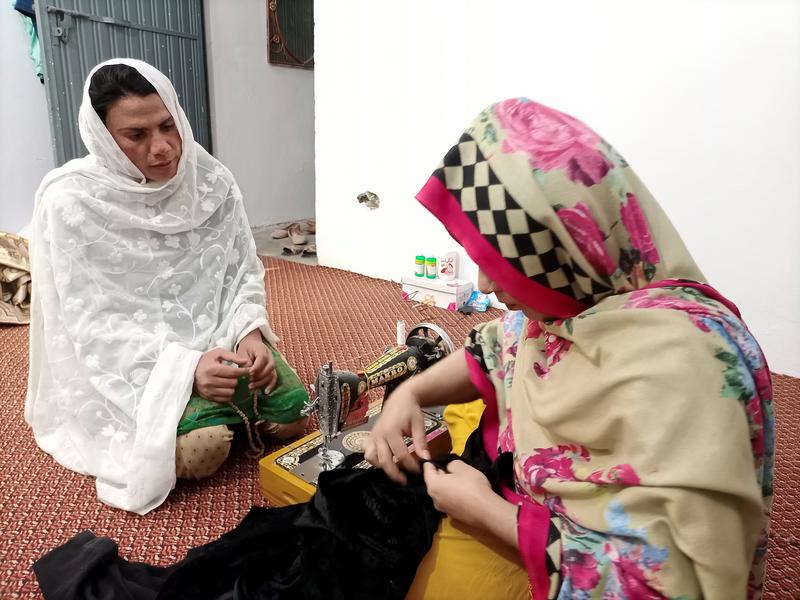


Rani Khan, a transgender woman who teaches the Qur’an at Pakistan's first transgender only madrasa or a religious school, looks at one of her students during a tailoring lesson in Islamabad, Pakistan March 10, 2021. (REUTERS)

Pakistan’s 2017 census recorded about 10,000 transgender people, though trans rights groups say the number could now be well over 300,000 in the country of 220 million.
“It gives my heart peace when I read the Qur’an,” said one madrasa student, Simran Khan, who is also eager to learn life skills. “It is much better than a life full of insults,” the 19-year-old added.


Islamabad dismisses claims about paying up to 8 percent interest on foreign loans as ‘misleading’

Updated 22 February 2026
Follow

Islamabad dismisses claims about paying up to 8 percent interest on foreign loans as ‘misleading’

  • Pakistan has long relied on external loans to help bridge persistent gaps in public finances and foreign exchange reserves
  • Pakistan’s total external debt, liabilities stand at $138 billion at an overall average cost of around 4 percent, ministry says

KARACHI: Pakistan’s finance ministry on Sunday dismissed as “misleading” claims that the country is paying up to 8 percent interest on external loans, saying the overall average cost of external public debt is approximately 4 percent.

Pakistan has long relied on external loans to help bridge persistent gaps in public finances and foreign exchange reserves, driven largely by a narrow tax base, chronic trade deficits, rising debt-servicing costs and repeated balance-of-payments pressures.

Over the decades, successive governments have turned to multilateral and bilateral lenders, including the International Monetary Fund, the World Bank and the Asian Development Bank, to support budgetary needs and shore up foreign exchange reserves.

The finance ministry on Sunday issued a clarification in response to a “recent press commentary” regarding the country’s external debt position and associated interest payments, and said the figures required contextual explanation to ensure accurate understanding of Pakistan’s external debt profile.

“Pakistan’s total external debt and liabilities currently stand at $138 billion. This figure, however, encompasses a broad range of obligations, including public and publicly guaranteed debt, debt of Public Sector Enterprises (both guaranteed and non-guaranteed), bank borrowings, private-sector external debt, and intercompany liabilities to direct investors. It is therefore important to distinguish this aggregate figure from External Public (Government) Debt, which amounts to approximately $92 billion,” it said.

“Of the total External Public Debt, nearly 75 percent comprises concessional and long-term financing obtained from multilateral institutions (excluding the IMF) and bilateral development partners. Only about 7 percent of this debt consists of commercial loans, while another 7 percent relates to long-term Eurobonds. In light of this composition, the claim that Pakistan is paying interest on external loans ‘up to 8 percent’ is misleading.

The overall average cost of External Public Debt is approximately 4 percent, reflecting the predominantly concessional nature of the borrowing portfolio.”

With respect to interest payments, public external debt interest outflows increased from $1.99 billion in Fiscal Year (FY) 2022 to $3.59 billion in FY2025, representing an increase of 80.4 percent, not 84 percent as reported. In absolute terms, interest payments rose by $1.60 billion over this period, not $1.67 billion, it said.

According to the State Bank of Pakistan’s records, Pakistan’s total debt servicing payments to specific creditors during the period under reference were as follows: the IMF received $1.50 billion, of which $580 million constituted interest; Naya Pakistan Certificates payments totaled $1.56 billion, including $94 million in interest; the Asian Development Bank received $1.54 billion, including $615 million in interest; the World Bank received $1.25 billion, including $419 million in interest; and external commercial loans amounted to nearly $3 billion, of which $327 million represented interest payments.

“While interest payments have increased in absolute terms, this rise cannot be attributed solely to an expansion in the debt stock,” the ministry said. “Although the overall debt stock has increased slightly since FY2022, the additional inflows have primarily originated from concessional multilateral sources and the IMF’s Extended Fund Facility (EFF) under the ongoing IMF-supported program.”

Pakistan secured a $7 billion IMF bailout in Sept. 2024 as part of Prime Minister Shehbaz Sharif’s efforts to stabilize the South Asian economy that narrowly averted a default in 2023. The government has since been making efforts to boost trade and bring in foreign investment to consolidate recovery.

“It is also important to note that the increase in interest payments reflects prevailing global interest rate dynamics. In response to the inflation surge of 2021–22, the US Federal Reserve raised the federal funds rate from 0.75-1.00 percent in May 2022 to 5.25–5.50 percent by July 2023. Although rates have since moderated to around 3.75 percent, they remain significantly higher than 2022 levels,” the finance ministry said.

“The government remains committed to prudent debt management, transparency, and the continued strengthening of Pakistan’s macroeconomic stability,” it added.