

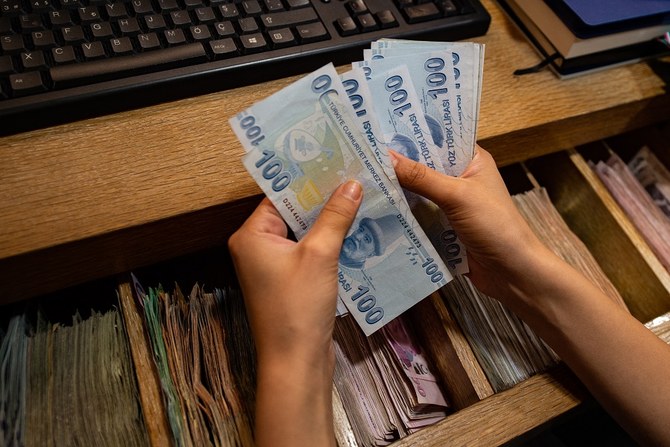
Turkish lira tanks as Ankara-exposed stocks tumble

The currency fell to as low as 8.47 against the dollar compared to 7.22 on Friday. (AFP)
Short Url
Updated 22 March 2021
Follow

Turkish lira tanks as Ankara-exposed stocks tumble

  • Erdogan abruptly ousted latest bank chief Agbal on Saturday
  • New bank chief an outspoken critic of tight policy

DUBAI: The Turkish lira crashed by nearly 15 percent Monday after the sacking of the country’s central bank chief rattled global markets.
The currency fell to as low as 8.47 against the dollar compared to 7.22 on Friday.

The currency recovered slightly later in the session to 8.09.
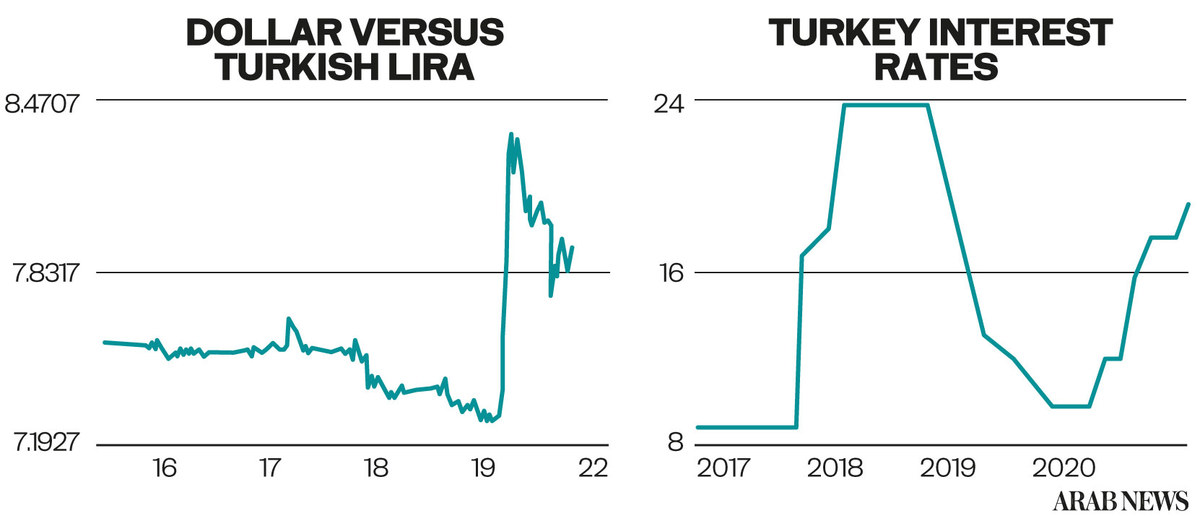
President Recep Tayyip Erdogan's abrupt dismissal of the reformist governor Naci Agbal sent shock waves across markets and triggered fresh worries for millions of Turks concerned about their savings.

The governor was replaced by former ruling party lawmaker Sahap Kavcioglu over the weekend.
A presidential decree on Friday did not explain why Agbal had been removed, but it comes a day after the bank hiked interest rates more than two percentage points to 19 percent in a bid to fight inflation.
“We now see the possibility of an inter-meeting interest rate cut under the new governor, alongside the potential for accelerated capital outflows,” said Abu Dhabi Commercial Bank chief economist Monica Malik, in a note to investors on Monday.
The Borsa Istanbul suspended trading twice when automatic circuit breakers kicked in amid a huge sell-off nearing 8 percent.
Yields on Turkish bonds also rose to record highs.
The fallout was felt across global currency and equities markets. The dollar gained as investors sought safety in the greenback while at the same time some companies with exposure to Ankara had their share price hammered.
Shares in Spain’s BBVA, which makes around 14 percent of its profits in Turkey through its Turkish unit Garanti, plunged as much as 7.7 percent.
The MSCI emerging market currency index was down about 0.1 percent, with high-yielding currencies including the South African rand and the Mexican peso easing about 0.8 percent and 1.4 percent, respectively.
“It may well be that interest rate hikes are once again permitted by Erdogan in a phase of crisis-like lira depreciation but the recent developments should have shown currency traders that even then a sustainable monetary policy regime change is not to be expected,” said Ulrich Leuchtmann, head of FX at Commerzbank.
“The calming effect of interest rate hikes has probably been largely destroyed.”

(With agencies)


Saudi Arabia’s cultural sector is a new economic engine between Riyadh and Paris, says ambassador

Updated 25 January 2026
Follow

Saudi Arabia’s cultural sector is a new economic engine between Riyadh and Paris, says ambassador

RIYADH: Culture has become a fundamental pillar in bilateral relations between France and Saudi Arabia, according to the French Ambassador to the Kingdom, Patrick Maisonnave.

Maisonnave noted its connection to the entertainment and tourism sectors, which makes it a new engine for economic cooperation between Riyadh and Paris.

He told Al-Eqtisadiah during the opening ceremony of La Fabrique in the Jax district of Diriyah that cultural cooperation with Saudi Arabia is an important element for its attractiveness in the coming decades.

La Fabrique is a space dedicated to artistic creativity and cultural exchange, launched as part of a partnership between the Riyadh Art program and the French Institute in Riyadh. 

Running from Jan. 22 until Feb 14, the initiative will provide an open workspace that allows artists to develop and work on their ideas within a collaborative framework.

Launching La Fabrique as a space dedicated to artistic creativity

The ambassador highlighted that the transformation journey in the Kingdom under Vision 2030 has contributed to the emergence of a new generation of young artists and creators, alongside a growing desire in Saudi society to connect with culture and to embrace what is happening globally. 

He affirmed that the relationship between the two countries is “profound, even cultural par excellence,” with interest from the Saudi side in French culture, matched by increasing interest from the French public and cultural institutions unfolding in the Kingdom.

Latest estimates indicate that the culture-based economy represents about 2.3 percent of France’s gross domestic product, equivalent to more than 90 billion euros ($106.4 billion) in annual revenues, according to government data. The sector directly employs more than 600,000 people, making it one of the largest job-creating sectors in the fields of creativity, publishing, cinema, and visual arts.

Saudi Arabia benefiting from French experience in the cultural field

Maisonnave explained that France possesses established cultural institutions, while Saudi Arabia is building a strong cultural sector, which opens the door for cooperation opportunities.

This comes as an extension of the signing of 10 major cultural agreements a year ago between French and Saudi institutions, aiming to enhance cooperation and transfer French expertise and knowledge to contribute to the development of the cultural system in the Kingdom.

He added that experiences like La Fabrique provide an opportunity to meet the new generation of Saudi creators, who have expressed interest in connecting with French institutions and artists in Paris and France.

La Fabrique encompasses a space for multiple contemporary artistic practices, including performance arts, digital and interactive arts, photography, music, and cinema, while providing the public with an opportunity to witness the stages of producing artistic works and interact with the creative process.