

Central Bank of Egypt offers EGP19 billion worth of treasury bills

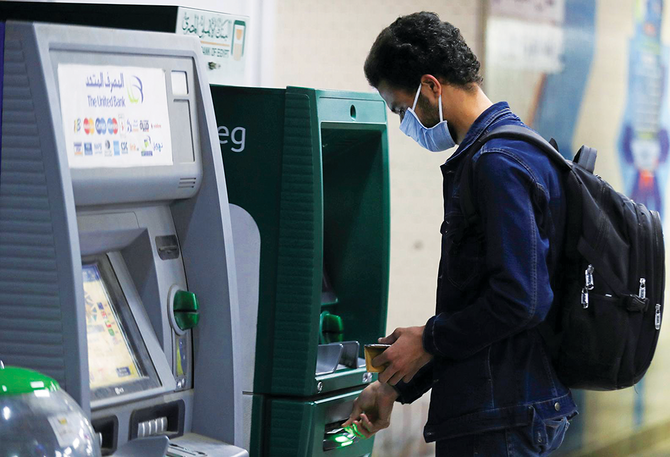
The Central Bank of Egypt confirmed that the value of the first offering amounted to EGP11 billion for a period of 91 days. (Reuters/File)
Short Url
Updated 22 March 2021
Follow

Central Bank of Egypt offers EGP19 billion worth of treasury bills

  • Governments resort to financing budget deficits by offering bonds and treasury bills as debt instruments, and public banks are their largest buyers. •Treasury bills are short-term debt instruments, with maturities ranging from three months to a year

CAIRO: The Central Bank of Egypt on Sunday issued treasury bills worth EGP19 billion ($1.21 billion) on behalf of the Finance Ministry.

Governments resort to financing budget deficits by offering bonds and treasury bills as debt instruments, and public banks are their largest buyers.

Treasury bills are short-term debt instruments, with maturities ranging from three months to a year.

On its website the Central Bank of Egypt confirmed that the value of the first offering amounted to EGP11 billion for a period of 91 days, while the second offering would be EGP8 billion for a period of 266 days.

Central bank revenues from loans and balances with banks, in addition to the proceeds from treasury bills and bonds, rose from EGP26.51 billion to a record EGP145.387 billion during the fiscal year ending June 30, 2019, compared to EGP118.875 billion for the year before that. 

Financial statements showed that the central bank increased its revenues from loans and bank balances to EGP18.7 billion at the end of June 2019, compared to EGP11.6 billion pounds at the end of June 2018.

NBE expansion plans

National Bank of Egypt (NBE) is looking to launch a subsidiary bank in South Sudan and a branch in Saudi Arabia, deputy chairman Yehia Abou El-Fettouh has said.

In an official statement, El-Fettouh said that NBE had obtained the necessary approvals from the Central Bank of Egypt to launch an affiliated bank in South Sudan with about $30 million in capital, adding that approval will soon be granted by South Sudan.

The Central Bank of Egypt also granted NBE permission to open a branch in Saudi Arabia, he said, adding that requirements by regulatory authorities in the Kingdom are being finalized.

El-Fettouh said that NBE seeks to consolidate its presence in emerging markets, especially in Africa, which is within the framework of Egypt’s goal to improve economic and commercial relations in the region.


Closing Bell: Saudi main index closes in red at 11,167  

Updated 11 February 2026
Follow

Closing Bell: Saudi main index closes in red at 11,167  

RIYADH: Saudi Arabia’s Tadawul All Share Index dipped on Wednesday, losing 46.43 points, or 0.41 percent, to close at 11,167.54. 

The total trading turnover of the benchmark index was SR4.88 billion ($1.30 billion), as 66 of the listed stocks advanced, while 192 retreated. 

The MSCI Tadawul Index decreased, down 5.52 points, or 0.37 percent, to close at 1,506.55. 

The Kingdom’s parallel market Nomu lost 153.40 points, or 0.65 percent, to close at 23,486.52. This comes as 32 of the listed stocks advanced, while 31 retreated. 

The best-performing stock was Tourism Enterprise Co., with its share price surging 9.95 percent to SR14.36. 

Other top performers included Mobile Telecommunication Co., Saudi Arabia, which saw its share price rise by 5.32 percent to SR11.48, and Al Masar Al Shamil Education Co., which saw a 4.86 percent increase to SR22.89. 

On the downside, Almoosa Health Co. was the day’s weakest performer, with its share price falling 4.81 percent to SR150.40. 

Dallah Healthcare Co. fell 3.81 percent to SR113.50, while Saudi Research and Media Group dropped 3.44 percent to SR100.90. 

On the corporate front, Arabian Plastic Industrial Co. has signed a non-binding memorandum of understanding with K. K. Nag to explore the establishment of a specialized manufacturing facility for expanded polypropylene products. 

According to a Tadawul statement, the agreement sets out initial mutual obligations and rights between the two parties as part of APICO’s broader expansion strategy to increase production capacity and meet rising industrial demand. 

The company’s share price rose 1.21 percent to SR43.52 on the parallel market.