

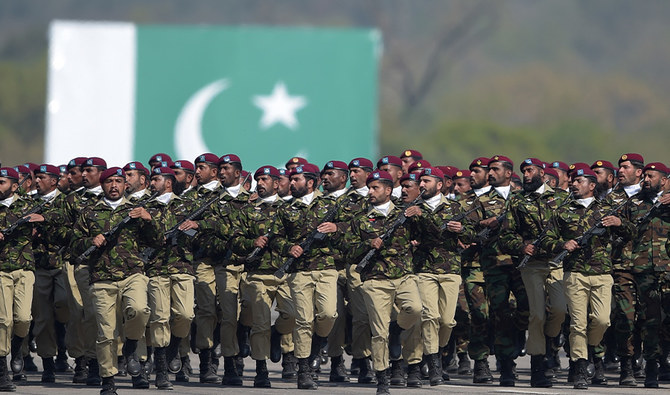

ISLAMABAD: Pakistan’s National Command and Operation Center (NCOC), the government’s central body dealing with the coronavirus pandemic, will meet on Monday to decide whether or not to hold the Pakistan Day parade this year amid a spike in COVID-19 cases across the country, state-run media reports said.
State-run Associated Press of Pakistan (APP) added that Monday’s session would also take stock of the rise in cases in the education sector and prevailing infections across the country.
The government had canceled the parade due to the COVID-19 pandemic last year as well.
“An NCOC meeting is scheduled to be held on Monday [March 22] at which we will review the situation, and if it doesn’t improve, a decision of stricter measures can be announced,” NCOC chief and planning minister Asad Umar told reporters on Friday.
In an interview last week, Umar had said that there was “no doubt” that Pakistan was dealing with the third wave of the outbreak.
“Absolutely. There is no doubt in this that the third wave has started and the phenomena that is driving this is the spread of the UK strain,” he said.
The Pakistan Day parade is held on March 23 every year to commemorate the Lahore Resolution, which was adopted on the same day in 1940 and laid the foundation for a Muslim-majority state in South Asia.
High-profile officials and foreign dignitaries – including Pakistan’s president, prime minister, cabinet ministers, services chiefs and members of the diplomatic community – attend the event, providing a platform for the armed forces to display their war readiness and weapons’ systems.
However, noting an uptick in COVID-19 cases, Interior Minister Sheikh Rashid said on Saturday night that the government might impose smart lockdowns soon.
Meanwhile, a lawmaker from the ruling Pakistan Tehreek-e-Insaf (PTI) party, Senator Faisal Javed, tweeted on Saturday that a complete lockdown was not “on the cards yet,” but stringent measures including selective lockdowns could be adopted to curb the spread of the disease.
“Complete lockdown devastates economy & pushes a large segment of population below poverty line posing bigger challenges of hunger & survival,” he said.
No complete lockdown on the cards yet. But stringent measures,incl selective lockdowns, hotspots ll be adopted to stop the spread of corona.Complete lockdown devastates economy & pushes a large segment of population below poverty line posing bigger challenges of hunger & survival https://t.co/JSm1OdOy3X
— Faisal Javed Khan (@FaisalJavedKhan) March 20, 2021
Authorities have already re-imposed partial lockdowns in some parts of the country, including in the capital city Islamabad, and re-introduced several restrictions such as making face masks mandatory.
This is in addition to a two-week spring break for educational institutions in Peshawar, Islamabad and other cities of the populous Punjab province to bring down the number of coronavirus cases.


