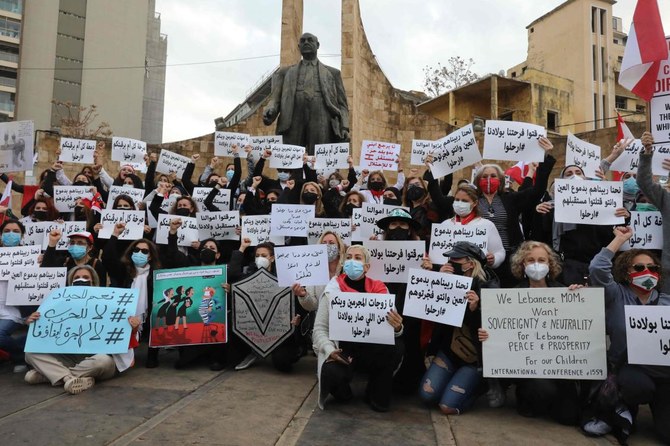
BEIRUT: Women took to the streets on Saturday afternoon on the eve of Mother’s Day, despite warnings from doctors about the risk of the coronavirus spreading.
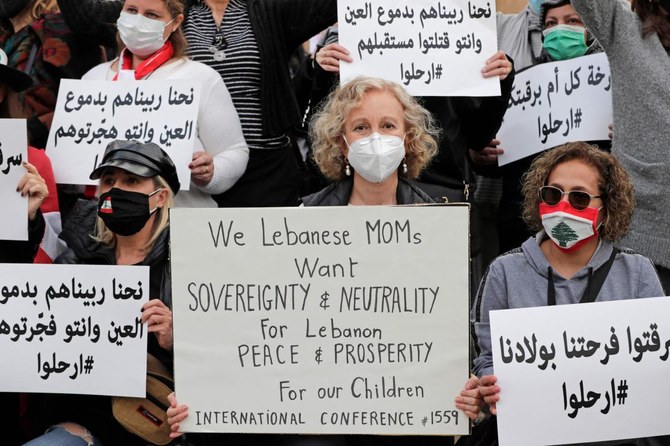
Mothers’ anger at the current situation, which has prompted a generation of young people to migrate, pushed dozens to protest.
A group of mothers gathered in the Bechara Al Khoury area in Beirut and went to downtown Beirut and to the port, site of the port blast seven months ago.
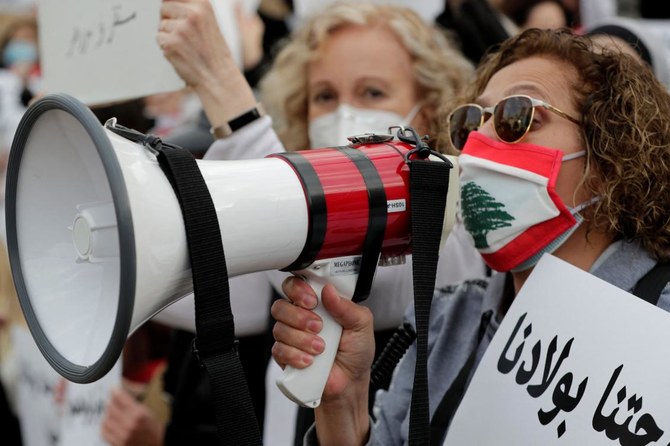
They wore face masks and waved Lebanese flags and banners.
The mothers cried and shouted slogans, demanding that the politicians leave.
The protests took place as dozens of flowerpots, wrapped in glossy colorful paper, were spread out in front of flower shops in Beirut and its suburbs on Saturday. Among their leaves were signs showing their price of 40,000 Lebanese pounds ($26).
The front of bakeries and patisserie shops were filled with cakes, whose prices ranged from 50,000-150,000 Lebanese pounds.
Mother’s Day on Sunday in Lebanon coincides with the beginning of spring. The Lebanese traditionally spend lavishly on gifts for their mothers or wives.
But celebrating the occasion this year is different. Compared to the situation in previous years, there are hardly any customers in the clothing and perfume stores in the main shopping centers.
The prices, as Mrs. Samar said, “are extremely high for those who get their salary in Lebanese pounds. They can barely buy food and baby milk, if they can find them at all, so how can I buy a jacket for my mother whose price is twice my salary? Or how can buy her a bottle of perfume whose price is more than 1.5 million Lebanese pounds?”
The dollar continued its decline on Saturday, trading at between 10,100-11,000 Lebanese pounds.
The country is waiting for the outcome of the meeting betwen President Michel Aoun and Prime Minister-designate Saad Hariri on Monday, but expectations are not high.
After meeting President Michel Aoun on Saturday, Lebanese Progressive Socialist Party Leader Walid Jumblatt, said: “We have reached absolute stalemate amid the economic collapse. Hunger is knocking on people’s doors, and reconciliation has become necessary. God bears witness that I have told people (the reality of the situation).”
Legal money changers are also cautious.
Bilal Ghandour, an owner of a jewelry store in Beirut, said: “On Saturday, money changers refrained from selling dollars. They only bought dollars, fearing that the exchange rate of the dollar would rise on Monday after the meeting at the Republican Palace.”
Ghandour described sales in his shop as “very light.”
He said: “The price of a gram of 18-carat gold is $42, which means 462,000 Lebanese pounds, as per the exchange rate on Saturday, and a small piece of gold must be more than five grams. The situation is very difficult.”
“Those who have dollars can buy, but they only buy pieces whose prices do not exceed $200-$300.”
In a statement, the Syndicate of Money Changers in Lebanon praised the decision of the Banque du Liban to launch its electronic platform and allow banks to trade in currencies similar to legitimate money changers.
The decline in the dollar’s exchange rate did not lead to a decrease in the price of the commodities on the market.
“Everyone wants to compensate for their future losses,” said Antoine, a shopkeeper in Furn El Chebbak.
Mohammed, who sells flowers and plants at Tayouneh Roundabout, said: “The price of the tulip plant this year is 30,000 Lebanese pounds, compared to its price last year of 7,000 Lebanese pounds.
“The price of the cyclamen plant last year did not exceed 10,000 Lebanese pounds, and now it is 50,000 Lebanese pounds,” he said.
“We are not the ones raising the prices. People are tired. Their priorities have changed, and flowers have become a luxury.”
However, demand for cakes had not been affected, according to Ali, the manager of one of the patisserie stores in the Chiyah area, Ain el-Remmaneh.
He said: “Although the prices of sweets intended for Mother’s Day have increased relatively, jumping from 50,000 to 95,000 Lebanese pounds, people are still buying. Perhaps because they are cheaper than clothes, perfumes, and gold, of course.”


![]()
![]()
![]()
![]()

Lebanese women mourn on Mother’s Day amid currency crisis and political stalemate

Short Url
https://arab.news/ge5pc
Lebanese women mourn on Mother’s Day amid currency crisis and political stalemate
- The mothers cried and shouted slogans, demanding that the politicians leave
- There were hardly any customers in the clothing and perfume stores in the main shopping centers


Latest updates


© 2026 SAUDI RESEARCH & PUBLISHING COMPANY, All Rights Reserved And subject to Terms of Use Agreement.