


CAIRO: Marwa Elselehdar has become the first woman to work as a sea captain in Egypt.
As a little girl, Elselehdar always loved the sea and enjoyed swimming.
She enrolled in the Arab Academy for Science, Technology and Maritime Transport in Egypt and joined the International Transport and Logistics Department, but she was more drawn to the curriculum that was being taught to her brother in the Department of Maritime Transport and Technology.
The department was limited to men, but she still submitted an application to join and was eventually accepted, becoming the first Egyptian woman to study in this department.
Elselehdar’s brother and mother supported her dream of becoming the first female captain in Egypt. Her father, while more apprehensive because of the difficulties in the field, did not object to her studies. She thus began the formalities to join the department, and her unique request was submitted to the president of the academy for consideration.
The president called for research in maritime law to verify the possibility of issuing a captain’s license to her, since it was the first case of its kind. After making sure that the law did not pose restrictions, examinations began.
Elselehdar passed the physical and medical tests, as well as personal interviews, proving her ability to be in control and manage diverse situations, and she joined the department like any other student.
I faced difficulties in adapting, especially during the first year, but the encouragement from those around me — and my own ability to believe in my dream — helped me overcome these challenges.
Marwa Elselehdar
“I started my journey in the department as the only woman among 1,200 students. I faced difficulties in adapting, especially during the first year, but the encouragement from those around me — and my own ability to believe in my dream — helped me overcome these challenges, and I graduated in 2013,” she said.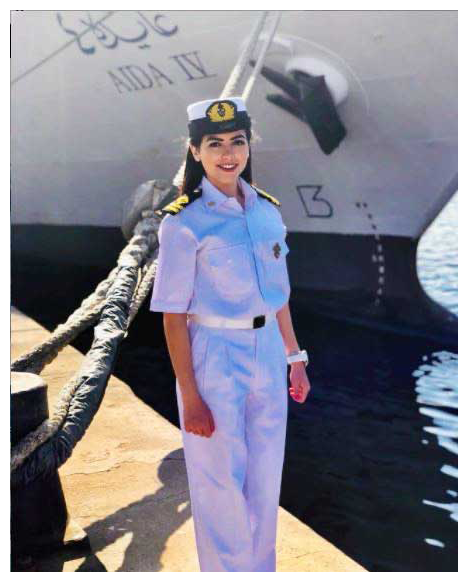
After her graduation, Elselehdar joined the crew of the AIDA IV ship, with the rank of the second officer.
At the time of the opening ceremony of the new Suez Canal, she applied to register as part of the crew that would lead the AIDA IV in the celebrations. Her request was accepted, and she prepared with her colleagues for the ceremony.
On the day of the ceremony, she led the AIDA IV — the first ship to cross the new shipping route — as the youngest and first Egyptian female captain to cross the Suez Canal.
Elselehdar has been working in the field for 10 years. She explained that the percentage of women in similar maritime positions does not exceed 2 percent worldwide, adding that being the first Egyptian woman in this regard was a great honor for her and noting that many girls followed her example and entered the field after her.
In 2017, Elselehdar was honored on Women’s Day by President Abdel Fattah El-Sisi.
She expressed her pride in this honor, seeing it not only as a form of appreciation from the state for what she has done but also as a demonstration of the state’s interest in empowering Egyptian women and placing them in leadership positions. Recently, Egyptian women have started participating in many occupations that were traditionally male-dominated.
The Encyclopedia of Arab-African Economic Integration chose Elselehdar among the top 20 Arab women in terms of achievement.
Elselehdar said that the boat she is now working on is owned by the Egyptian Authority for Maritime Safety, affiliated with the Egyptian government and managed by the Arab Academy for Science, Technology and Maritime Transport.
“Unlike fast flights, cruises can be long and arduous and can take up to a month or more. Of course, on these trips, I am the only woman among my fellow men.
“In the beginning, it was somewhat difficult, but we later became one team, and we split tasks equally. And because of the length of these trips, we all become like siblings,” she added.
Now almost 30 years old, Elselehdar dreams of obtaining a master’s degree and a Ph.D. She also hopes that marriage and having a family will not hinder her career.