PARIS: Camila Campodonico was at work in Paris on Thursday evening when the government announced the city was entering a new lockdown to combat COVID-19, and she knew her plans for a get-together with friends this weekend were over.
“I heard that and I said: ‘Oh no, not again. A lockdown.’ I wasn’t very happy,” said Campodonico, a student from Argentina who is working temporarily for a marketing company.
French Prime Minister Jean Castex announced that, because intensive care units were close to over-flowing, Paris residents could only leave home for essential trips or exercise, and non-essential travel to other parts of the county was banned.
Large numbers of Paris residents headed to railway stations on Friday morning so they could get out of the city before the restrictions, due to last for a month, come into force at midnight.
At the Gare de l’Est station in Paris, there were long lines of people at the ticket office. People, some with pets, rushed to board trains heading for Strasbourg and Luxembourg.
Valentino Armilli, 27, was going to visit his parents in Thionville, in the Lorraine region in eastern France, for the weekend. He took the decision to go there on Thursday night, because of the new lockdown.
“My parents had COVID a month ago and I have not seen them since. This weekend is the last time for a long while that I’ll be able to see them,” he said.
There was relief though that the restrictions were less severe than in previous lockdowns. This time, for example, hairdressers can stay open.
“I think that it’s important for people’s mental health to have a decent hair style,” hairdresser Marie Leroy said at her salon in Joinville-le-Pont, just outside Paris.
“People are a bit depressed, they’re fed up I think at the moment so going to the hairdresser’s is important.”

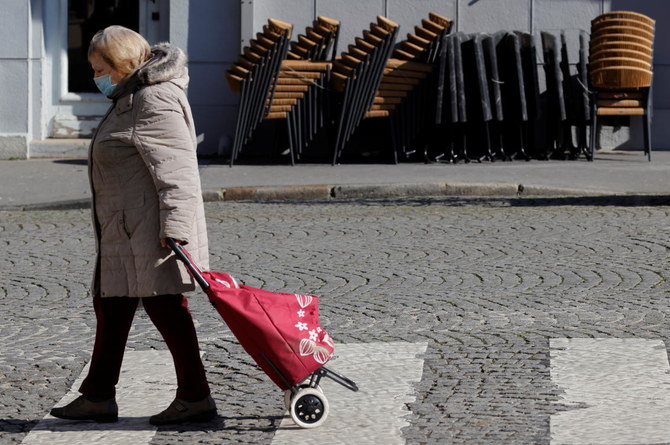
Parisians brace for new COVID-19 lockdown
Short Url
https://arab.news/yecze
Parisians brace for new COVID-19 lockdown
- Large numbers of Paris residents headed to railway stations on Friday morning so they could get out of the city before the restrictions
Global AI summit in India still without final statement
NEW DELHI: A summit statement on how the world should approach the promises and pitfalls of artificial intelligence was still not published Saturday afternoon, a day after it had been expected at global talks in New Delhi.
Dozens of national delegations, including leaders from France, Brazil and other countries, had gathered in the Indian capital this week to discuss the fast-developing technology.
On Friday, India’s IT minister Ashwini Vaishnaw said there was “huge consensus on the declaration,” the details of which he declined to provide.
He said the statement already had more than 70 signatories, but he hoped it would pass 80.
“We are just trying to maximize the number,” the minister said as the five-day AI Impact Summit drew to a close.
AFP contacted summit organizers and the IT ministry for comment on Saturday.
The summit, attended by tens of thousands of people including top tech CEOs, was the fourth annual international meeting to discuss the implications of generative AI, and the first hosted by a developing country.
Some visitors had complained of poor organization, including chaotic entry and exit points, at the vast summit and expo site.
Hot topics included the societal benefits of multilingual AI translation, the threat of job disruption and the heavy electricity consumption of data centers.
But analysts said that the summit’s broad focus, and vague promises made at its previous editions in France, South Korea and Britain, would make concrete commitments unlikely.
The United States, which did not sign last year’s AI summit statement, released its own bilateral declaration with India on Friday.
The two countries agreed to “pursue a global approach to AI that is unapologetically friendly to entrepreneurship and innovation.”
Also on Friday, White House technology adviser Michael Kratsios, head of the US delegation, warned against centralized control of generative AI.
“As the Trump Administration has now said many times: We totally reject global governance of AI,” he said.
Dozens of national delegations, including leaders from France, Brazil and other countries, had gathered in the Indian capital this week to discuss the fast-developing technology.
On Friday, India’s IT minister Ashwini Vaishnaw said there was “huge consensus on the declaration,” the details of which he declined to provide.
He said the statement already had more than 70 signatories, but he hoped it would pass 80.
“We are just trying to maximize the number,” the minister said as the five-day AI Impact Summit drew to a close.
AFP contacted summit organizers and the IT ministry for comment on Saturday.
The summit, attended by tens of thousands of people including top tech CEOs, was the fourth annual international meeting to discuss the implications of generative AI, and the first hosted by a developing country.
Some visitors had complained of poor organization, including chaotic entry and exit points, at the vast summit and expo site.
Hot topics included the societal benefits of multilingual AI translation, the threat of job disruption and the heavy electricity consumption of data centers.
But analysts said that the summit’s broad focus, and vague promises made at its previous editions in France, South Korea and Britain, would make concrete commitments unlikely.
The United States, which did not sign last year’s AI summit statement, released its own bilateral declaration with India on Friday.
The two countries agreed to “pursue a global approach to AI that is unapologetically friendly to entrepreneurship and innovation.”
Also on Friday, White House technology adviser Michael Kratsios, head of the US delegation, warned against centralized control of generative AI.
“As the Trump Administration has now said many times: We totally reject global governance of AI,” he said.
© 2026 SAUDI RESEARCH & PUBLISHING COMPANY, All Rights Reserved And subject to Terms of Use Agreement.