

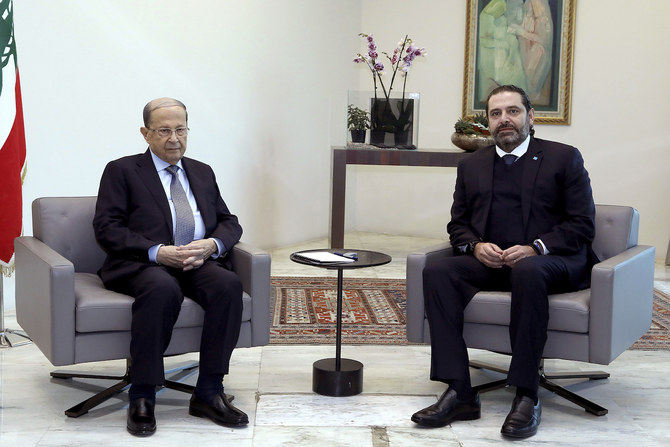

BEIRUT: Lebanese President Michel Aoun and Prime Minister-designate Saad Hariri will meet again on Monday after they failed to resolve their differences over the formation of a new government during their meeting on Thursday.
Monday’s meeting, Hariri predicted, will “provide some answers regarding the possibility of forming a government as soon as possible.”
During the hour-long meeting on Thursday, both parties focused on easing the tension between them. “Our aim is to stop the collapse, and the meeting (sought) to ease the tensions that happened on Wednesday. I listened to the president and his remarks and we agreed to meet again on Monday,” Hariri said. “I will always remain honest. Today, there is an opportunity that we need to seize in order to reach a solution by Monday. We need to regain the trust of the international community. The current economic situation does not justify this rise in the dollar’s exchange rate, but the absence of prospects does. The goal behind this government is to halt the Lebanese pound’s collapse.”
Prior to Thursday’s meeting, the director-general of Lebanese General Security, Maj. Gen. Abbas Ibrahim, had visited politicians including Speaker of the Parliament Nabih Berri — the leader of the Amal Movement — to attempt to help find a path towards the formation of a new government. However, leaked information suggested Ibrahim's efforts were largely unsuccessful.
Aoun had, on Thursday morning, set an appointment at 3 p.m. for Hariri, asking him to come “carrying a government-formation vision that takes into account the requirements of balance, distribution and competence, drawn from the five months that have passed since his designation.”
Mustafa Alloush, vice president of Hariri’s party the Future Movement, said on Thursday, “Hariri carried with him a file containing the same government formation he had previously suggested and he is open to all discussions except the one related to the ‘blocking third.’
“For Hariri, the aim of this meeting was to keep the channels of communication open and prevent the situation from reaching the point of no return. Aoun was very clear on Wednesday that he does not want Hariri to head the upcoming government and presented him with the ‘blocking-third’ demand to get him to step down,” Alloush continued. “What Hariri did today was to calm President Aoun down and properly deal with the situation, but Aoun needs to retract his statement.”
Monday’s meeting is now seen by observers as critical: It will potentially either lead to a solution to the government formation deadlock and therefore save the country from total collapse, or result in a dramatic end to the 146 days that have passed since the parliamentary majority entrusted Hariri with the formation of a new government. The second possibility would be seen as a failure on the part of the entire ruling class to save Lebanon from its current crisis.
Rami Al-Rayes, an advisor to the leader of the Progressive Socialist Party (PSP) Walid Jumblatt, said the PSP is “keen to maintain stability, particularly in some sensitive areas that are geographically and demographically overlapping. This requires a higher level of coordination between the actors on the ground in order to contain any tensions that might get out of hand.” He added that Jumblatt had asked regional officials to “be vigilant and closely follow up with the various official and partisan actors to maintain stability.”
On Wednesday night, protestors who had blocked a road in Beirut clashed with armed individuals believed to be supporters of the Amal Movement. Shots were fired and several people were wounded.
The Future Movement issued a statement saying that it had no connection to those events, and asked all parties to “exercise restraint, cooperate with the security and military forces, and not be dragged into anything that could aggravate the tensions and spread chaos.”
Lebanese Army Command issued a statement saying: “It was an isolated incident that led to gunfire, injuring four people who were taken to the hospital for treatment while the military intervened and contained the situation.” The statement also called on everyone to “refrain from doing anything that could threaten civil peace.”
That incident did not stop supporters of the president heading to the presidential palace carrying Lebanese flags and the flag of the Free Patriotic Movement (FPM) — the party founded by Aoun and led by his son-in-law Gebran Bassil — later that night, after Aoun’s televised speech in which he said Hariri should abide by Aoun's government-formation conditions or step down.
Hariri responded by calling on Aoun to “be honest with the Lebanese people and explain the real reason why he is trying to disrupt the will of the parliament that names the prime minister-designate.” He also asked Aoun to “alleviate the suffering of the people by making way for early presidential elections.”
On Thursday, the dollar exchange rate dropped suddenly by 2,000 Lebanese pounds on the black market to between LBP12,900 and 13,000 to the dollar. However, this drop did not translate to reduced prices in the market place, reflecting merchants’ lack of trust in the state.
Protests continue, but, given the current circumstances, are generally limited to the blocking of some roads and roundabouts, along with the burning of tires.


