

Female rangers guard world’s largest arid mangrove forest in Pakistan

1 / 3
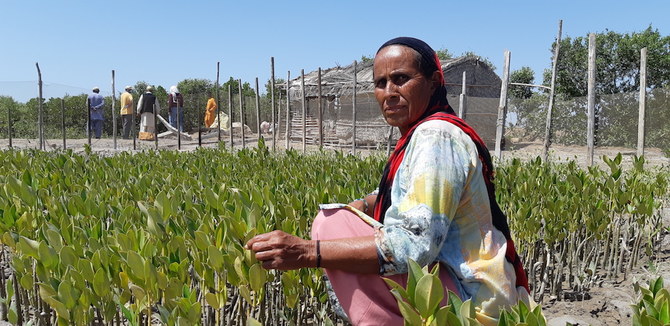
A female forest worker poses with the signboard of a mangrove nursery established by WWF-Pakistan in Mero Dablo village in Thatta, Pakistan, on March 09, 2021. (AN Photo by Zulfiqar Kunbhar)
2 / 3
Sixty-year-old forest worker Hawa Dablo poses at a mangrove nursery established by WWF-Pakistan in Mero Dablo village in Thatta, Pakistan, on March 09, 2021. (AN Photo by Zulfiqar Kunbhar)
3 / 3
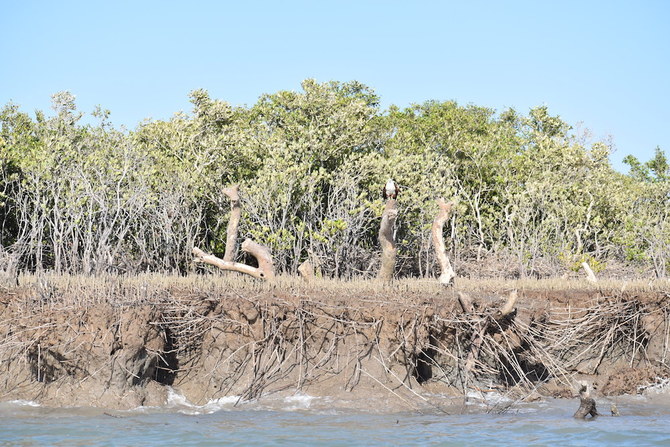
A view of a mangrove plantation on the Indus Delta’s Hajamro Creek in Thatta, Pakistan, on March 09, 2021. (Photo Courtesy: Mangroves Program, WWF-Pakistan)
Short Url
Updated 18 March 2021
Follow

Female rangers guard world’s largest arid mangrove forest in Pakistan

  • 250 female eco-guards trained by Sindh Forest Department and WWF
  • The women, along with their families, plant and guard new trees against animals, illegal logging

THATTA: For decades, grazing animals and loggers destroyed thousands of trees on Pakistan’s Indus River Delta, home to the largest arid mangrove forests in the world.

The Indus Delta has around 95 percent of the total mangrove forest cover in Pakistan, and was once home to eight species of mangroves, which the Sindh Forest Department (SFD) says forest destruction reduced by half.

By 2005, mangrove cover had declined to 84,000 hectares — the lowest recorded level — from 260,000 hectares in the 1980s.

In 2019, as part of an ongoing campaign to improve forest cover, the SFD collaborated with the World Wildlife Fund (WWF) to set up a mangrove nursery, hiring 250 women not just to plant new trees but also to guard them against threats from animals and humans.

Hired along with their families, the women, officially called eco-guards, play a “vital role in the protection of mangroves, which is a family unit job,” Riaz Ahmed Wagan, the SFD’s chief conservator of mangroves, told Arab News.

Assessments by the SFD showed that mangrove cover had increased once more to 210,000 hectares by 2020.

The women eco-guards, Wagan said, had a large role in improving the numbers.

One of them, 60-year-old Hawa Dablo from Mero Dablo, a fishing village on the edge of the Arabian Sea, said she spent her days planting seeds, looking after saplings and standing guard, with other members of her family, against the trees being destroyed by roaming animals.

“I have been working here for the last two years since this nursery was established in my village,” Dablo told Arab News.

She said the most vulnerable trees were young mangroves that had to be protected from grazing camels and buffaloes as well as from local loggers.

“In order to preserve mangroves, locals start initiatives from their own households and at the personal level,” Dablo said. “Every household or village will ensure that their animals are released for open grazing in only those areas where there are mature mangroves; locals will make sure that animals will not touch the areas where new plantations have been done.”

But she said illegal logging still remained a threat, although it was no longer rampant.

“If we notice any mangrove cutting activity we inform our male family members to take further action,” Dablo said. “When there is a deliberate cutting of mangroves, mostly by outsiders, we complain to local SFD officials through our male partners.”

Dr. Tahir Rasheed, the regional head for the Sindh and Balochistan wing of WWF Pakistan, said that under the mangrove protection program, the women rangers were paid a small stipend and given incentives “including sewing machines to do stitching and embroidery work, iceboxes, and ponds for fishing to improve their livelihoods.”

The incentives, he said, were important in an area where it is estimated that nearly 90 percent of the population lives below the poverty line.

Most households on the delta rely on fishing, and preserving mangroves was key to maintaining the marine ecosystem, another female eco-guard explained, given that a wide variety of fish lay their eggs in mangrove bushes on the delta.

“We guard mangroves and don’t allow people to cut green mangroves,” said Razia Dablo from the island fishing village of Khariyoon Takur. “If there are no more green mangroves, it will destroy the ecosystem for fish; that will negatively affect our livelihoods.”

Besides employing eco-guards, the SFD has given full-and part-time “green jobs” to over 50,000 people since 2000 — around 40 percent of them women.

“Despite social restrictions that put limitations on work on women outside their homes, female participation in afforestation on the Indus River Delta is almost half of the total forestation workforce, which is a great achievement,” Wagan said. “For upcoming plantation projects on the delta and elsewhere, we are planning to achieve maximum female participation.”


UK’s Starmer calls Trump’s remarks on allies in Afghanistan ‘frankly appalling’

Updated 5 sec ago
Follow

UK’s Starmer calls Trump’s remarks on allies in Afghanistan ‘frankly appalling’

  • Britain lost 457 service personnel killed in Afghanistan, its deadliest overseas war since the 1950s

LONDON: British Prime Minister Keir Starmer called ​US President Donald Trump’s comments about European troops staying off the front lines in Afghanistan insulting and appalling, joining a chorus of criticism from other European officials and veterans.
“I consider President Trump’s remarks to be insulting and frankly appalling, and I’m not surprised they’ve caused such hurt for the loved ones of those who were killed or injured,” Starmer told reporters.
When asked whether he would demand an apology from the US leader, Starmer said: “If I had misspoken in that way or said those words, I would certainly apologize.”
Britain lost 457 service personnel killed in Afghanistan, its deadliest overseas war since the 1950s. For several of the war’s most intense years it led the allied campaign in Helmand, Afghanistan’s biggest and most violent province, ‌while also fighting as ‌the main US battlefield ally in Iraq.
Starmer’s remarks were notably strong coming ‌from ⁠a ​leader who has ‌tended to avoid direct criticism of Trump in public.
Trump told Fox Business Network’s “Mornings with Maria” on Thursday the United States had “never needed” the transatlantic alliance and accused allies of staying “a little off the front lines” in Afghanistan.
His remarks added to already strained relations with European allies after he used the World Economic Forum in the Swiss ski resort of Davos to again signal his interest in acquiring Greenland.
Dutch Foreign Minister David van Weel condemned Trump’s remarks on Afghanistan, calling them untrue and disrespectful.
Britain’s Prince Harry, who served in Afghanistan, also weighed in. “Those sacrifices deserve to be spoken about truthfully and with respect,” he said in a statement.

’WE PAID IN ⁠BLOOD FOR THIS ALLIANCE’
“We expect an apology for this statement,” Roman Polko, a retired Polish general and former special forces commander who also served in Afghanistan and ‌Iraq, told Reuters in an interview.
Trump has “crossed a red line,” he added. “We ‍paid with blood for this alliance. We truly sacrificed our ‍own lives.”
Britain’s veterans minister, Alistair Carns, whose own military service included five tours including alongside American troops in Afghanistan, called ‍Trump’s claims “utterly ridiculous.”
“We shed blood, sweat and tears together. Not everybody came home,” he said in a video posted on X.
Richard Moore, the former head of Britain’s MI6 intelligence service, said he, like many MI6 officers, had operated in dangerous environments with “brave and highly esteemed” CIA counterparts and had been proud to do so with Britain’s closest ally.
Under NATO’s founding treaty, members are bound by a collective-defense clause, Article ​5, which treats an attack on one member as an attack on all.
It has been invoked only once — after the September 11, 2001 attacks on New York and Washington, when allies pledged to support ⁠the United States. For most of the war in Afghanistan, the US-led force there was under NATO command.

POLISH SACRIFICE ‘MUST NOT BE DIMINISHED’
Some politicians noted that Trump had avoided the draft for the Vietnam War, citing bone spurs in his feet.
“Trump avoided military service 5 times,” Ed Davey, leader of Britain’s centrist Liberal Democrats, wrote on X. “How dare he question their sacrifice.”
Poland’s sacrifice “will never be forgotten and must not be diminished,” Defense Minister Wladyslaw Kosiniak-Kamysz said.
Trump’s comments were “ignorant,” said Rasmus Jarlov, an opposition Conservative Party member of Denmark’s parliament. In addition to the British deaths, more than 150 Canadians were killed in Afghanistan, along with 90 French service personnel and scores from Germany, Italy and other countries. Denmark — now under heavy pressure from Trump to transfer its semi-autonomous region of Greenland to the US — lost 44 troops, one of NATO’s highest per-capita death rates.
The United States lost about 2,460 troops in Afghanistan, according to the US Department of Defense, a figure on par per capita with those of Britain and Denmark. (Reporting by Sam ‌Tabahriti and Elizabeth Evans in London, Stine Jacobsen in Copenhagen and Terje Solsvik in Oslo, Malgorzata Wojtunik in Gdansk, additional reporting by Andrew MacAskill, Muvija M and James Davey in London and Bart Meijer in Amsterdam; Writing by Sam Tabahriti; editing by Gareth Jones, Andrew Heavens, Ros ‌Russell and Diane Craft)